AFPA
Crafting a government awareness campaign for the Australian Federal Police Association
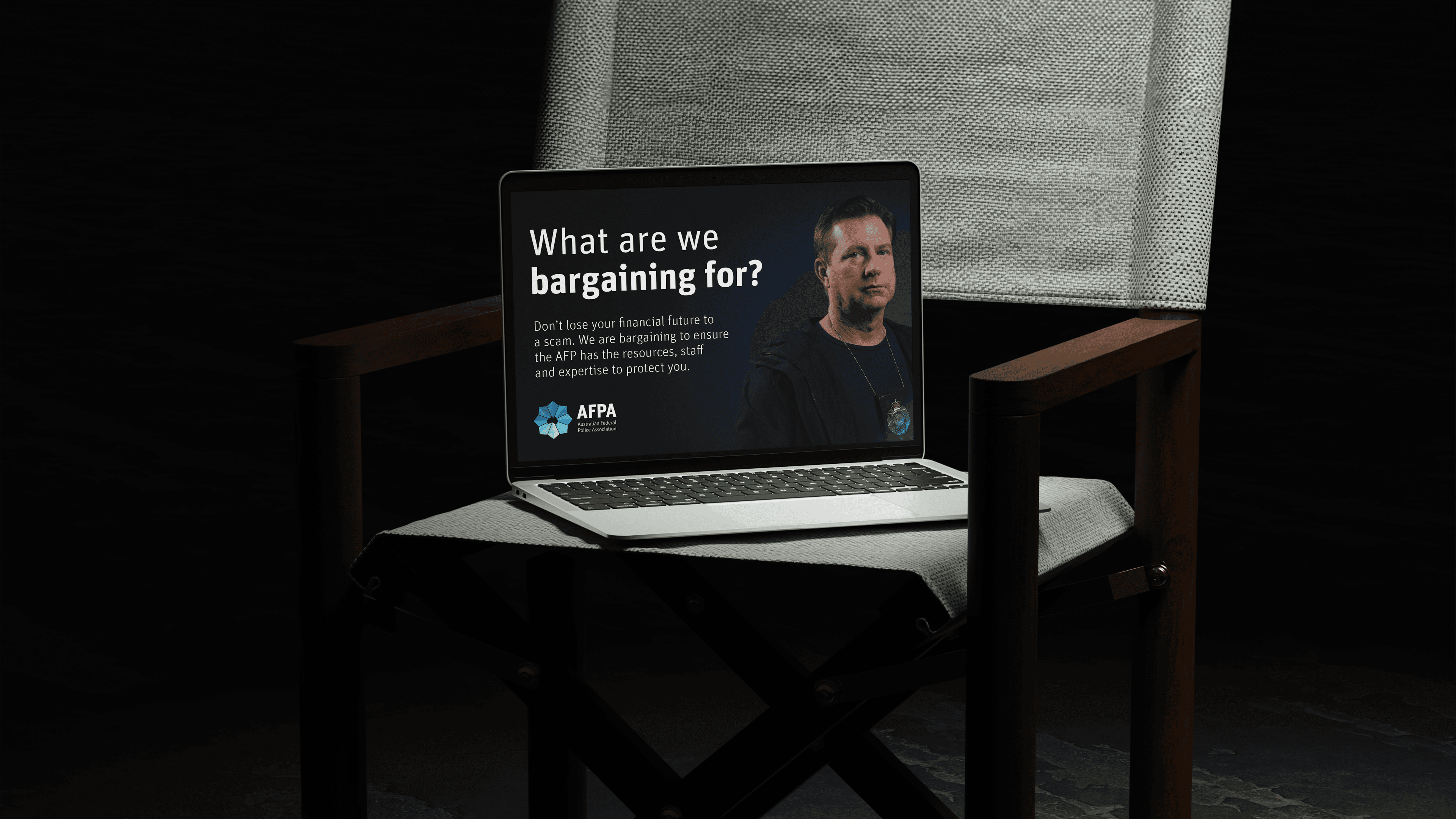
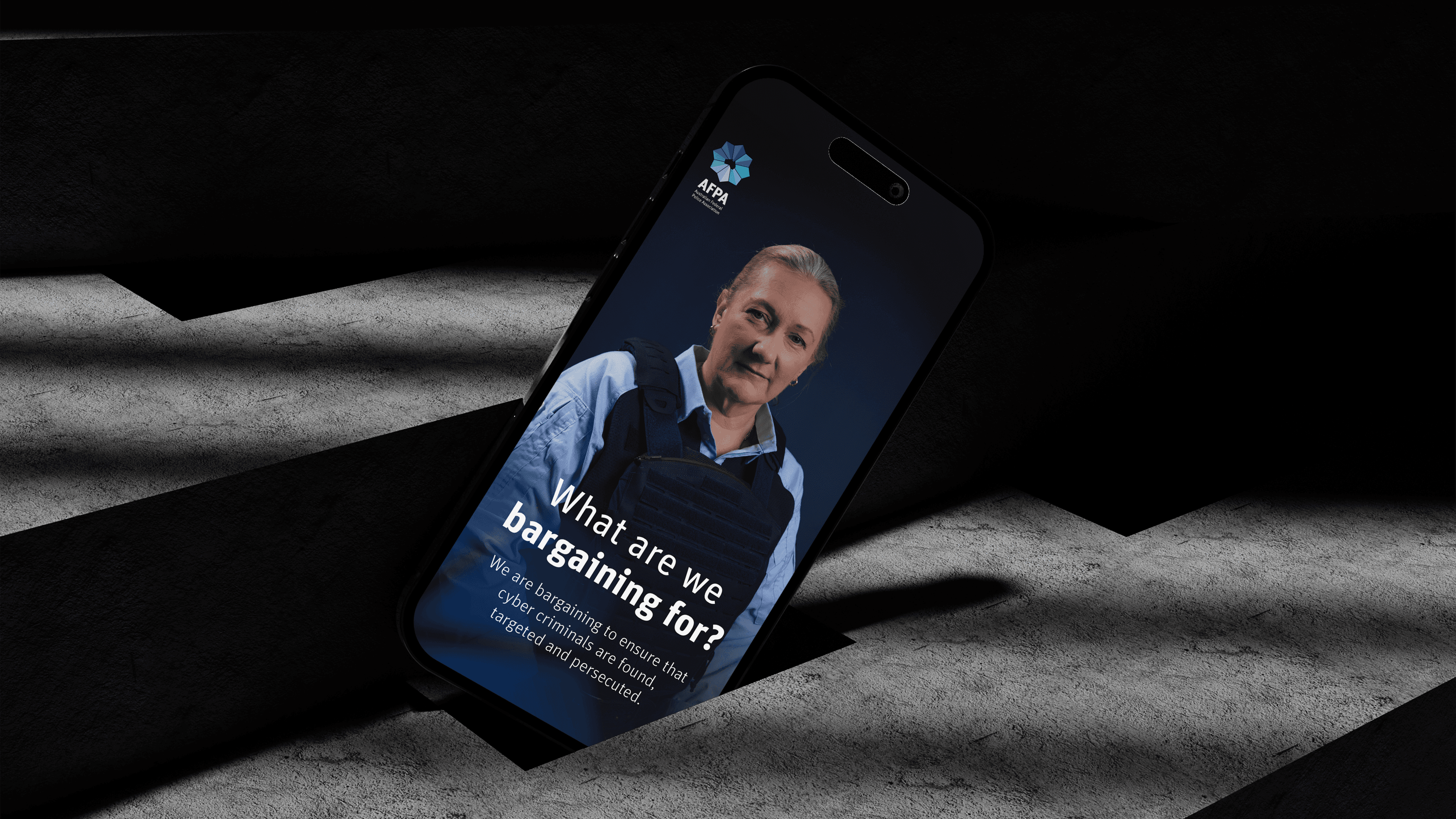
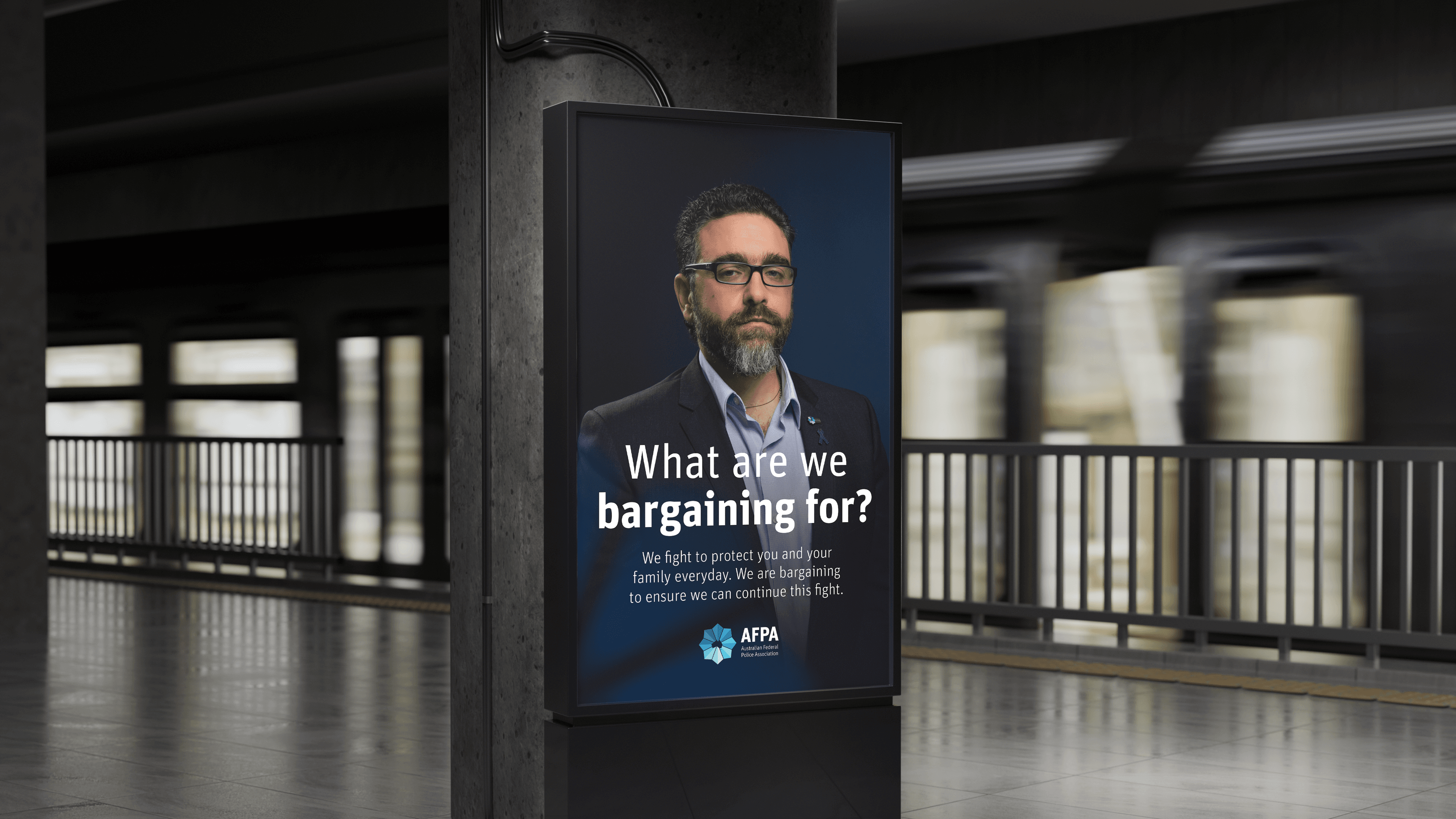
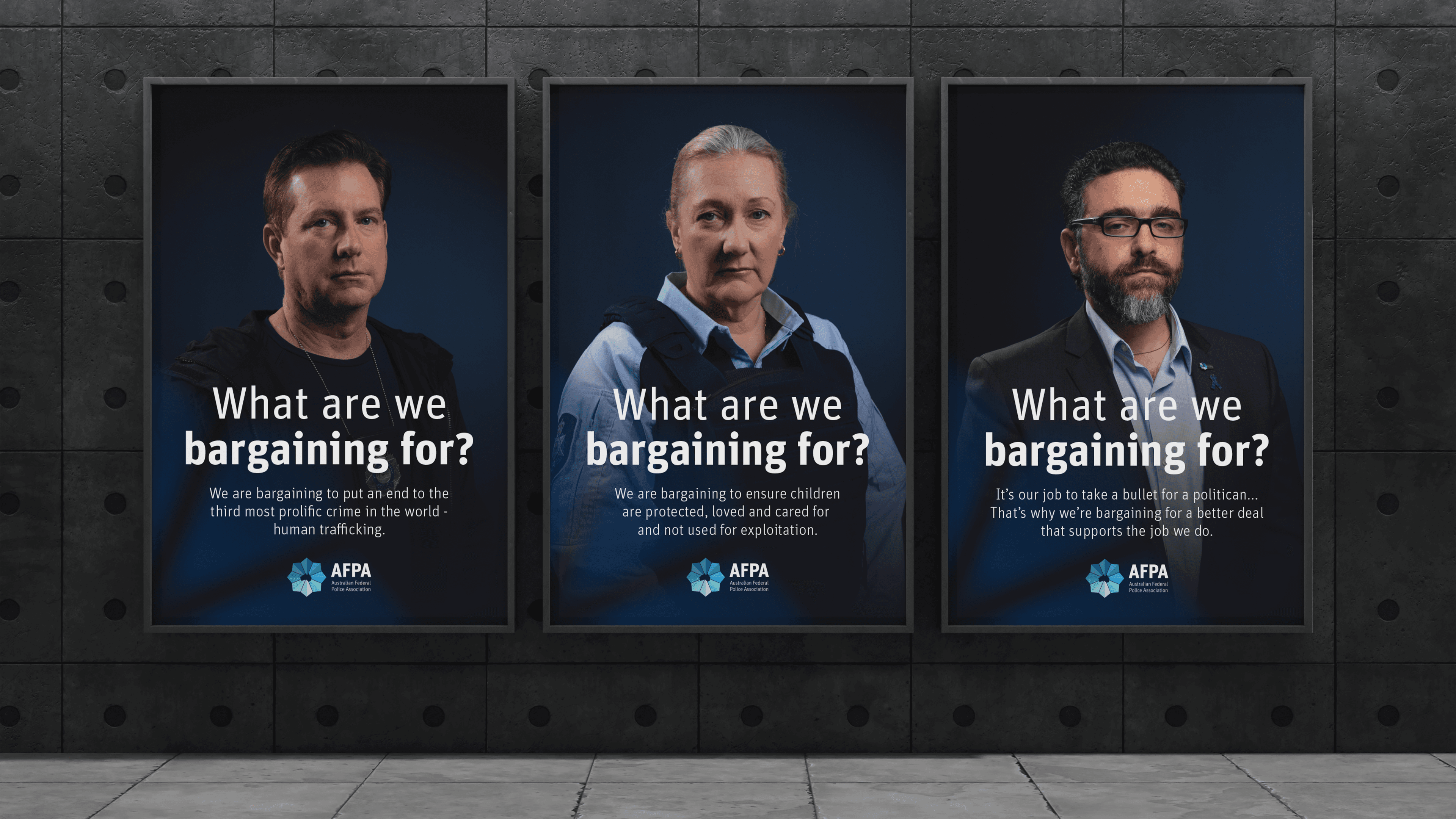
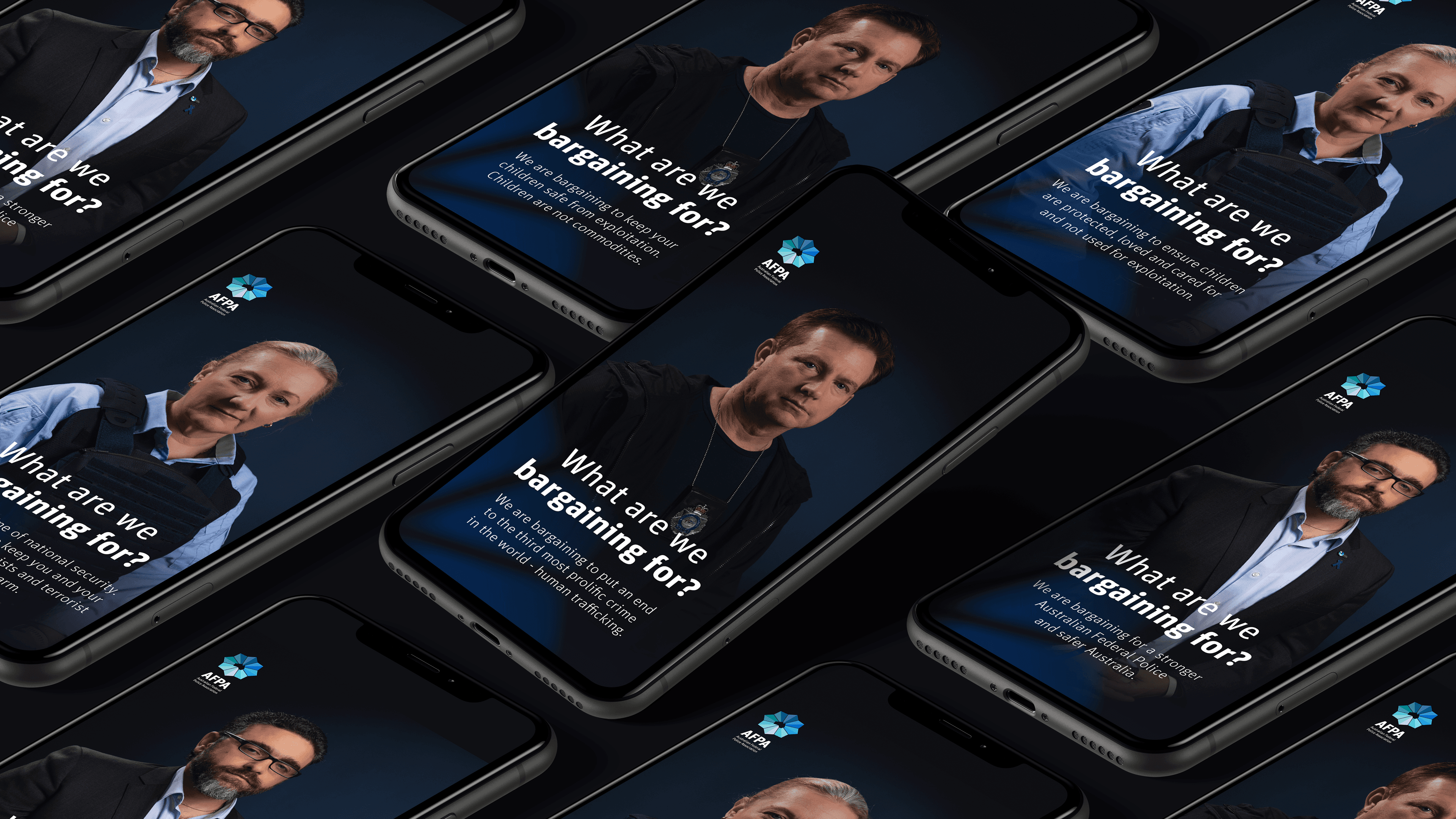
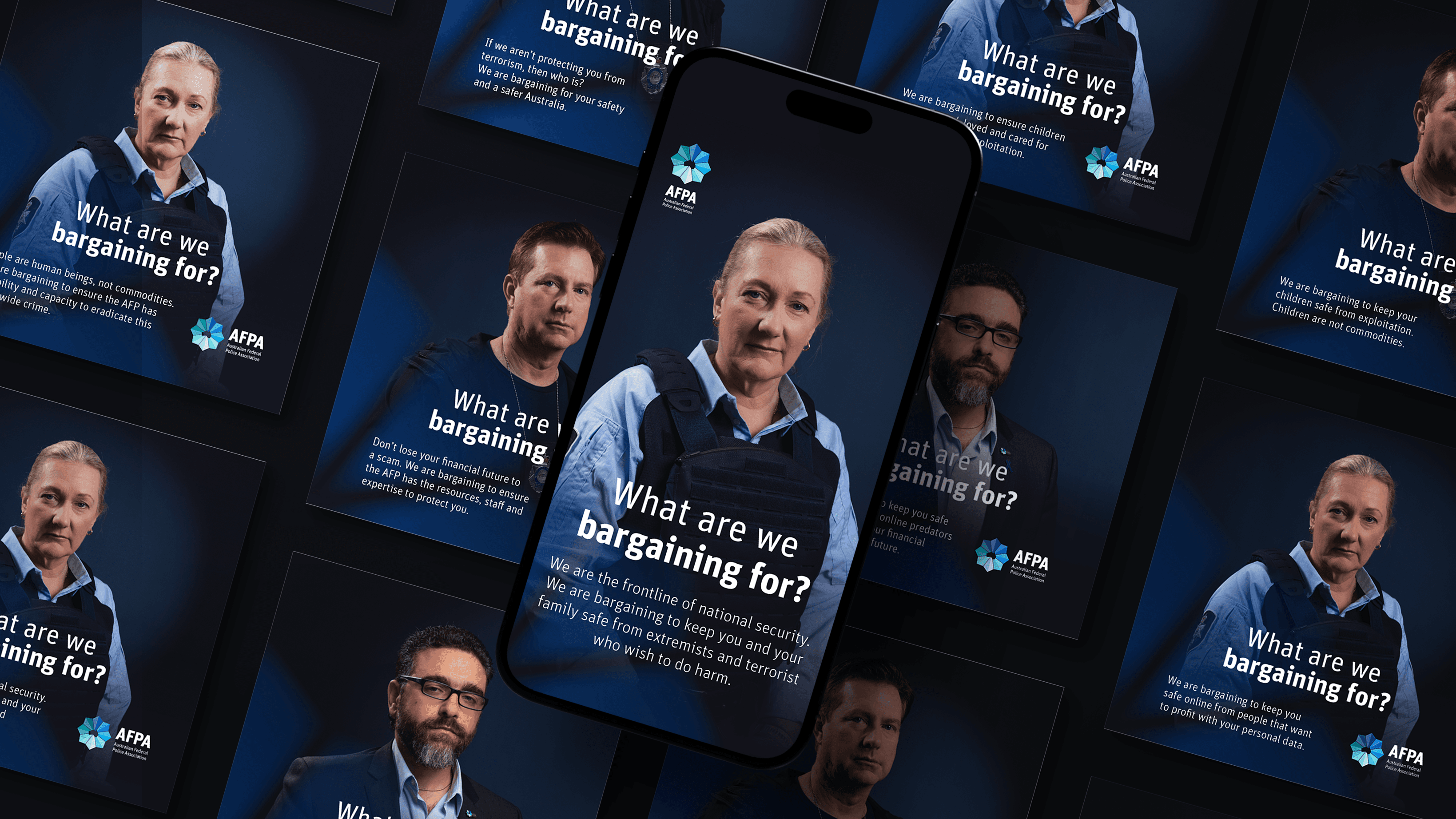
Mude partnered with the Australian Federal Police Association on a government awareness campaign in Australia for the digital phase of What Are We Bargaining For? — a national push to highlight the realities faced by frontline officers.
The police force deal with a vast amount of vital work, often underpaid, often abused on the job by the people they are trying to serve, often working long tiring hours which take a toll on their mental health and their family. We developed creative to communicate these factors with a strong impact, and ensure that their needs and voices are heard by key policy makers and the public who will support them.
The campaign set out to bring visibility to the pressures behind the badge: long hours, rising public hostility, and the personal toll that service takes on families and mental health. Our role was to deliver a public sector campaign creative approach that turned these lived realities into a clear, human message. Through digital storytelling, visual design and targeted content, we helped ensure their voices were seen and heard, not just as statistics, but as people. The campaign aimed to build empathy, drive awareness and influence policy outcomes across key audiences, from government stakeholders to everyday Australians.
Related Projects
View Project
Video
Secretariat of the Pacific Regional Environment Programme (SPREP)
Telly Awards
8View Project

Brand, Graphic Design
Capital Athletics
View Project
Brand, Graphic Design
Australian Medical Council
View Project
Brand, Video
Worldview
View Project
Website
Australian Strategic Policy Institute
View Project
Brand
The Y
View Project
Video
Amnesty International
View Project
Website
Australian Strategic Policy Institute
Frequently Asked Questions
The pressures behind the badge
A public awareness campaign works when it makes people feel something specific and gives them somewhere to put that feeling,. Most awareness work leads with information. Information rarely changes how someone feels, so the creative that lands usually opens with a human moment and lets the facts follow it.
For the AFPA’s ‘What Are We Bargaining For?’, Mude built the digital creative around what the job costs an officer: the long hours, the hostility faced on the job, and the toll service takes on mental health and family,. The aim was to let someone who will never wear the uniform feel the weight of it, so that public support and political attention had something real to attach to.
A feeling on its own is not enough, and a campaign that moves people without offering them anything to do with it wastes the attention it earned. Awareness is also a low bar than persuasion, and where people already hold a settled view, being seen does little to change it.
An advocacy campaign influences policy mostly by moving the public whose support a decision-maker needs,. Public attention is the pressure politicians tend to respond to, so the campaign’s job is to build it on an issue that would otherwise stay quiet.
The AFPA’s case sat inside a government bargaining process most people would never read about. Mude’s role on ‘What Are We Bargaining For?’ was the creative that turned that case into something the public could feel and pass on, so the people deciding on pay and conditions saw attention on the issue.
The creative is one part of this, not the whole of it. The lobbying, the negotiation and the timing belong to the organisation running the campaign, and public sympathy does not always convert into a result. The AFPA has been open that the eventual agreement fell short of what it set out to win.
Data resonates when a number is attached to a specific person and the cost it describes,. A figure on a chart is easy to read past, so the work is to give it a human form people recognise.
The AFPA campaign had hard numbers behind it. Beyond Blue’s national study found that one in three police and emergency services workers experience high or very high psychological distress, against one in eight adults generally, and that the risk rises the long someone serves. Mude’s creative for ‘What Are We Bargaining For?’ put the lived version of those figures in front of people, the hours and the strain behind the statistic, so the data had somewhere human to land.
The number still matters, since a story with nothing behind it is only an anecdote, and a strong work keeps both. Used carelessly, a single emotive case can also overstate a trend, so the human example has to be true to the wide picture.
Cause creative has to hold up among hundreds of posts and shares. The campaign is competing with everything else in the feed, so a consistent look does steady work where an isolated standout cannot.
A campaign that looks like one coherent thing across every post builds recognition, and familiarity is part of how a passing viewer comes to trust it, where a scatter of unrelated designs reads as noise. For ‘What Are We Bargaining For?’, Mude designed the digital phase as a single visual system, so the campaign held together across the run of content.
Consistency should not harden into sameness, since a look that never changes stops being noticed, so the work has to keep its signature while giving each piece a reason to exist. A carefully made one-off has its place too, just rarely in a campaign that has to appear day after day.
On a contested issue, the safe ground is the human truth almost everyone already accepts. Leading with the part people agree on gives the hard argument somewhere to stand. When a campaign opens with the demand instead, opponents find it easy to recast the whole thing as self-interest.
Police pay is one of these issues, easy to dismiss as a union chasing a rise. Mude built the AFPA creative to stay on what the job costs the people doing it, which is hard to argue with, and to leave the dollar figure to the bargaining, where it belonged.
Staying on common ground is not a reason to hide the ask, since a campaign that never reaches its point does not persuade anyone, so the human story still has to lead somewhere. Some issues are also divided at the root, where no framing will win everyone, and the realistic aim is to move the persuadable middle. If a campaign draws fire, handling that response is a separate discipline again.
A campaign about police works in an unusual gap between a public that regards police reasonably well in the abstract and the hostility and wear officers meet on the ground. The creative has to respect that goodwill while showing the part of the job the public does not usually see, and without leaning on the goodwill to do the work for it.
Public regard for police is real and moves with events. Roy Morgan’s long-running survey put police at a record 76 per cent for ethics and honesty in 2017, then 51 per cent in 2021 after a difficult few years, still ahead of many professions. Over the same period, assaults on officers have risen sharply in some states. Mude built the AFPA creative to sit inside that tension, speaking to people who broadly respect police while showing them the cost that respect tends to overlook.
Policing is also genuinely contested for some audiences, and a campaign that ignores that reads as tone-deaf, so the work cannot assume everyone starts from goodwill. Where to push and where to tread carefully is a judgement the client and the studio reach together.
A public awareness campaign starts by finding the one true thing the audience does not yet feel, and building the work from there. Most of the effort happens before any design: narrowing a broad issue down to a single human idea the creative can carry, so the campaign is not trying to communicate the whole platform in every piece.
For the AFPA, the broad issue was a contested enterprise-bargaining fight with a long list of demands. The simple idea underneath it was that the people the public calls when something goes wrong are being worn down by the job. Mude built the digital phase of ‘What Are We Bargaining For?’ from that, so each piece of creative and content carried one point.
This depends on a clear brief and a client willing to stand behind a sharp message, since a studio can sharpen a position. It cannot supply one the organisation will not own. The strategy, the lobbying and the media buying sit with the client or with specialists, so the creative has to fit a plan it does not run.
A public sector campaign has to turn a policy or an official position into a plain human message that can survive the heightened scrutiny most commercial work avoids. The difficulty is usually not the idea itself. That the message has to satisfy several audiences at once and still hold up when it is read by people looking for a reason to reject it.
For the AFPA, the same creative had to reach everyday Australians and the policymakers watching the bargaining, without overstating a claim that opponents would be glad to pull apart. Mude built the digital phase of ‘What Are We Bargaining For?’ to stay on the ground most people could accept, the realities of the job,.
This kind of work also plays out in public and political arenas where commercial brands rarely operate, and where a misjudged line gets challenged quickly. The strategy and the approvals sit with the organisation, so the studio’s job is to make the creative clear and human enough to come through that intact.
A human story works when it is specific and true to one person’s experience,. Particular detail makes a story believable, and believable stories tend to be the ones people pass on.
Digital lets that story arrive in pieces across a feed. For ‘What Are We Bargaining For?’, Mude built the digital phase so the everyday reality of the job carried across the formats people actually scroll,.
There is a real line between specific and exposing, and a story told without the subject’s say can damage the cause beyond the campaign’s worth, so the people in it have to be willing and looked after. The format should follow the story as well, and some stories work better as one long piece than as a run of short ones.
Empathy for frontline workers comes from showing the cost the job extracts off the clock, on health, sleep and family,. People tend to respect the role while rarely seeing what it does to the person doing it, and the second part is where a campaign can add something.
That is the gap the AFPA campaign worked in. The daily wear of the job stays out of view: the long and unsocial shifts, the hostility met on the job, and what both do to sleep, health and family over a career. Mude’s creative for ‘What Are We Bargaining For?’ put that hidden cost where people could see it.
Showing what a job costs does not settle what should be done about it, which is the AFPA’s argument to make. The approach also has a limit, since pushed too far it tips from empathy into pity, which tends to lose the respect it was trying to build.
A not-for-profit rarely has the budget to win a campaign on paid reach, so the money is better spent on getting the message right and building a look the organisation can reuse without paying for each new piece. The aim is a system the team can run itself,.
A member association like the AFPA has reach a small charity would envy, with its own members, channels and magazine. The creative’s job is to give those channels something strong and consistent to carry, so Mude built the digital phase of ‘What Are We Bargaining For?’ as a system the AFPA could keep using,.
There is a limit to doing more with less, since a small budget still buys less than a large one, so the honest move is to narrow a campaign to the few things that matter. Paid distribution and media buying, where a campaign needs them, sit outside what a creative studio provides.