
Cultural brand strategy, status, and the “premium” problem
The status game is the part of cultural brand strategy everyone pretends is crude, while everyone unintentionally designs half their lives around it.
The status game in brand strategy
The status game is the part of cultural brand strategy everyone pretends is crude, while everyone unintentionally designs half their lives around it. Status is the hidden currency in the game of brand strategy. Status is often misunderstood because people equate it with wealth signalling and partly because it sounds vain. Wealth can be a status cue, but it’s only one cue among many. Most genuinely effective brand differentiation strategy is, underneath, status work.
Status isn’t a single ladder but a set of ladders, one per tribe. In one group, the status cue is taste. In another, it’s competence. In another, it’s moral purity. In another, it’s being the person who “knows” before everyone else knows. Status is not in the object, but in the audience.
Status is really about rank inside our own group of peers, and it only exists in relation to the people whose judgement you care about. The actual mechanics of status in brand: how brands borrow cultural codes that already exist, how they package those codes, and how customers use those cues to be seen within their group as competent, good looking, important, credible, tasteful, current, smart, creative or whatever their tribe rewards.
That peer group might be a profession, a scene, a class, a subculture, a dinner table, a boardroom, or a group chat. Each one has its own rules about what counts as impressive, what counts as respectable, and what counts as embarrassing.
Cultural brand strategy: the brand orbits culture, it does not invent it
Another truth about the great brands is that they have a cultural posture, and the posture almost always comes from somewhere else first. What gets called cultural brand strategy is, in practice, the discipline of choosing which culture to orbit and earning the right to be recognised inside it.
It’s rare for brands to be inventors of culture, because in most cases the culture predates the brand. Good brands orbit existing subcultures. They borrow their rituals, their heroes, their aesthetics and their moral codes, then package those signals into a brand posture that’s coherent enough to be recognised by the people inside the subculture.
At that point the loop completes: the brand becomes an organising centre and the tribe starts to orient around it, because the cult brand is now one of the easiest ways for someone to say, without saying it, “I’m one of us,” and ideally, “I’m one of us in good standing, recognised as one of us who gets it.”
The “premium” problem in brand positioning
The more interesting truth is that many high-status brands don’t look like luxury at all, because luxury is only one status dialect, and in some tribes it’s actually the wrong dialect, because the wrong dialect of status reads as try-hard, gauche, or as a sign you don’t belong. This is why “premium” briefs are so common and so vague. As a brand agency, we could run a drinking game every time a brief mentions “premium” as a brand attribute, and the team would be maggoted before the kickoff workshop ends.
Premium isn’t really a posture. It’s mostly an outcome, usually tied to charging more, which is the main reason companies invest in brand strategy in the first place. The word “premium” in a brand brief is unhelpful because it collapses too many different status stories into one, then invites people to copy the most obvious surface cues of luxury. Status is local, so a niche brand can carry enormous status inside a subculture while being invisible to the general public, and not be luxury-coded at all.
The clearest way to see what status work actually looks like, rather than what people mean when they say “premium,” is to look at some brands that operate in different sub-cultures.
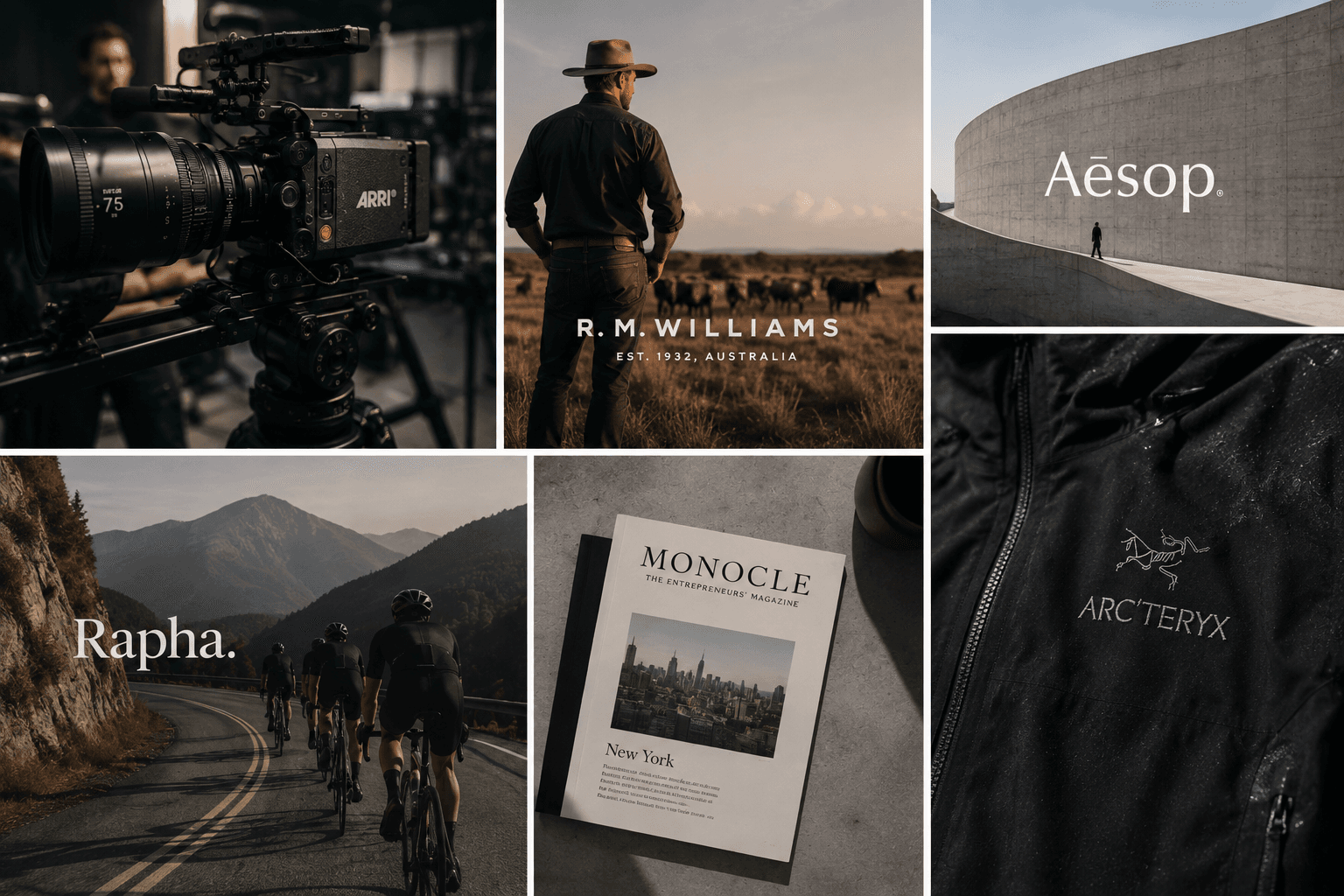
ARRI: status as competence signal
ARRI is a good example because it isn’t luxury, yet it carries serious status inside the film world, because the people who matter can tell what it signals, which is that you are operating at a serious level. The camera is expensive, yes, but the important part is that the expense is understood to signal seriousness, not as a claim of “I like expensive things”, but as “I belong here.” The status work the brand does is invisible to anyone outside the film industry and instantly readable to anyone inside it, which is exactly the asymmetry status brands are built to produce.

Ari Wegner
Courtesy of ARRI
RM Williams: status disguised as practicality
RM Williams is a particularly Australian case study because it shows how a local culture that dislikes peacocking still manages to have status symbols, as long as they come disguised as sensible purchases. Australia has a mildly suspicious relationship with overt luxury. If you peacock, you’re a try-hard. So the status game here relies heavily on things that look practical and come with a justification. i.e “They just last” is the most common way people rationalise buying RM.
RM is also a loophole. It lets you borrow rural legitimacy without actually living a rural life, and turns status into something morally acceptable by disguising it as practicality. RM Williams is a kind of cultural passport. You can wear it in a boardroom and look serious. You can wear it at a field day and avoid looking like you’ve dressed up as a regional person for the weekend. That ability to move between contexts without changing costume is status.
From a costly-signalling perspective, the boot is expensive enough to signal seriousness, but not so expensive it reads as indulgence, which matters because indulgence is socially risky unless you can frame it as responsibility. RM makes that easy. Morally acceptable spending is the best spending, because it gives you status without guilt and without looking like a poser.
It’s also become a cult-brand badge for a very specific Australian stereotype: privately educated, professionally credentialed, mildly conservative in taste, perhaps in politics too, while also enjoying the quiet implication that the boot suggests a certain level of success, though naturally they’d never talk about that because talking about that would be, you guessed it, a bit try-hard.

Image by
Special Group
McKinsey: status as a seriousness signal
McKinsey works the same way in a different tribe. Hiring McKinsey is a declaration of posture aimed at a very particular audience: boards, investors, senior execs, ambitious operators, and the managerial elite. It functions as a declaration of rank. It says, “this is a very, very serious organisation doing very, very serious things.” It’s a visible choice that tells a specific audience, “we operate at this level”, and it does that regardless of what the eventual recommendations are. McKinsey is a brand you hire when you want to look like you’re thinking at the same altitude as other people who hire McKinsey.
Skyline: borrowing the cycling subculture’s visual discipline
Closer to home, our FMCG branding work with Skyline is the same status dynamic operating inside a drinkware category. The founder had spent years as an OEM manufacturer producing premium drinkware for brands like 3CE, Starbucks and Disney — building the product other brands sold, with the quality already there, but no brand presence of his own to charge what the product was worth.
The category had been carved up by tribe-markers, each brand a badge for a specific group with a specific kind of status to claim. Frank Green: the inner-city aesthetically-attuned young professional woman, where the bottle reads as outfit and sustainability credential. Hydro Flask: the high-schooler, where the colour you carry signals which clique you sit with. Nalgene: the outdoor-club student and the deliberate functionalist, where the badge says I don’t care about fashion and that’s the point. YETI: the American outdoorsman who actually owns a truck, where the brand reads as I use this gear, I don’t pose with it. Stanley: the trend-driven suburban-American audience that effectively chose the brand off the back of a viral moment, where carrying one means being in the cultural current.
The strategic move was borrowing from another category, against Rapha and Arc’teryx rather than against Frank Green or YETI. Cycling carried the codes Skyline’s tribe wanted to be read as carrying — discipline, precision, endurance, ambition — with room to grow into other endurance sports without losing posture.
The discipline of the move was in what we didn’t do. Put a cyclist on the bottle and you’ve made cycling merchandise. Let cycling’s visual discipline shape how the brand behaves — form language, typography, photography direction — and you’ve made performance gear that a cyclist would recognise as belonging to their world.
The result is that Skyline can charge a price that wouldn’t be defensible on bottle specs alone, because the people buying it aren’t really paying for the plastic — they’re paying for the small piece of in-group recognition the brand allows them to carry visibly.
The Brand Identity also did a writeup on this branding for Skyline: Mude designs a water bottle brand that feels like performance gear | The Brand Identity
What to do with this if you’re building brand identity
If you mean identity as posture, personality, codes and cultural stance, rather than just visuals, there are two decisions worth making explicit before any branding work starts.
The first is choosing the culture you want to orbit, because the culture precedes the brand. Most successful status brands are satellites that borrow from existing tribes. You’re selecting a world, not inventing one, and getting honest about which world you’re actually selecting is harder than it sounds, because the obvious answers usually turn out to be either the world the founder personally lives in (which may or may not be commercially useful) or the world the category has already saturated (which usually isn’t).
The second is deciding what status claim you’re enabling for the customer, and keeping it explicit internally even if you never say it publicly. Status-based brand strategy starts with admitting the status game exists, and being deliberate about which version of it you’re playing. Brands that constantly switch postures end up signalling the only truly universal message: we don’t really know who we are. The test for whether the work is doing its job is unsentimental. Every purchase is a status transaction in one way or another, and every great brand is doing some version of identity-based branding.
Cultural branding is mostly a discipline of choosing which existing subculture to orbit, then earning the right to be recognised inside it. When someone chooses your brand, does it signal something about themselves to the people whose judgement they care about?
If yes, you’ve built status.
If no, add all the gold foil you like.
4-item recap
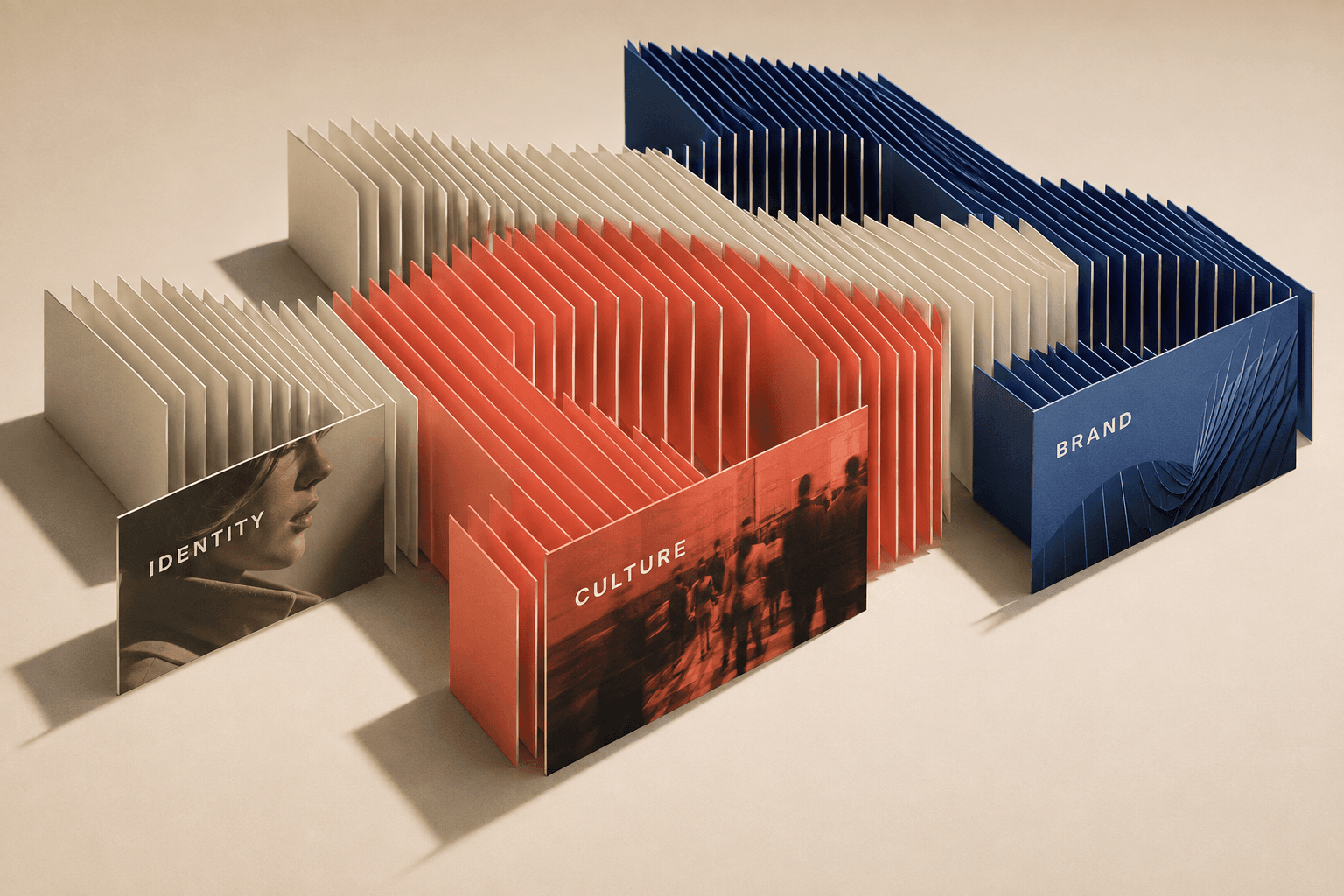
- Status is the hidden currency in most brand decisions. Customers buy products partly to signal something to their peer group.
- Status isn’t a single ladder — it’s a set of ladders, one per tribe. Taste, competence, moral purity, insider knowledge. Different tribes reward different signals.
- Culture predates the brand. The strongest status brands orbit existing subcultures rather than inventing new ones.
- Luxury is one dialect of status, not the whole language. “Premium” in a brief usually means the strategic work hasn’t been done yet.
About Mude
Mude’s cultural brand strategy work starts with finding the cultural posture a brand can credibly inhabit, then designing the system — purpose, vision, mission and activation — that holds the posture in place over time. See how it plays out in the pillar piece on building a brand-led business, the onlyness that sits underneath defensible positioning, or the Skyline case study referenced above.
Mude is a brand and creative agency in Sydney and Canberra, working with clients across Australia and internationally. We build charismatic, culturally relevant brands and take them from branded to brand-led. Recent work includes the Sunstrata solar rebrand, the Skyline FMCG identity, the Full Proof hospitality brand, campaigns for the Department of the Prime Minister and Cabinet and BreastScreen Australia, and creative partnerships with Amazon Music.
The studio works as a brand and creative agency across brand strategy, brand identity design, video production, photography, and graphic design, with federal panel experience including the Digital Marketplace Panel 2 (DMP2) as a foundation supplier and the buy.nsw Supplier Hub. See the full brand strategy and creative capability for more.
See the full brand strategy and creative capability for more.
Related Posts



Frequently Asked Questions
What people ask us about cultural brand strategy.
Cultural brand strategy is the practice of building a brand around the cultural codes and tribes its audience already operates within. The brand orbits an existing culture; it does not invent one. The output is a brand that earns preference through cultural affinity rather than category benefit claims.
It is broader than positioning. Positioning chooses where to play in a market. Cultural brand strategy chooses which culture the brand sits inside and which status ladders it competes on. Positioning is one of its outputs.
Status is the social claim a customer is making by choosing the brand. It is what they signal to themselves and the people whose opinion they care about when they pick this brand over the alternatives.
Status in brand strategy is rarely about wealth. Wealth is one status cue, but most brands compete on others: taste, competence, moral seriousness, in-group belonging, refusal of mainstream norms. Different audiences play different status games at the same time, and the brand’s job is to identify which game its target audience is actually playing.
This is why two brands at the same price point can perform very differently. The one that signals the status the audience actually wants, gets preference and pricing power.
A B2B brand strategy benefits from cultural brand strategy as much as a consumer brand does, and the dynamics are often more important in B2B and regulated sectors than in consumer ones.
B2B, regulated and government audiences play status games the same way consumer audiences do, but the cues are different. In consumer luxury, the dominant ladders are taste and in-group belonging. In B2B, the dominant ladders are competence and seriousness: McKinsey signals seriousness for example. In regulated industries the dominant ladder is often technical mastery and proven judgment, because the buyer’s career risk is high if they pick wrong.
Cultural brand strategy in these contexts is less about looking premium and more about being read by the buyer’s peer group as a defensible, competent choice.The mechanism is the same. The cultural codes are different.
Brand strategy, sometimes called branding strategy, is the set of decisions a brand makes about how it wins: who it is for, what it offers, how it is different, and how that difference creates value. Most brand strategies treat culture as something the brand applies after the strategic decisions are set, usually through visual identity or campaign tone.
Cultural brand strategy moves culture into the strategic decisions themselves. Which culture the brand sits inside is not an output of the strategy; it is one of the inputs. The choice of tribe, status ladder and cultural codes shapes how the audience is defined and how the brand competes inside that audience’s world. Visual identity follows from those choices rather than the other way around.
The simplest test: in standard brand strategy you can describe the brand without naming its cultural context. In cultural brand strategy you cannot, because the cultural context is part of what the brand is.
Premium describes where a brand sits on price. People often use it to describe a particular look. But premium basically just means ‘someone would pay a premium for this’ over something else. Status describes what the customer claims by choosing it.
Most brands described as premium are doing status work. The premium label is a category descriptor; the work underneath is signalling membership in a particular status game: taste, competence, attractiveness, moral purity … whatever that particular tribe rewards.
Pricing power comes from preference that is hard to substitute. Cultural brand strategy creates that preference by making the brand a credible member of a culture the customer wants to belong to, which competitors with generic positioning cannot match by cutting price.
When a customer chooses a culturally specific brand, they are paying for two things at once: the product, and the status claim they make by choosing this brand over its rivals. If the status claim is valuable to them — competence, taste, in-group belonging — they will pay a premium and accept fewer features rather than switch to a cheaper alternative that does not carry the same cultural meaning.
This is why brands with strong cultural specificity hold margin in downturns and resist commoditisation longer than brands with generic positioning. The product is replaceable. The cultural membership is not. Pricing power follows from how irreplaceable the cultural position feels to the customer, not from how premium the price tier looks on a website.