Sun Baby
A brand identity for little ones who live in the sun
Sun Baby started with a problem every new parent knows too well: keeping your baby cool, safe, and comfortable in the harsh Australian sun.
For founder Amy, that challenge sparked something bigger. A social enterprise built around protective clothing that doesn’t compromise on style or substance. We shaped a visual identity that reflects the world Amy is creating, where kids can play freely, and parents feel good about what they put on their child.
Whimsical illustrations nod to childhood without tipping into cute-for-cute’s-sake. A muted, nature-led colour palette gives the brand a little more maturity. And the logo is bold but soft, like the clothing itself. Sun Baby is for families who spend weekends outside. Who care where things come from. Who want their kid to look great in the group photo, and still be crawling through the grass five minutes later.
Where the idea came from
Sun Baby started with Amy Nixon, a new mum in Canberra, on summer pram walks around the lake where she found she couldn’t keep her nine-month-old daughter out of the sun.
Baby sunscreen at $80 a bottle wasn’t going to be a sustainable answer to that problem on its own, and the cover-up alternatives weren’t much better: pram shades didn’t follow the direction the sun moved in throughout the day, and putting the baby in regular clothes meant she overheated within minutes of leaving the house.
Of the UPF-rated babywear that did exist in the market, roughly half of it was built like technical camping gear designed for parents who already identified as outdoorsy, and the other half was being sold by other new mums on Instagram in home-video format, with the marketing essentially reduced to: I’m a mum, here’s the product I made. Neither end of that market spoke to the audience Amy could see in her own social circle, parents who wanted sun-safe babywear that didn’t make them choose between earnest functionality and looking like they were trying.
Amy worked out what most founders do at this point — that if she wanted this product, other parents probably wanted it too — and started designing it herself.
By the time she came to us, she had mocked-up designs sitting in PDFs, a sourcing agent secured for manufacturing, samples on the way, and the commercial structure largely resolved: UPF 40/50+ bamboo babywear for ages 0–4, lightweight enough to keep babies cool, priced around $60 a piece so it wouldn’t sit in boutique-only territory, with ten percent of profits earmarked for food banks because she’d been working closely with her local church and felt strongly that sun safety shouldn’t be a privilege confined to families with disposable income. The product was real and the supply chain was forming, but the brand around all of it hadn’t been built yet.
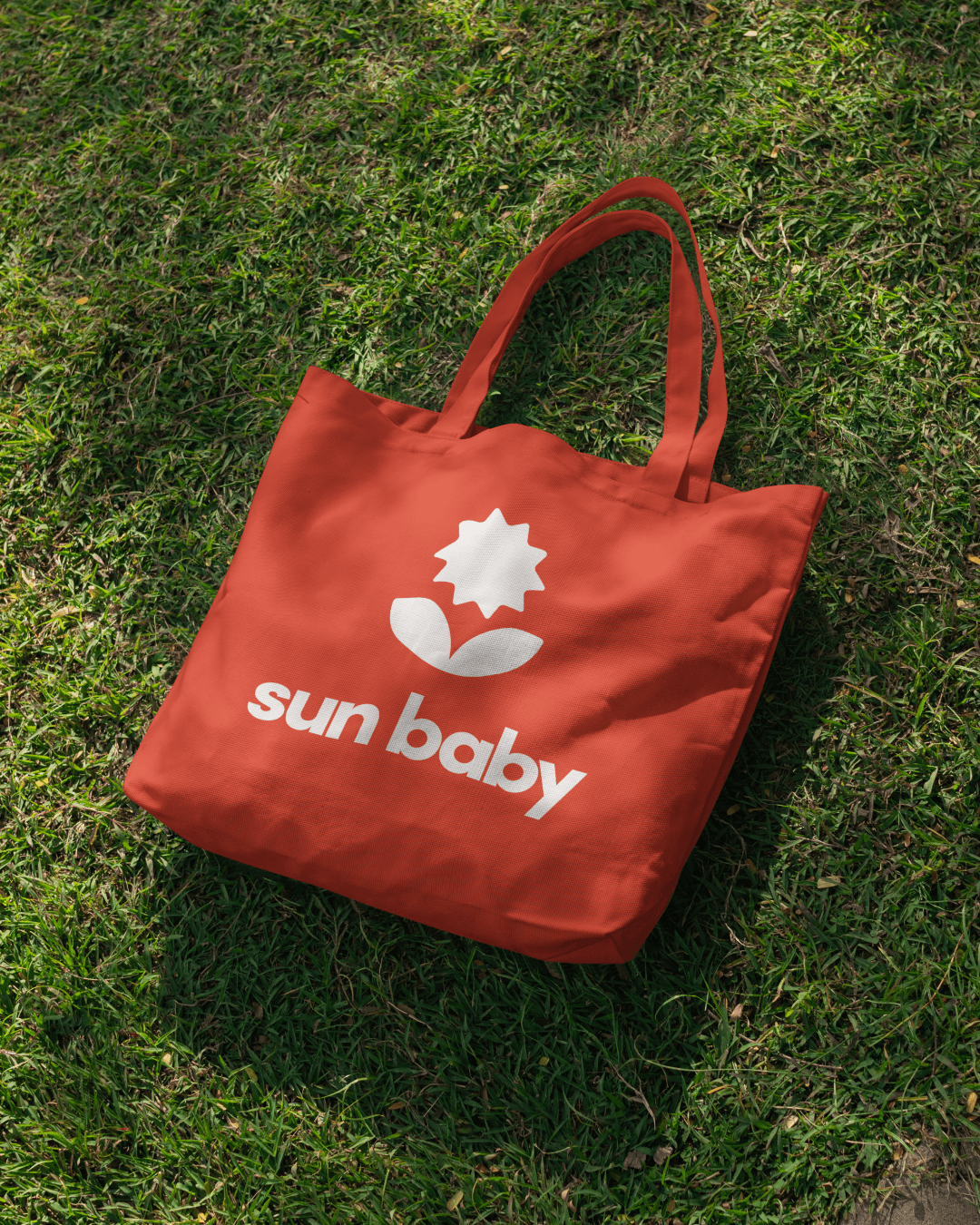
Tote Bag
Tote bag from Mude’s brand identity project for Sunbaby. Demonstrates how the logo and brand palette translate onto lifestyle merchandise.
The brief
The brief Amy gave us was straightforward in shape and unusual in one specific detail: build the brand around the product, but don’t make it about the founder.
Amy was clear about this from the first workshop — she didn’t want Sun Baby to read as a mum-and-her-baby story, because the whole point of starting Sun Baby was to escape the DIY-mum aesthetic the category had defaulted to, and any brand that leaned too hard into Amy-the-founder would end up looking like exactly the kind of small-scale Instagram mum-brand she was trying to position above.
The founder origin was the commercial engine driving the business, but the brand had to behave like something that already existed at scale, treating Amy’s story as supporting context rather than the central piece of brand expression.
We ran two discovery workshops with Amy to do the strategic work properly before any visual exploration started. The first session worked through the current state of the business and where Amy wanted it to be in one, three and five years, and went deep on who Sun Baby was actually for and what kind of cultural posture the brand would need to take to compete.
The second session translated those strategic findings into a tactical awareness plan and gave us the brief for the visual identity work that followed. By the end of those two sessions we’d identified the two audience tribes the brand needed to win and mapped the competitive wedge nobody else was occupying. We’d also locked the tonal direction tightly enough that the creative team had a clear brief to work to.
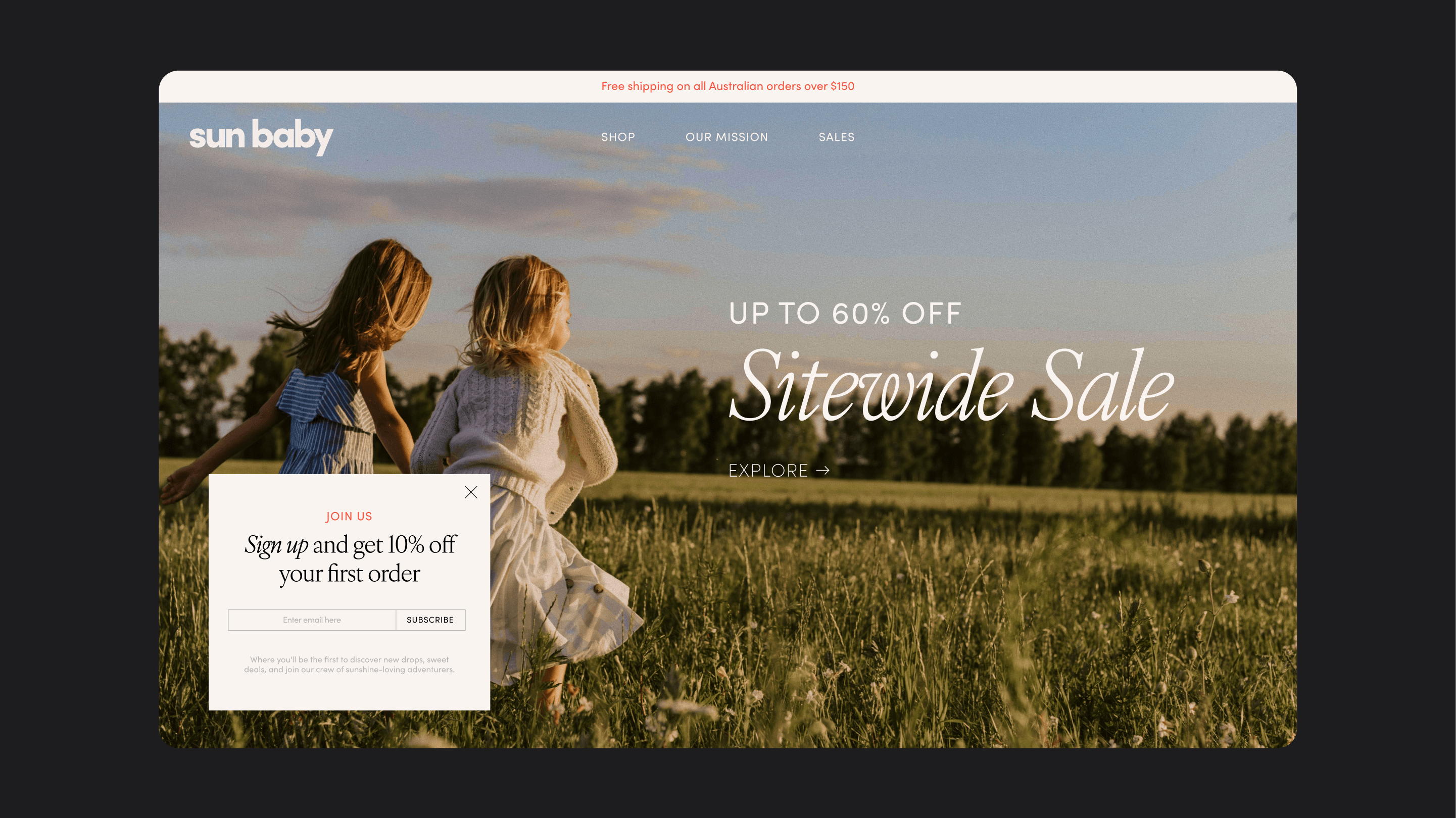
Website Mockup
Website design mockup from Mude’s Sunbaby brand identity project.
The two audiences we needed to design the brand around were genuinely different in their motivations, even where they overlapped on price tolerance and ethical disposition. The first was the affluent mum — Northern Rivers, Byron, Palm Beach, Northern Beaches — running an online business from home, juggling Pilates and pram walks, buying from Seed Heritage, Country Road, Pure Baby and Assembly Label, and using product choice as a way of signalling to her own community that she’d thought about it.
She’d buy multiple pieces from a single collection if the brand looked like it belonged in her photo grid, and she’d bounce within seconds from a site that looked cheap. The second was the outdoorsy parent — Blue Mountains, Margaret River, the West Australian coast — who carried their baby on hikes, prioritised function and ethics, paid more for durability and natural materials, and shopped from Patagonia and similar performance-ethical brands.
The two groups respond to different aesthetics and live different daily lives, but their price tolerance and brand expectations were close enough that a single brand could win both audiences if it was built with that overlap deliberately in mind.
When you audit that category properly, the gap becomes obvious. Bebe Trek owns the earnest end of UV protection with a genuinely good magnetic-closure onesie and a well-told sustainability story, but the brand world is dusty brown, navy, and Patagonia-adjacent in a way that closes off the more aspirational mum audience entirely.
Bedhead Hats has trust and an Australian-made story going for it, and parents reach for them by name when their child needs a hat, but the brand has aged into something cautious and practical, the visual identity hasn’t moved in years, and they only really play in hats.
Purebaby owns organic indoor essentials with strong national distribution and a real position in the GOTS-certified cotton space, but has barely any presence in the sun-safe outdoor category and treats it as adjacent rather than core.
The general rashguards from Rip Curl, Billabong and Quiksilver treat babywear as a seasonal afterthought rather than a serious category they want to compete in, and the eco messaging that does exist there isn’t baby-focused.
Little Fisho is fun but niche and built around a specific outdoor-fishing aesthetic, and Cabo Collection is stylish but fashion-led rather than function-led, and built for swim rather than the everyday wear most parents are actually looking for.
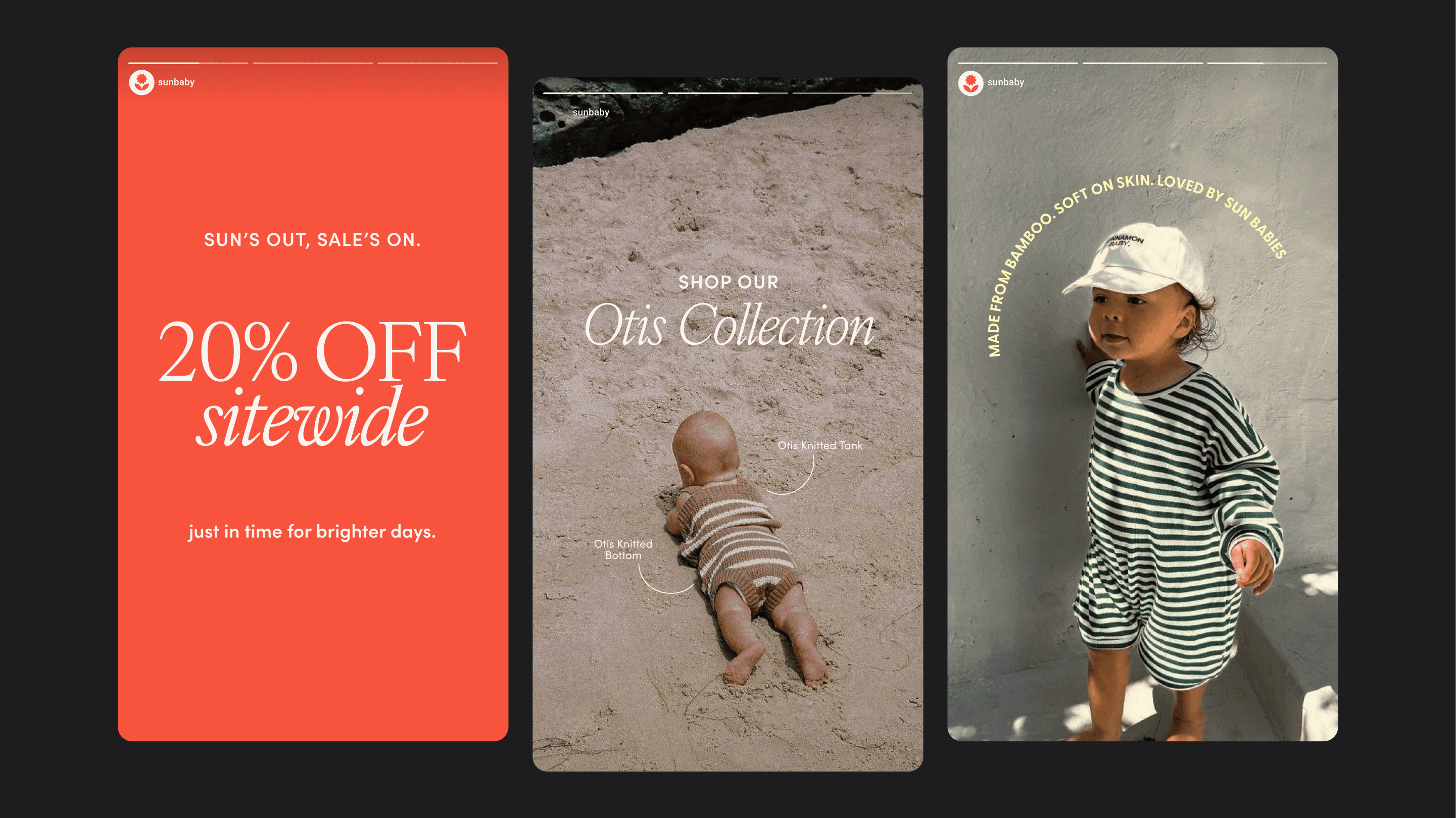
The wedge that opened up for Sun Baby was a full protective wardrobe ranging from hats and swim through to everyday wear, built with a baby-first design language, with sun-safety as the anchor and a softer, more emotionally led tone than any of the utility-led brands in the category were able to carry.
The brand needed to look like the kind of thing a Northern Beaches or Byron mum could put her baby in for a photo without feeling she’d shopped at Kmart, while also being functional enough that a Patagonia-leaning Blue Mountains family would buy multiple pieces for a camping trip. The social-enterprise structure underneath the brand — ten percent of profits to food banks — sits as part of the brand’s substance rather than its lead message, available when the moment is right to talk about it but not the headline at first contact.
The visual identity ended up in territory we called colourful minimalism. The lead colour is Sun Ember, a warm red that does most of the heavy lifting because it carries the optimism of the brand without tipping into the pop-y primary palette most kids’ brands default to, and it sits a long way from the dusty earth tones the eco end of the category has been saturating for years.
Sun Ember holds up at any scale from large-format print down to small embroidery, and gives the brand a distinct primary asset that nothing else in this category is using. Wild Olive grounds the system with an outdoor-adjacent green that’s mature rather than camping-store. Blush Petal pulls in the affluent-mum audience without going saccharine, and Sun Pollen adds warmth and lightness without sliding into the kids’-TV yellow that lurks at the edge of this category. Milky Cloud — a soft warm off-white — sits underneath the whole system as breathing room, and pure white was kept out of the palette deliberately because it cools the system down in a way that would have fought against everything else the brand is trying to do.
The brandmark is a small flower-sun hybrid that reads as both bloom and sunrise depending on how you come at it, and Amy spent a weekend sitting with two favourites from the concept refinement round before settling on it. She also asked us to keep a second character — a small smiling sun face she’d grown attached to during the concept work — as a secondary illustration, and we carried that character into the brand pattern, which is built from hand-drawn motifs of petals, leaves, twigs, clouds and tiny suns.
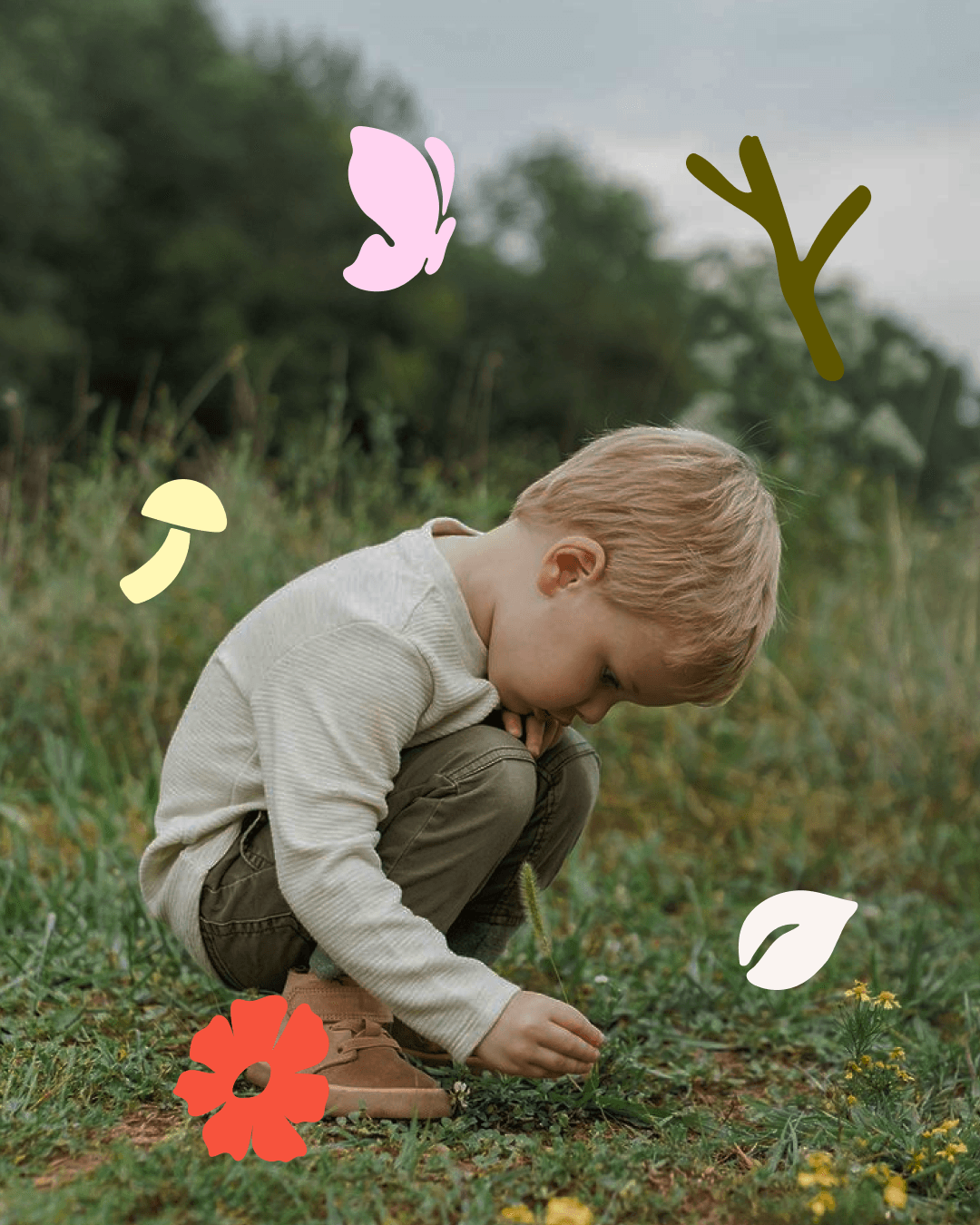
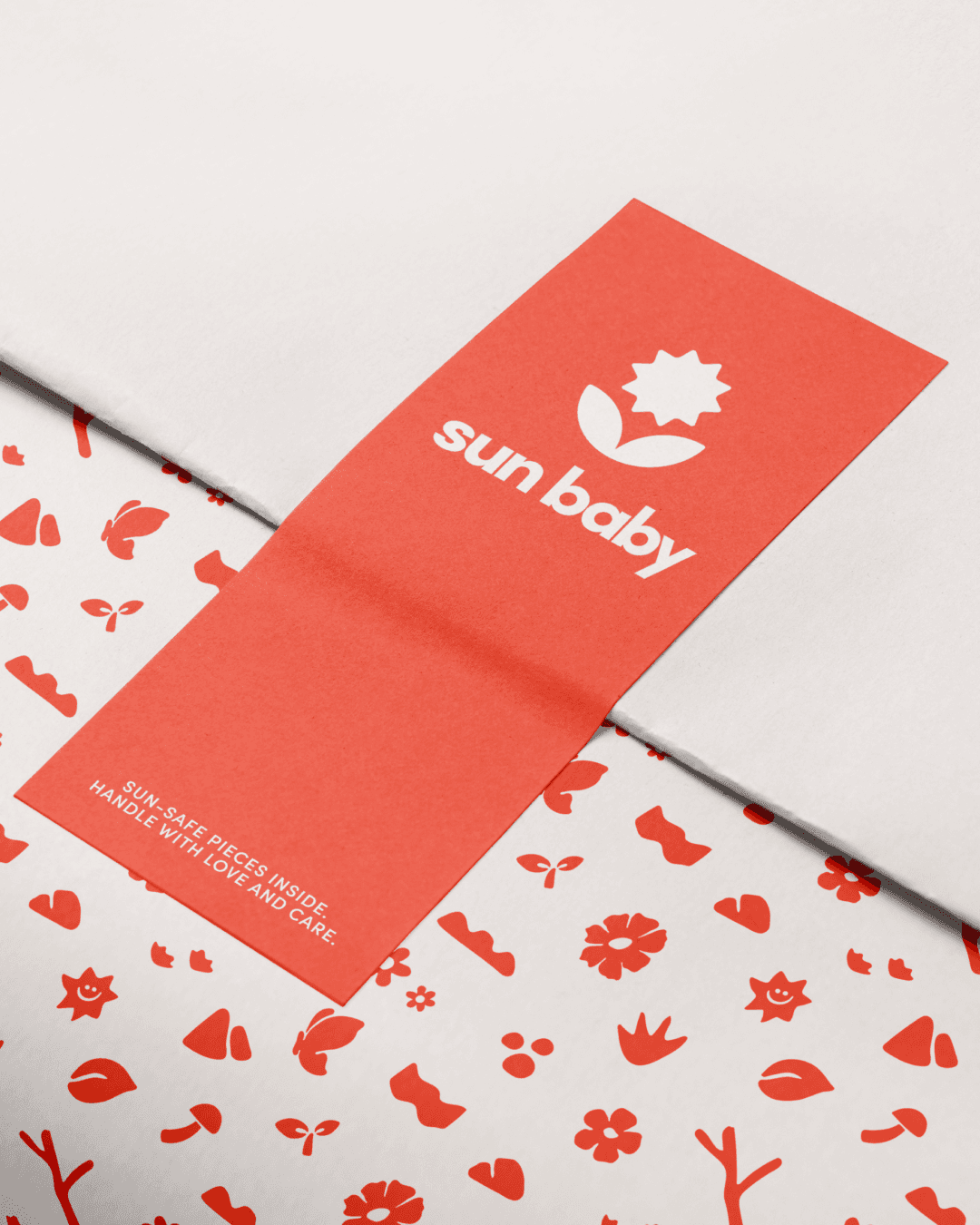
The pattern does serious work for the brand across packaging, tags, swing labels and physical touchpoints, giving the system warmth and personality without leaning on photography of the founder or any specific baby, and adding a layer of small observed detail at the kind of scale a child might actually notice.
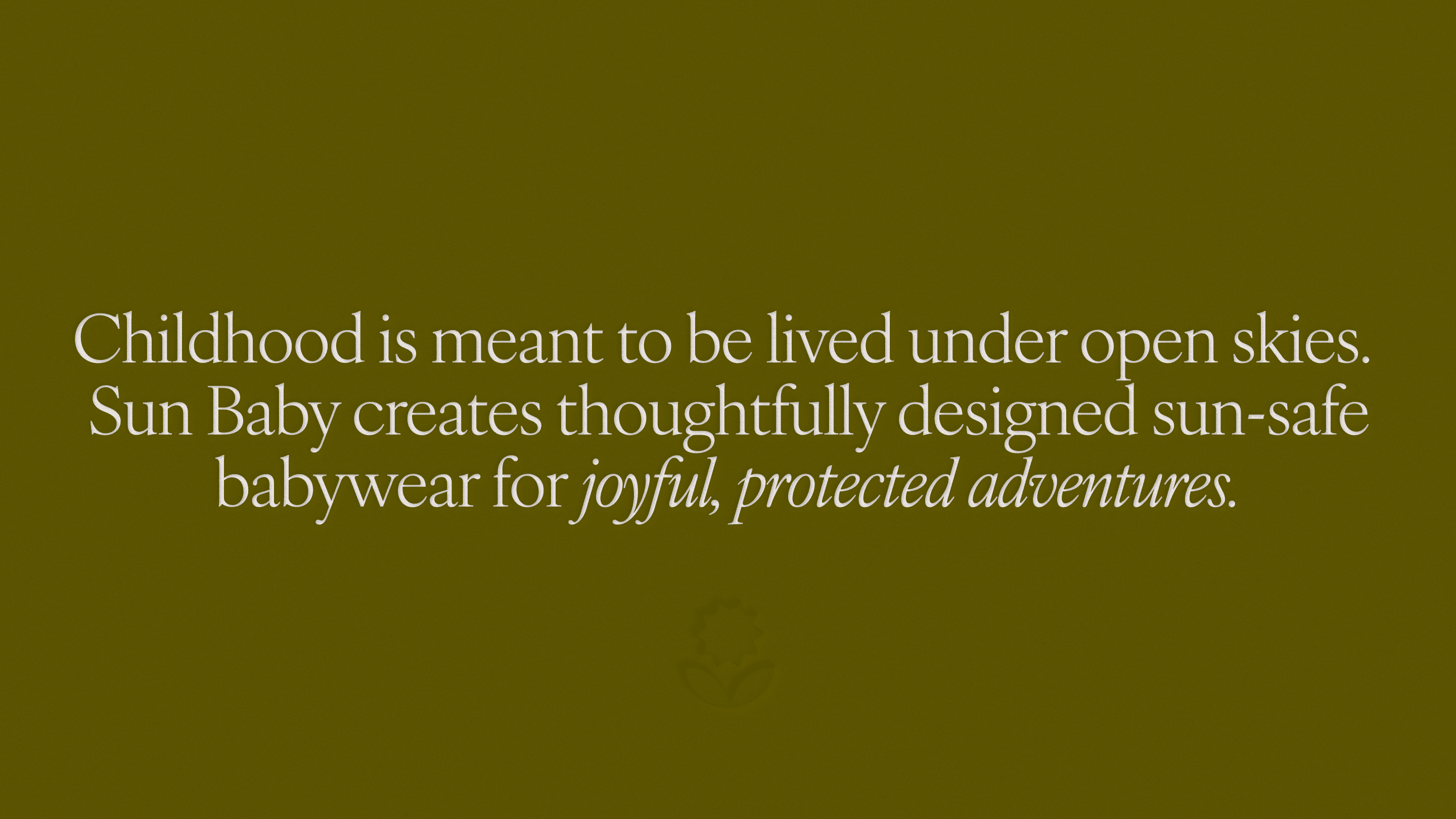
Typography pairs IvyOra Text, a serif with quiet historical weight, against Sofia Pro for body copy and labels, and we stayed mature on the type system on purpose. The category leans hard on novelty fonts, hand-lettering and rainbow display work, and a lot of the smaller brands rely on licensed-IP cartoon prints (Cookie Monster, Dora, Bluey) to do the personality work the brand itself should be doing. Holding the type closer to a fashion brand’s register — with Seed Heritage and Pure Baby as the comparable references parents already trusted — does more for Sun Baby’s price point than another playful font would, and frees the colour system and pattern to handle the warmth and play the brand needs.
The reference set for tone landed on Go-To Skincare, Patagonia, The Iconic and Depop — pulling Go-To’s confident light hand together with Patagonia’s outdoor-ethical seriousness, The Iconic’s clean non-intrusive product storytelling, and Depop’s sustainability voice that manages to be present in the brand without lecturing the reader.
The voice that emerged from those references carries sophistication and a light playful quality across product and storytelling copy, stays confident on sun safety without slipping into public-service-announcement territory, and is explicitly not founder-led.
Sun Baby now has a brand that holds up at the standard of the boutique retailers Amy plans to pitch to. That gives her two things she didn’t have when she first walked into the studio. The first is pricing room — Sun Baby can sit at $60 a piece and look honest about it next to the brands charging more and the brands charging less, which is the position you want to be in when you’re trying to build a sustainable margin without sliding into boutique-only territory.
The second is the room to grow. The brand is built to extend into hats, into more design ranges and colour drops, into international markets including the US and East Asia where Amy is already mapping demand, and into the boutique baby-store distribution she’s targeting at the three-to-five-year mark, none of which would have been credible from a brand still styled like an Instagram mum-brand.
Related Projects
View Project

Video, Campaigns
Department of Health, Disability & Ageing
View Project

Video, Graphic Design
Department of Health, Disability and Ageing
View Project

Brand, Video
Dr Aya Naj
View Project
Brand, Graphic Design
Australian Medical Council
View Project
Website, Photography
Cosmetic Connection
View Project

Video
Department of Health, Disability and Ageing
View Project

Brand, Website
MagnaTerra Technologies
View Project
Brand, Website
Sunstrata
Frequently Asked Questions
You were going to ask anyway.
A challenger brand is one that enters an established category from a small position and competes by changing the terms of the game. The category usually rewards the dominant brand on scale, distribution and brand familiarity, so the challenger has to win on something else, a sharper point of view, a specific audience the incumbent has stopped serving well, or a product that solves the same problem with a different mechanic. The framework is most often associated with Adam Morgan’s Eating the Big Fish, which named the posture in 1999 and still does most of the strategic work in this space.
Sun Baby competes in the Australian FMCG babywear category, which is the fast-moving consumer goods structure that covers babywear, infant nutrition, baby care and the adjacent product categories parents repurchase on a regular cycle. FMCG incumbents in babywear include Bonds Baby (mass retail, owned by Hanesbrands via Pacific Brands), Purebaby (omnichannel GOTS-certified organic cotton, founded 2002, the closest FMCG competitor on values), and Baby Bunting as the retail aggregator carrying roughly half the category’s third-party brand footprint. In the UPF and sun-safe sub-category specifically, Bedhead Hats owns hats by name recall, Bebe Trek owns earnest eco-utility with magnetic-closure onesies, and the generalist beach brands (Rip Curl, Billabong, Quiksilver) treat babywear as a seasonal afterthought. Little Fisho leans into fishing imagery, Cabo Collection leans into fashion-first swim. Each one has settled into a defensible groove, and the grooves between them are where the challenger plays.
Sun Baby is built as a challenger FMCG brand on three pattern breaks against those category defaults. The first is a full protective wardrobe. The second is colour and typography that read closer to a fashion brand than a kids’ category brand, which pulls the brand out of the dusty-beige eco-utility lane and away from the cartoon brightness of the cheap end. The third is a deliberate decoupling from founder-led branding, which is the category’s most overused move and the one most likely to flatten a brand into Instagram visibility.
The commercial logic of a challenger FMCG brand sits in the pricing and distribution it can defend. Sun Baby sits at around $60 a piece, which is comfortable for the affluent mum buying from Seed Heritage and Country Road, and credible for the outdoorsy parent comparing it to Patagonia’s children’s range. Neither incumbent at the price extremes can move to that middle without retraining their customer about what their brand stands for. That’s the gap Mude built the brand positioning strategy around, and it’s what challenger brand strategy is for in an FMCG context: brand as the competitive lever, not the marketing layer applied to the product after the fact.
Founder-led branding works in three specific scenarios, and the decision to use it should be tested against each one before defaulting to it. The first is when the founder already carries cultural equity the audience trusts on the relevant subject. The second is when the founder’s biography is genuinely distinctive in a category where every other brand sounds the same. The third is when the brand is small enough, and is going to stay small enough, that the founder’s personal capacity to show up on camera is the marketing budget.
Founder-led examples that worked because the founder pre-existed the brand include Go-To Skincare (Zoë Foster Blake’s decade as a beauty editor), Glossier in its early years (Emily Weiss’s Into the Gloss readership), and Thankyou (Daniel Flynn’s documented activism around clean water before the bottled water launched in 2008). These brands did not invent the founder personality at launch. They borrowed equity that the founder had spent years building elsewhere and applied it to a product the audience hadn’t yet evaluated.
Founder-led examples that worked because the founder biography was structurally distinctive include Spanx (Sara Blakely as a self-funded female founder in a category dominated by men), Bumble (Whitney Wolfe Herd as the woman who left Tinder to build a women-first dating app), and Bombas (Randy Goldberg and David Heath turning a sock company into a giving model where one pair donated for every pair sold). The founder is the brand’s reason-to-believe, and removing them would remove the strategic logic of the brand.
Founder-led examples that worked because the brand stayed small include the vast majority of Instagram-era boutique brands, where the founder posts daily, ships orders themselves, and runs the business at a scale where personal involvement is the operating model. This works commercially until the founder wants to scale, take a holiday, sell the business, or be replaced by a CEO. At that point the founder-led model has to convert into a product-led one, which is a much hard transition than starting product-led from day one.
For Sun Baby, none of the three scenarios held. Amy Nixon is not a pre-existing cultural figure to the audience, her biography (new mum identifies gap, mocks up designs, sources manufacturing) is the exact biography a hundred other Instagram-era mum brands lead with, and the brand has commercial ambitions (boutique retail by year five, US and East Asian markets) that founder-led branding would actively constrain. Product-led from day one was the only option that gave the brand somewhere to grow into.
The premium baby clothing buyer in Australia is typically the mother in a household earning a six-figure income, living in a small set of geographic clusters with shared brand affinities and shared retail habits. The clusters are Sydney’s Northern Beaches, the Northern Rivers (Byron, Bangalow, Federal), Palm Beach, the Mornington Peninsula, and the equivalent enclaves in Perth and Brisbane. She has discretionary income, time-poverty that comes with running her own online business from home while raising young children, and a tightly-curated set of brands she trusts.
Her retail set is highly specific. Seed Heritage, Country Road, Assembly Label, Pure Baby, and Zara Kids are the brands she buys from for her kids, with Bonds Baby and Cotton On Kids treated as utility purchases (basics, sleepwear, things that get destroyed). She shops on Instagram, in local boutiques during pram walks, and on the brand’s website after the kids are in bed. She will not be seen at Kmart for the visible items, even if Kmart’s babywear is functionally fine, because the visible brand of the item her child is wearing in her own photography is part of how she signals to her peer group.
Her brand affinities are sustainability, non-toxic materials, women-owned businesses, and brands with a giving-back component that she can mention without feeling she’s performing virtue. She wants her child to look effortlessly considered in family photos, which means she rejects fussy or overly dressed clothing, primary-colour palettes, novelty fonts and licensed-IP prints (Cookie Monster, Dora, Bluey). The brands she’s drawn to operate at the register of a fashion brand. This is the audience Sun Baby’s brand identity is built to win first, because her social proof on Instagram (where her own audience runs into thousands of women who look like her) carries disproportionate weight in the launch year, well above any paid acquisition channel.
She is not a single demographic. She spans roughly the 28 to 42 age range, has between one and four children, runs a business or works in a knowledge profession, and reads brand signals quickly. The signal she reads against is a brand that looks like it was designed by its founder. Sun Baby is built specifically to pass that test.
Yes, with the qualification that it requires finding the overlap the two audiences share at the level of brand expectation, building the brand at that overlap, and letting each audience project their own meaning onto it without the brand having to flex to either. DTC brands (direct-to-consumer brands selling through their own website and a small set of retail partners) live or die on this in categories where the buyer pool is segmented into clear sub-tribes, because the brand can’t have separate identities for each one without losing the cost efficiency that DTC depends on.
The overlap between Sun Baby’s two audiences is where the brand work happens. Both audiences are willing to pay for quality, both expect the brand to look like it’s been considered. Those overlaps are enough to anchor a brand that holds both audiences without going generic. The brand has to do the work of being recognisably premium enough for the affluent mum and recognisably functional enough for the outdoorsy parent, without either audience reading those signals as a compromise made for the other.
The visual and verbal system Mude built for Sun Baby is calibrated to that overlap. Sun Ember as the lead colour signals warmth and optimism without the primary-colour intensity most kids’ brands default to. Wild Olive grounds the system with an outdoor-adjacent green that’s mature. Typography sits in IvyOra Text and Sofia Pro, closer to a fashion brand’s register than a kids’ brand’s, which buys credibility with the affluent mum and stops the outdoorsy parent reading the brand as twee. Photography direction is natural light, mid-to-wide framing, real skin tones, babies playing. Each decision is calibrated to read well from both ends of the audience spectrum.
The mechanic that holds it together is restraint. The brand says less than it could about either audience specifically, which lets each audience see themselves in it without the brand having to make either feel courted at the expense of the other. That’s what a well-built brand positioning strategy does, and it’s the work a brand positioning agency is paid to do before any visual decision gets made, not after.
The right Australian baby clothing brand depends on what you’re optimising for. For mass-retail value, Bonds Baby (owned by Hanesbrands via Pacific Brands) dominates the basics category. For organic everyday essentials, Purebaby (founded 2002 by Mirabai Winford) leads on GOTS-certified cotton and runs strong national omnichannel distribution. For sun-protective hats specifically, Bedhead Hats is the trusted Australian-made brand most parents end up buying at some point. For UPF babywear, Bebe Trek leads on earnest eco-utility with magnetic-closure designs. For premium organic toddlerwear, Country Road, Seed Heritage, and Pure Baby’s premium seasonal range cover the affordable luxury bracket.
Each one occupies different category territory and prices into different tiers. Bonds Baby and Cotton On Kids sit in mass retail at $5 to $20 per piece. Purebaby’s everyday essentials sit at $30 to $45. Bebe Trek and the dedicated UPF specialists sit at $45 to $75. Seed Heritage, Country Road, and Pure Baby’s premium tiers sit at $50 to $80. Bonpoint, Petit Bateau, and the international boutique-luxury brands sit at $80 and above. The pricing tells you which brand the parent is buying for what occasion, and most parents end up buying across two or three tiers depending on the use case.
Sun Baby is built specifically for the sun-safe outdoor category that the existing players treat as adjacent. The brand prices at around $60 a piece in bamboo fabric with UPF 40 and UPF 50+ certification, which positions it against Seed Heritage and Country Road on price while competing functionally with Bebe Trek and Bedhead Hats on protection. The strategic difference Mude has called colourful minimalism is a position built on Sun Ember, Wild Olive, Blush Petal, Sun Pollen and a warm off-white called Milky Cloud, with a hand-drawn pattern of petals, leaves, twigs, clouds and tiny suns that gives the system personality at the small physical touchpoints without leaning on photography of the founder or any specific baby.
The brand idea Sun Baby is built around is first steps into the wild, which holds the outdoor activity, the sun-safety anchor and the baby-first focus inside a single emotional frame that the established players have not claimed and would struggle to claim retroactively. That positioning gives Sun Baby room to grow into hats, into international markets, into boutique baby-store distribution, and into the adjacent product categories the brand will need over the next three to five years, without competing directly with any one incumbent for any one piece of category territory.
You make an affordable brand look premium by getting typography, colour discipline, packaging and photography right at every visible touchpoint, and by exercising restraint everywhere the cheap end of the category exercises abundance. Each of these is a place where value-tier brands consistently get the call wrong, and a place where a brand-led product can claim disproportionate perceptual lift over the category default. The work is challenging because most of the signals that read as cheap are individually small, and the brand has to get them all right.
Typography is the first signal and a common place to get it wrong. The category default in babywear leans on novelty fonts, hand-lettered scripts, rainbow display work, and licensed-IP prints (Cookie Monster, Dora, Bluey, Cocomelon). These read as cheap because they’re the type of typography decisions a small brand makes when it doesn’t have a typographer, and the audience reads the signal correctly. Sun Baby pairs IvyOra Text, a serif with quiet historical weight, against Sofia Pro for body copy and labels. The pairing sits at the register of a fashion brand, which buys credibility with the premium-baby-clothing audience and stops the outdoor parent reading the brand as twee.
Colour discipline matters alongside colour choice. Sun Baby’s palette holds Sun Ember as the lead, with Wild Olive, Blush Petal, Sun Pollen, and Milky Cloud as the supporting set. Pure white was deliberately excluded because pure white cools the system down in a way that fights the warmth the brand is trying to project. Brands that try to look premium with broad palettes (six, eight, ten colours used interchangeably across surfaces) usually lose the perceptual coherence the price requires. Restraint reads as taste; abundance reads as uncertainty.
Packaging design is where the price gets paid back perceptually. The unboxing experience for an online order is the moment the buyer evaluates whether the price was honest, and a brand that has invested in tissue paper, swing tags, garment labels and the small details that compound across the experience usually converts that first purchase into a repeat one. Sun Baby’s hand-drawn pattern does most of this work, applied across packaging surfaces in a way that gives each physical touchpoint personality without the cost of bespoke printing on every component. Good FMCG packaging design at this price tier is the visible test of whether the brand work has done its job, which is why the packaging design agency engagement usually has to run in parallel with the brand strategy work.
Photography direction holds it all together. Natural light, mid-to-wide framing, real skin tones, babies playing. The brands that get photography wrong tend to overproduce (which reads as stock) or underproduce (which reads as DIY), and both failures damage the price. Sun Baby’s direction is calibrated to feel real and unstaged while still being unmistakably composed, which is the visual register that holds the price together.
Babywear and children’s clothing share a market and a retail footprint. They sit on different commercial logic. The Australian infants’ and children’s clothing retail market sits inside the broad FMCG apparel category and was worth roughly $5.2 billion in 2025 according to IBISWorld, declining 1.7 percent on the year, with the babywear sub-category absorbing the early years (0 to roughly 4) before children’s clothing takes over from preschool into early primary. The buyer behaviour, the brand expectations and the design constraints differ between those two phases in ways that change how the FMCG brand has to behave.
The babywear buyer is almost always the parent (the mother in roughly 80 percent of category research, with the father as the engaged secondary buyer), and the buying decision is loaded with first-time-parent anxiety in the early months and routine-purchase logic thereafter. The brand has to do reassurance work that the children’s clothing buyer doesn’t need, on materials, on safety, on washability, on regulatory compliance with standards like AS 4399:2020 for sun-protective clothing or AS/NZS 1249 for nightwear flammability. That reassurance shows up in the brand work as material naming, certification visibility, photography that focuses on the texture and fit of the garment, and copy that resolves the question before the parent has to ask it.
The design language is also different. Babywear has to be built around the body of a baby that can’t dress itself, which constrains everything from neckline geometry to closure mechanics. Magnetic closures, kimono-style wraps, footed bottoms, expandable necks for over-the-head dressing without distressing the baby. These are babywear-specific design problems that don’t apply to older children’s wear, and they show up in the photography, the product naming and the brand voice. A baby-first design language means the brand reads as having been built by people who understand the parenting moment, beyond a generic clothing-design process.
Sun Baby is built specifically for the 0 to 4 phase, in UPF 40 and UPF 50+ bamboo fabric, which puts it in babywear and toddler-wear specifically. The FMCG brand positioning, the pricing, the photography direction and the cultural register are all calibrated to that phase. A brand built for the early years and held there for the long run usually competes better than one stretched across the full age range, because the early-years FMCG buyer is making different decisions than the school-uniform buyer and the brand can only really speak to one of them well at a time.
Brands use custom patterns in their identity systems because patterns convert physical and digital touchpoints (which are otherwise expensive to make distinctive) into compounding brand surface area. A pattern is a piece of visual IP that’s distinctive, scalable, and hard to copy than a logo or a colour. It’s cheap to apply at production once the original creative work is done, and impossible to replicate without redoing that creative work, which makes it one of the more durable pieces of a brand identity system.
The pattern earns its place by doing the personality work that founder-led photography would otherwise do, which means the brand can carry warmth and detail at every physical and digital touchpoint without leaning on the founder, a specific face, or stock imagery the audience has already seen elsewhere. For a product-led brand, the pattern is one of the most useful identity assets a system can carry, which is why most considered consumer brands commission a bespoke pattern alongside the wordmark and the colour palette.
For Sun Baby the pattern is built from hand-drawn motifs of petals, leaves, twigs, clouds and tiny suns, drawn at a scale where a child can find individual elements on their own item of clothing. Patterns at this scale of detail reward closer looking, which is the right behaviour for a brand whose audience is parents who spend a lot of time looking at their baby up close. The pattern’s lead motif also picks up the brandmark, a small flower-sun hybrid that reads as both bloom and sunrise depending on how you come at it, which means the pattern feels of a piece with the rest of the identity.
The pattern earns its place on packaging, swing tags, garment labels, hangtags, dust bags, branded tissue paper, and the back of the website’s product detail pages. On packaging it does the unboxing-experience work that gives the brand its sense of considered care, which is one of the signals that supports the price tier. On swing tags it gives the retail buyer a moment of brand contact at the touchpoint where most baby brands fall back on a printed logo and a price sticker. On garment labels it gives the customer a quiet brand cue inside the garment, where it does compounding work over the life of the product as it gets washed, folded and rediscovered in the drawer.
Patterns like this work because they distinguish a brand-led product from a product with a brand applied to it, and they’re part of how a packaging design agency engagement pays itself back over the life of an FMCG product range. The pattern, the brand naming work, the typography decisions and the packaging design are all parts of the same identity engagement, and they work hardest when they’re commissioned together.
A founder-led brand is one where the founder’s name, story and personality are the primary surface the audience interacts with. A product-led brand is the opposite arrangement, where the product, the design system and the cultural posture do the brand’s work while the founder operates behind the brand. Both can work commercially, and the choice between them is a positioning decision with downstream consequences for scale, exit and credibility. The decision turns on what the founder is bringing to the launch in cultural equity, and what the category looks like underneath the brand. For most FMCG consumer startups, leading with the founder places the brand inside a visible cohort.
Founder-led works when the founder is already known to the audience for the relevant thing. Zoë Foster Blake spent a decade as beauty director at Cosmopolitan and Harper’s Bazaar Australia before launching Go-To Skincare in 2014, which means the audience trusted her on skincare before the brand existed. Emily Weiss had built Into the Gloss into a million-readers-a-month publication before launching Glossier in 2014. Both founders showed up to launch with brand equity already banked, and the product-side brand work could rest on that foundation.
Product-led works when the product, the design system and the cultural posture can do the brand’s work alone, and when scaling the brand internationally or selling it to a strategic acquirer is a credible medium-term outcome. Aesop, founded in Melbourne in 1987 by hairdresser Dennis Paphitis, never leaned on its founder for brand work. The product, the apothecary bottle, the typography, the retail environments and the editorial voice carried the brand, and Aesop sold to L’Oréal in 2023 for US$2.5 billion without the founder ever needing to be the brand’s public face. Glossier later spent years moderating Emily Weiss’s brand presence as the company scaled, partly to build a brand durable beyond any single person.
For Sun Baby, the call was product-led from the first brand strategy workshop. Amy Nixon, the founder, is the commercial engine of the business and the reason the gap was identified. The audience she’s trying to win (the affluent mum buying from Seed Heritage and Pure Baby, the outdoorsy parent buying from Patagonia) doesn’t know who Amy is yet, and the FMCG babywear category is already crowded with founder-led brands running on the same DIY playbook. Leading with the founder would have placed Sun Baby inside that cohort, which is precisely the cohort it needs to outrun on perception, pricing and retail credibility. Building the brand around the product, the design system and the cultural posture, with the founder origin available as supporting context.
The right audience for a new brand is the one that produces the most commercial impact against the brand’s primary success metrics, with the brand affinities the product can actually deliver against. Most founders skip the second test and end up chasing audiences who would buy the product in theory and who don’t recognise themselves in the brand the founder is actually capable of building. The audience work has to test both halves, and brand strategy workshops cover that test at the discovery stage of a brand engagement.
The brand discovery workshop process Mude runs for consumer brands maps audience types against two specific success metrics for the launch phase, scoring each audience on impact against each metric. For Sun Baby, the two priority metrics were getting sales volume going (cashflow validation in year one) and building social proof on Instagram (the channel both target audiences live on). Six audience types were tested against those metrics: affluent mums, gift buyers (typically grandparents), outdoorsy parents, budget-conscious parents, childcare providers, and safety-conscious parents.
The scoring matters because it forces the trade-off out of the abstract. Affluent mums scored 10 on both metrics because they buy across a full collection (high cart value), they post their purchases (high social proof), and they refer within tightly clustered peer groups. Outdoorsy parents scored 8 and 6 because they buy for function and durability, with quieter social posting. Gift buyers scored 7 and 3, useful for revenue and limited for social proof. Budget-conscious parents and childcare providers scored low on the metrics that mattered for the launch phase, which doesn’t mean those audiences don’t matter, it means they’re not where the brand should aim its scarce launch attention. The workshop captures this in writing so the next person making a creative decision can apply the same logic without rerunning the discovery session.
The primary audience for Sun Baby’s launch year is the affluent mum, with the outdoorsy parent as a strong secondary. Every brand decision downstream (typography, photography direction, social cadence, retail strategy, packaging design) is calibrated to land first with the affluent mum without alienating the outdoorsy parent, in that order. This is how a brand strategy workshop for a consumer startup turns into something that ships: a primary audience, a secondary audience, a clear set of audiences the brand consciously isn’t for, and the rationale captured in writing as the deliverable a brand strategist hands to the design team.
Outdoor parents in Australia typically buy children’s clothing from Patagonia, Kathmandu, Macpac, Icebreaker, and Country Road’s outdoor-adjacent lines, with sun-protective specialists like Bedhead Hats and Bebe Trek filling out the wardrobe for hot-weather use. These are families who buy for function and ethics first, aesthetics second, and whose lifestyle (hiking with the baby in a carrier, camping weekends, beach as a default destination.
The geography for this audience is distinct from the premium-baby-clothing audience. Blue Mountains, Margaret River, the WA coast, parts of Tasmania and northern New South Wales are the clusters where the lifestyle is the daily default. Bonpoint and the high end of children’s fashion don’t enter the consideration set, and aspirational Instagram styling reads to this audience as effort that misses the point.
The brand affinities overlap with the premium-baby-clothing buyer more than the surfaces suggest. Both audiences care about sustainability, both pay more for quality, both reject fast fashion, and both will switch brands quickly if a purchase feels like a mistake. The differences sit at the level of what the brand is signalling. The premium-baby buyer is signalling considered taste to her peer group. The outdoor parent is signalling alignment with a set of values about how a child should grow up. The signals don’t compete. They get communicated through different visual and verbal cues, and a brand that pitches itself at one in a way that excludes the other usually ends up losing both.
The decision-making process for outdoor parents is also different. The mother is usually the primary buyer, with the father as the engaged secondary buyer who responds to the same advertising. She shops online after the kids are in bed, runs a Google search. She wants a founder story without a founder-led brand, which is a useful nuance: she wants to know there’s substance behind the brand. She doesn’t want to feel marketed to by the founder. Brands that overshare on founder narrative read to her as the same Instagram cohort she’s trying to avoid. Sun Baby is built to win this audience as a strong secondary in year one and to convert into a primary audience over the next three to five years as the product range expands.
A brand audit is the structural work of naming what each competitor in a category actually owns, in detail, and testing where the genuine open space sits before any creative direction is locked. It’s usually the first deliverable in a brand positioning engagement, sitting between the discovery workshop and the strategy document, and it’s what allows a brand strategist to recommend a position that’s defensible.
Most brands skip this step and end up either copying an incumbent’s posture (which is the surest way to lose to them on every metric that matters) or differentiating on a superficial layer (a logo refresh, a colour change) that doesn’t change the strategic equation. A proper brand audit precedes any visual identity work, and the absence of one is usually visible in the brand work that follows: positions that feel arbitrary, identities that look like the category default, brands that get stuck competing on price because they have nothing else to compete on.
The brand audit asks the same set of questions of every competitor. What does the look and feel actually communicate? What value or expertise does the brand provide? What is the core product offering and where does it stop? Who is the audience the brand actually wins, not the audience the brand says it’s for? How does the brand market itself, and on what channels? What does it do well? What does it not do well? What makes the new brand similar to this one (so the audit can spot the territory you’d be walking into) and what makes the new brand different (so the audit can spot the territory you’d be trying to claim)?
For Sun Baby the brand audit ran across six brands in the Australian FMCG babywear category. Bebe Trek owns earnest eco-utility with magnetic-closure onesies and a strong sustainability story. The brand world reads as dusty brown and navy in a way that closes off the more aspirational mum audience entirely. Bedhead Hats owns the baby hat category by name recall and parent trust. The visual identity hasn’t moved in years and the brand only really plays in hats. Purebaby owns organic indoor essentials with strong national distribution and a real position in GOTS-certified cotton. It barely plays in the sun-safe outdoor category and treats it as adjacent. Little Fisho leans into a specific fishing aesthetic that limits its audience. Cabo Collection leans fashion-first and seasonal, which doesn’t carry across into everyday wear. The generalist rashguards from Rip Curl, Billabong and Quiksilver treat babywear as a seasonal afterthought.
Once the incumbents are mapped, the open territory usually becomes obvious. For Sun Baby it was a full protective wardrobe ranging from hats through to everyday wear, anchored on sun safety, built with a baby-first design language, and held in a soft, emotionally led tone the utility-led brands in the category had not built into their identities. None of the incumbents could move to that position without retraining their existing customer about what their brand stands for, which is the test for whether a wedge is real and defensible. Brand audit work like this is the standard pre-strategy deliverable a brand positioning agency produces before any visual identity engagement starts.
Affordable luxury pricing is the strategy of pricing comfortably above mass retail and below boutique luxury, at a price point where the buyer is making a considered choice. The position is defined by what it sits between (above mass retail, below boutique luxury), and the buyer at this tier is typically paying for quality, restraint, and a brand that doesn’t make them feel they’ve been priced gouged. The strategy works in fashion, consumer electronics, beauty, hospitality, food and beverage, and most other discretionary consumer categories.
In babywear specifically, affordable luxury pricing means pricing above mass retail (Bonds Baby, Kmart, Cotton On Kids in the $5 to $25 range) and below boutique luxury (Bonpoint, Petit Bateau, the high tiers of Pure Baby’s seasonal range, typically $80 and above). For Sun Baby that price point lands around $60 a piece, which positions the brand against Seed Heritage, Country Road, and the mid-to-upper Pure Baby tier. The pricing is part of the positioning, not a separate decision applied to it afterwards.
Pricing at this level only works if the brand visually and verbally lives at that level. A buyer comparing a $60 Sun Baby piece to a $20 Kmart equivalent has to feel that the price difference is honest, which means the brand has to look considered in every signal she encounters. The packaging, the website, the product photography, the typography, the language on the product page, the swing tag, the unboxing experience and the brand voice all have to read as a piece. One cheap-feeling signal in that chain is enough to break the price.
The pricing also has to make commercial sense for the brand at the unit level once the brand work is paid for. $60 retail on bamboo babywear with UPF 40 or 50+ certification, manufactured offshore through a sourcing agent, with margin reserved for retail wholesale (boutique baby stores from year three onward), is a tight commercial structure. The brand work needs to support that margin by making the price feel like a fair exchange. Brands that get this wrong end up either discounting to clear stock (which trains the customer to wait) or holding price and watching conversion collapse.
The reference set Sun Baby is operating against is instructive. Seed Heritage and Country Road sit at similar price points for kids’ apparel and have built their brands on consistent quality and restrained taste. Pure Baby occupies a similar tier in organic basics. The FMCG brands that fail at this price tier in babywear tend to either drift up into boutique luxury (which limits volume) or down into mass retail (which destroys margin). Holding the middle requires brand work, which brand positioning services are for, and what makes the price defensible over the long run.
The brands that pass scrutiny on this question have built their social position into operational behaviour. The category trap is the opposite arrangement, where the cause is the headline and the operational substance underneath it is thin or invented for the brand work. Buyers, journalists and regulators are now well enough trained on the difference that the latter is increasingly a commercial risk.
Patagonia is the most cited case for a reason. Telling customers to buy less, publishing detailed supply chain data, running the global Worn Wear repair programme at scale, and in 2022 transferring the company’s ownership to a trust whose sole purpose is fighting climate change are not messaging choices. They are operational decisions with real margin consequences, and the brand sits on top of them. Bank Australia plays the same game in Australian banking with a published Responsible Banking Policy that excludes lending to fossil fuels, gambling, intensive animal farming, tobacco and arms, combined with customer ownership.
For consumer products with a small social commitment, the same logic applies at the scale of the commitment. Sun Baby directs ten percent of profits to food banks, with the programme built around Amy’s existing relationships with her local church and the recognition that sun safety shouldn’t be a privilege confined to families with disposable income. The commitment is real, recurring and operational. The brand’s job is to keep it as substance, not lead with it. International FMCG precedents at a similar scale include Thankyou (clean water programmes funded by bottled water sales), STREAT (cafes that employ young people experiencing disadvantage), and Bombas (one pair of socks donated for every pair sold).
The brand expression decision that follows comes down to what to put on the front foot. If the cause sits as the lead message across all touchpoints, the brand reads as cause-first and product-second, which makes the product hard to evaluate on its own merits and hard to scale into international markets where the cause story doesn’t travel cleanly. If the cause sits as substance available when the moment is right, the product carries the brand and the social commitment shows up at the moments where it does real work, on the about page, in the impact reporting, in the partner conversations, in the founder’s media appearances. That’s what Sun Baby does.
The regulatory context for this has moved. ASIC issued an $11.3 million penalty to Mercer in 2024 as its first greenwashing case, followed by Vanguard at $12.9 million and Active Super at $10.5 million. The regulator is now actively testing whether brand claims about social, environmental or governance positioning hold up to scrutiny. Brands that haven’t built the operational behaviour underneath the claim are exposed in a way they weren’t five years ago, which is one of the reasons the smartest move for a social enterprise consumer brand is to make the substance visible and let the claim sit modestly on top of it.
UPF (Ultraviolet Protection Factor) is the rating system used to measure how much ultraviolet radiation a fabric blocks. The scale runs from UPF 15 (the minimum rating that qualifies as sun-protective) through UPF 30 (good protection) to UPF 50+ (excellent protection, blocking at least 98 percent of UV radiation). UPF measures fabric protection in the same way SPF measures sunscreen protection. The two are not interchangeable: UPF is for clothing, SPF is for skin.
Sun-protective clothing sold in Australia is regulated by AS 4399:2020, the Australian standard for sun-protective clothing evaluation and classification. The standard sets the testing methodology, the labelling requirements, and the rating scale. Australia was the first country to formalise UV protection claims for clothing, and the standard remains the global reference, with US and EU regulators having adopted parallel versions. The accredited testing laboratory in Australia is ARPANSA (the Australian Radiation Protection and Nuclear Safety Agency), which works alongside Cancer Council Australia on public sun safety guidance.
The reason this matters commercially for a brand like Sun Baby is that the UPF rating is a hard credibility signal in a category where parents are well-trained to expect documented protection. Cancer Council Australia reports that two in three Australians will be diagnosed with skin cancer by age 70, a global outlier rate, which is why the standard exists and why the audience reads UPF labelling as substantive. Sun Baby’s products are tested to UPF 40 and UPF 50+ in bamboo fabric, which sits at the top end of the protection scale and credentials the brand into both the Australian market and the export markets the brand has identified for years three and beyond.
Other standards a babywear brand needs to be aware of include AS/NZS 1249 for children’s nightwear flammability, AS/NZS ISO 8124 for children’s product safety where there are attached components (buttons, cords, drawstrings), and the ACCC’s product safety guidance for children’s clothing more broadly. Brands selling internationally also need to meet country-specific equivalents, including the US Skin Cancer Foundation’s Seal of Recommendation testing protocol (AATCC Method 183) and the EU’s equivalent standards, which are largely harmonised with the Australian baseline.
The regulatory and certification layer becomes a brand asset. Sun Baby’s product pages reference UPF 40 and UPF 50+ directly, the bamboo material and its breathability properties are explained without jargon, and the testing methodology is summarised on the brand’s About page. That visibility does the reassurance work for the safety-conscious parent without forcing the broad brand voice into a clinical register, which is the trade-off most brands in this category get wrong.
Brand voice is the consistent register a brand uses across every piece of written communication, from product pages and packaging inserts to email flows, social captions, and customer service replies. It matters because most of the brand’s contact with the audience after the first purchase is verbal.
Brand voice carries heavy weight in a product-led brand, because the founder’s personality isn’t there to absorb the slack. Every piece of written copy has to land in a register the audience can recognise as belonging to the brand, which tone of voice work is for, and it’s why verbal identity engagements usually pay back faster than visual identity engagements for FMCG brands operating at Sun Baby’s scale.
The tone of voice Mude built for Sun Baby is calibrated to land confidently on sun safety without slipping into public-service-announcement territory, and to carry warmth without slipping into the saccharine register most baby brands default to. The reference set for tone includes Go-To Skincare (confident, light hand, knows when to be informative versus when to be playful), Patagonia (outdoor-ethical seriousness without preachiness), The Iconic (clean product storytelling that doesn’t crowd the product), and Depop (sustainability voice that’s present in the brand without lecturing the reader). The voice borrows the confidence from each of those tone of voice examples without copying any of them.
The anti-positioning is just as important as the positive direction. Sun Baby is deliberately not the DIY mum-brand voice that dominates the category (the “I’m a mum, here’s the product I made” register), not the eco-utility lecture (Patagonia’s most over-imitated mode, which the small eco brands tend to copy badly), not the kids’-TV brightness of the cheap end, and not the founder-led personality of the brands the premium-baby-clothing audience is trying to avoid. Each of those rejections shapes the verbal identity alongside the affirmative direction, which is why the brand voice work specifies the anti-patterns explicitly in the brand guide.
The character the voice projects sits somewhere between the cool mum in the local group and the considered older sister figure who’s already worked out the answer to the question. She is confident, informative, warm, and never preachy. She talks about the product’s uses and the parent’s reality. She lets the social commitment sit as substance. And she trusts the reader to be smart enough to read the signals without having them explained. That tone of voice allows a product-led FMCG brand to build emotional connection at the same pace a founder-led brand can, without the constraint of having the founder show up on camera to deliver every piece of communication.