Australian Medical Council
Rebranding Australia’s national standards body for medical education and assessment
Mude rebranded the Australian Medical Council (AMC) — the independent national standards body for medical education and assessment in Australia and New Zealand.
AMC’s previous identity was a 2011 style guide that no longer fit how the organisation actually worked. Staff were building committee reports, stakeholder communications and IMG-facing materials in Word and PowerPoint, often on machines that didn’t have the full system installed. At first contact, the visual language blurred AMC into AHPRA, the Medical Board of Australia, and the AMA. International medical graduates, one of AMC’s largest fee-paying audiences, were arriving at the regulatory process. They met four acronyms with broadly similar visual systems.
The brief asked for a healthcare rebrand that would distinguish AMC inside the Australian medical regulator landscape, embed cultural safety as procedure rather than gesture, and meet the accessibility standards a national standards body has to operate to. The system also had to be deployable by AMC staff with no design software in the room.
The audience that mattered most was the one already inside the building
When Mude scored every user segment against the two metrics AMC had selected as the most important: brand trust and clarity, and employer of choice and staff retention. AMC’s own staff came out on top with the highest possible score. Directors followed. Committees and panels followed them. Internal audiences dominated the table; the regulators AMC reports to (AHPRA, the MBA) came next; education providers and IMGs sat further down.
That changed the shape of the engagement. Most of the visible payoff in a regulator rebrand sits on outward-facing surfaces — public communications, stakeholder reports, the website. AMC’s diagnostic put the highest-leverage audience inside the building. Staff had told us in workshop that they didn’t feel attached to the identity. The 2011 guide had become something they pushed against rather than worked with.
The first design constraint Mude set was that this had to be a system the team would want to use. That meant a deployability standard. Staff with no design software, working in Word and PowerPoint, producing committee agendas and stakeholder reports under deadline pressure, could produce on-brand output without a designer in the room.
The Australian Medical Council (AMC) faced significant challenges with an outdated brand identity that no longer aligned with its evolving role in the medical field. The existing style guide, created in 2011, was causing inefficiencies, confusion, and a lack of cohesion across various applications. The problem grew as the organisation moved from paper-based to digital platforms.
Additionally, the AMC’s brand lacked inclusivity and wasn’t speaking to its full audience, including Aboriginal, Torres Strait Islander, and Maori communities. AMC ran a brand discovery process to rework how it looks and sounds.
Distinct from the regulators around it
The rebranding process focused on creating a distinct and modern identity that would set AMC apart from similar bodies. It built in cultural safety, innovation, and community engagement. This involved auditing the existing brand applications, developing a new set of brand guidelines, and creating a library of diverse and inclusive imagery.
The goal was to empower AMC staff to apply the brand consistently and effectively, fostering a sense of attachment and pride in their work. By prioritising inclusivity and accessibility in the new brand identity, AMC successfully positioned itself as a leader in the medical community, committed to excellence and cultural respect.
The other diagnostic finding was commercial. AMC was being confused with AMA, AHPRA and the Medical Board of Australia at first contact. The audience most affected was international medical graduates, one of AMC’s largest fee-paying audiences.
An IMG navigating the path to practising medicine in Australia was being met by four acronyms and four broadly similar visual systems (institutional blue palettes, clean sans-serif type, restrained civic register). It left no clear sense of which regulator was responsible for what.
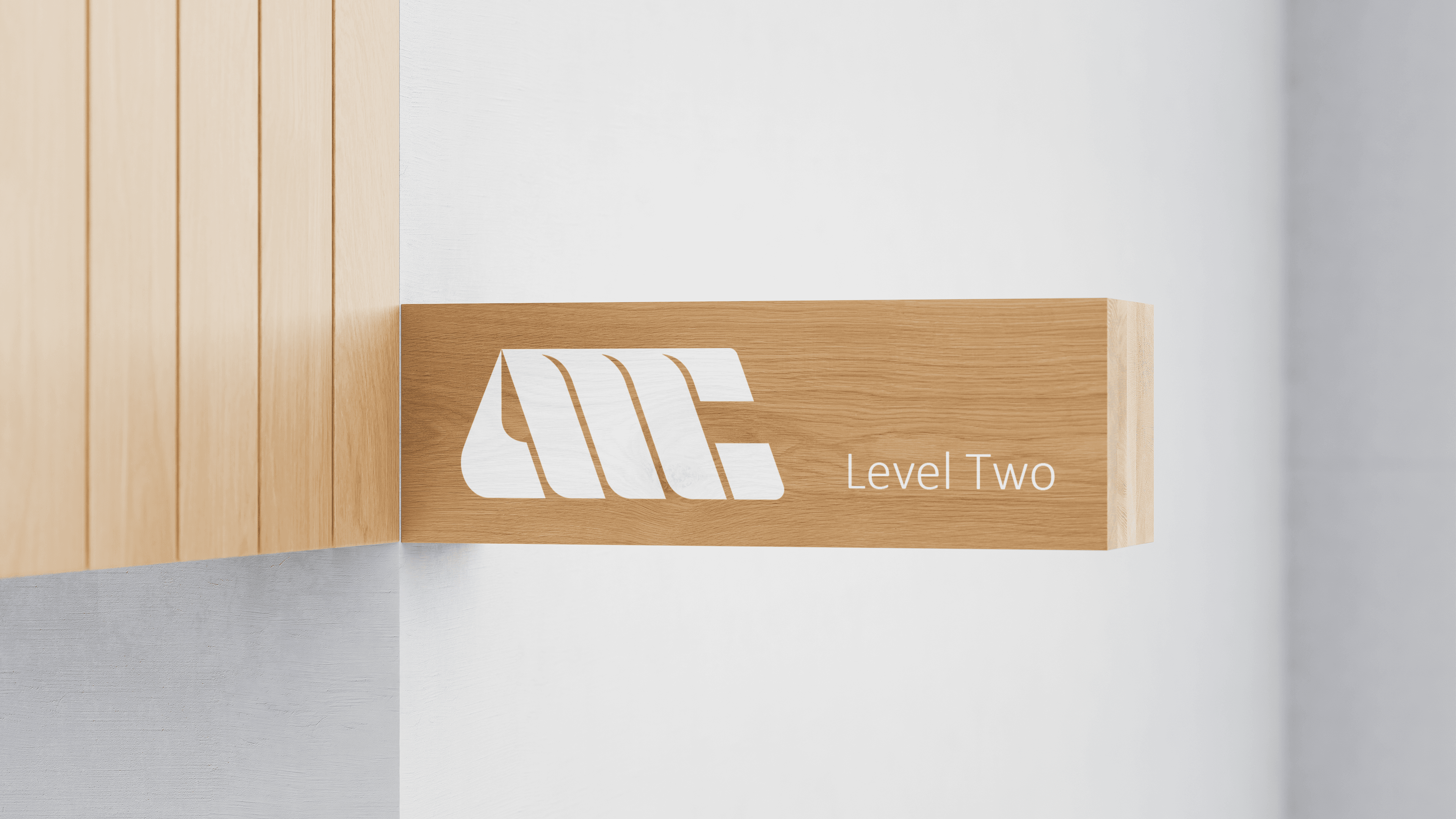
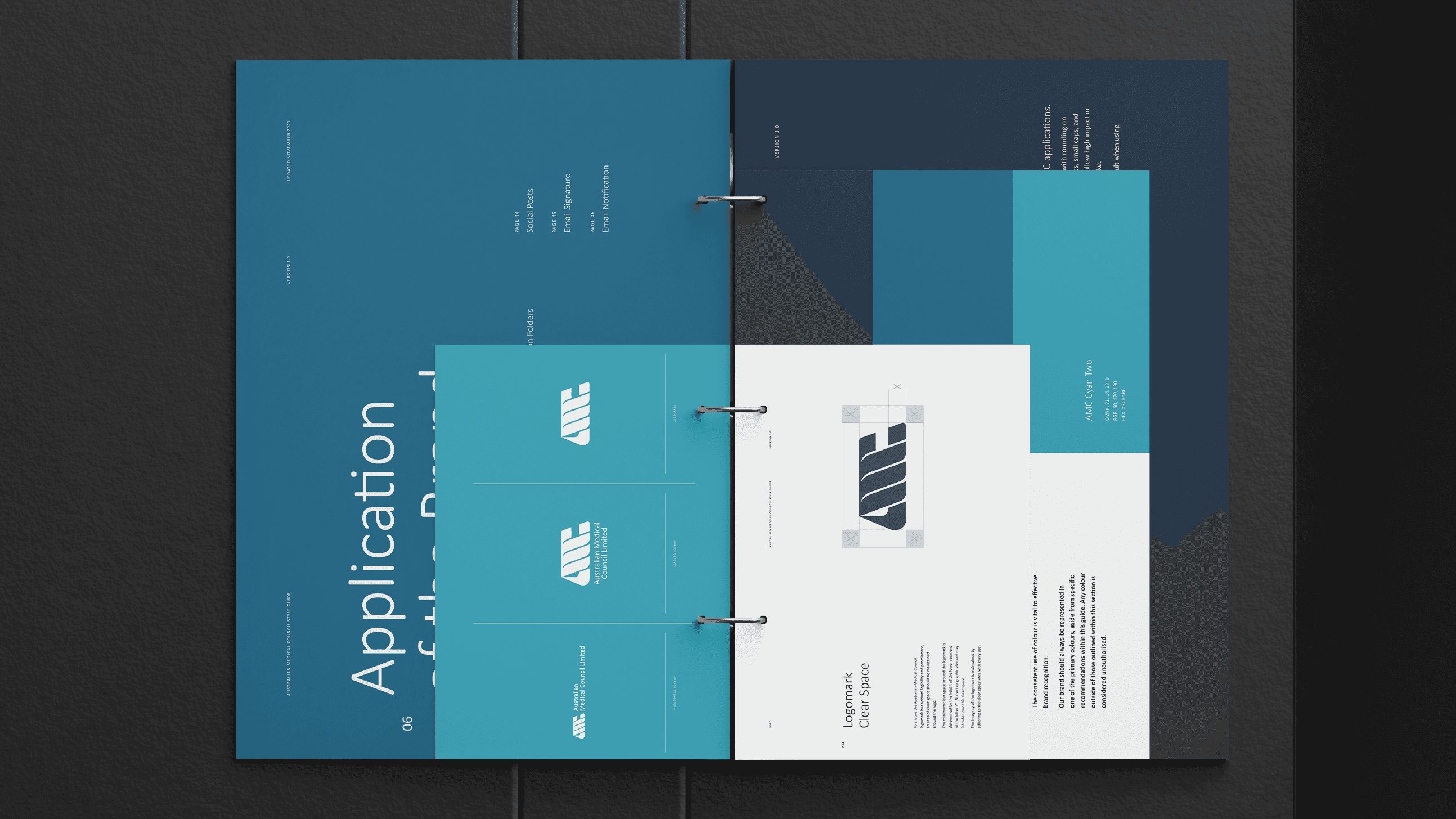
The logomark was a refinement of its existing logo. The original AMC monogram — the angular letters where A, M and C overlap — was named in the workshop as the one piece of the existing identity the team felt attached to. Staff read the overlapping letters as a signal of collaboration. The new mark holds that geometry but tightens its execution and locks it into a system of stacked and horizontal lockups with documented clear-space rules and minimum sizes (65px for the symbol, 100px stacked, 250px horizontal).
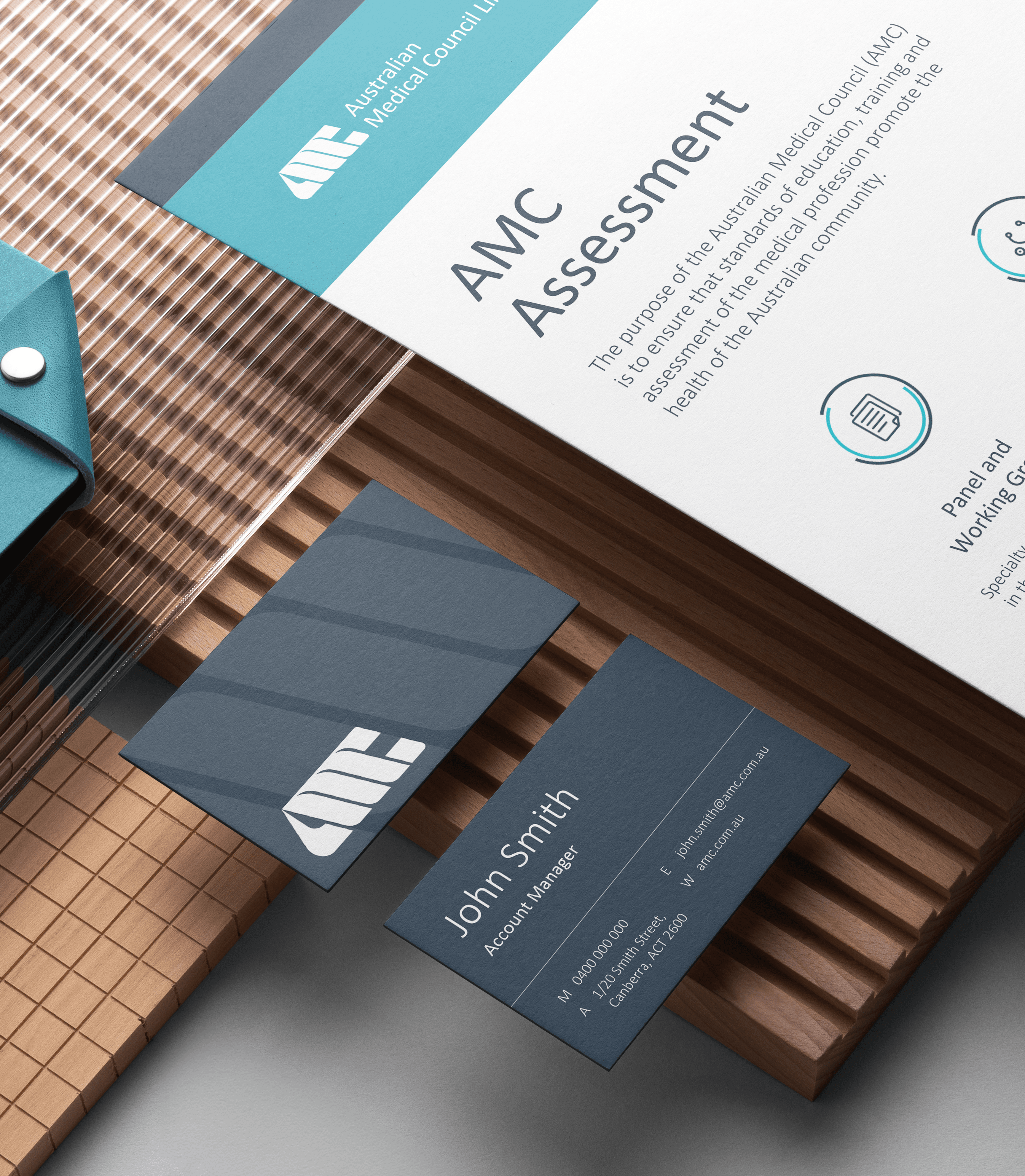
The colour palette is built around AMC Navy (#2C3E50), with two cyans, a yellow, and two light blues for ground tones. A secondary palette of five colours sits behind that for charts, infographics, and section coding: orange flagged for Medical School Accreditations, for instance, so AMC’s publications can carry their own departmental identity inside the master system. Every pairing in the guide has been contrast-tested against WCAG AA Large, AAA Large, AA Normal and AAA Normal standards.
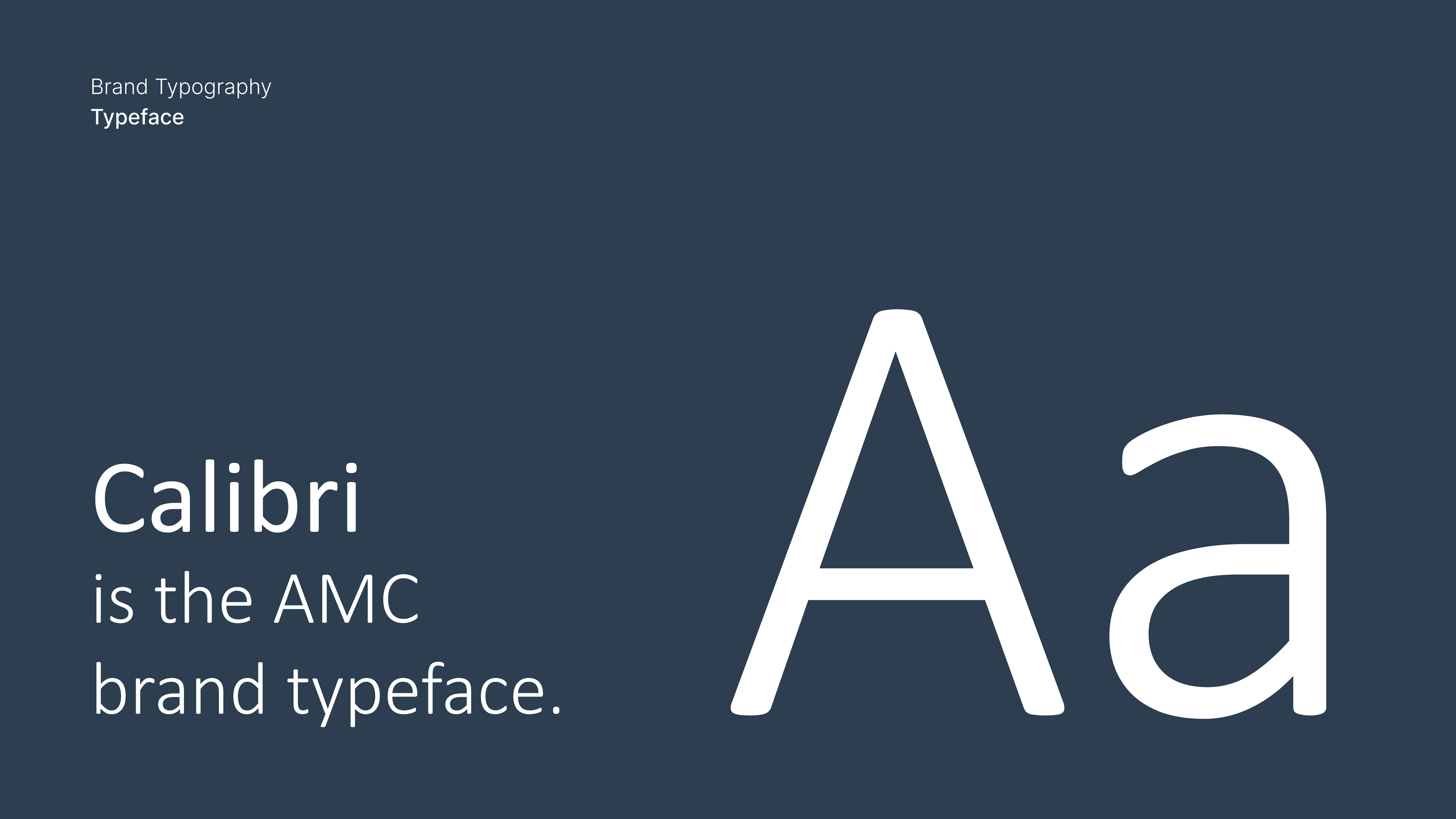
The typeface call was Calibri. That decision is the engagement’s deployability argument in one move. Open Sans and Public Sans both performed better as expressive typefaces in the mudeboards. Most of AMC’s surface area gets produced in Word and PowerPoint by staff who aren’t designers.
Calibri is the Microsoft default. It renders identically across staff machines, it doesn’t trigger licensing or installation friction, and it makes the bar for producing on-brand output exactly the bar staff were already operating at.
The system chose deployability over distinctiveness because distinctiveness in the guide means nothing if most of the brand’s surface area is being produced without the typeface installed.
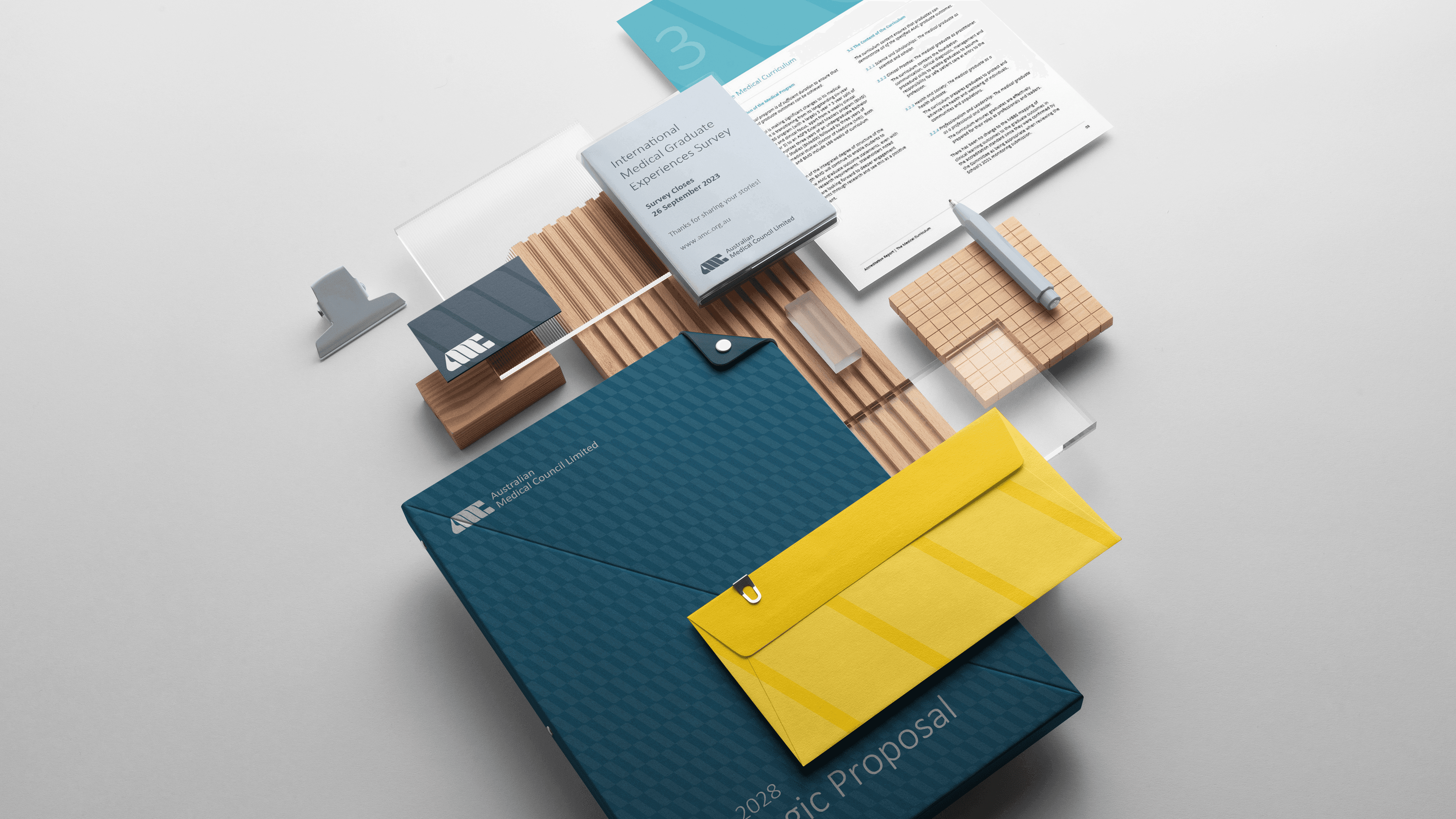
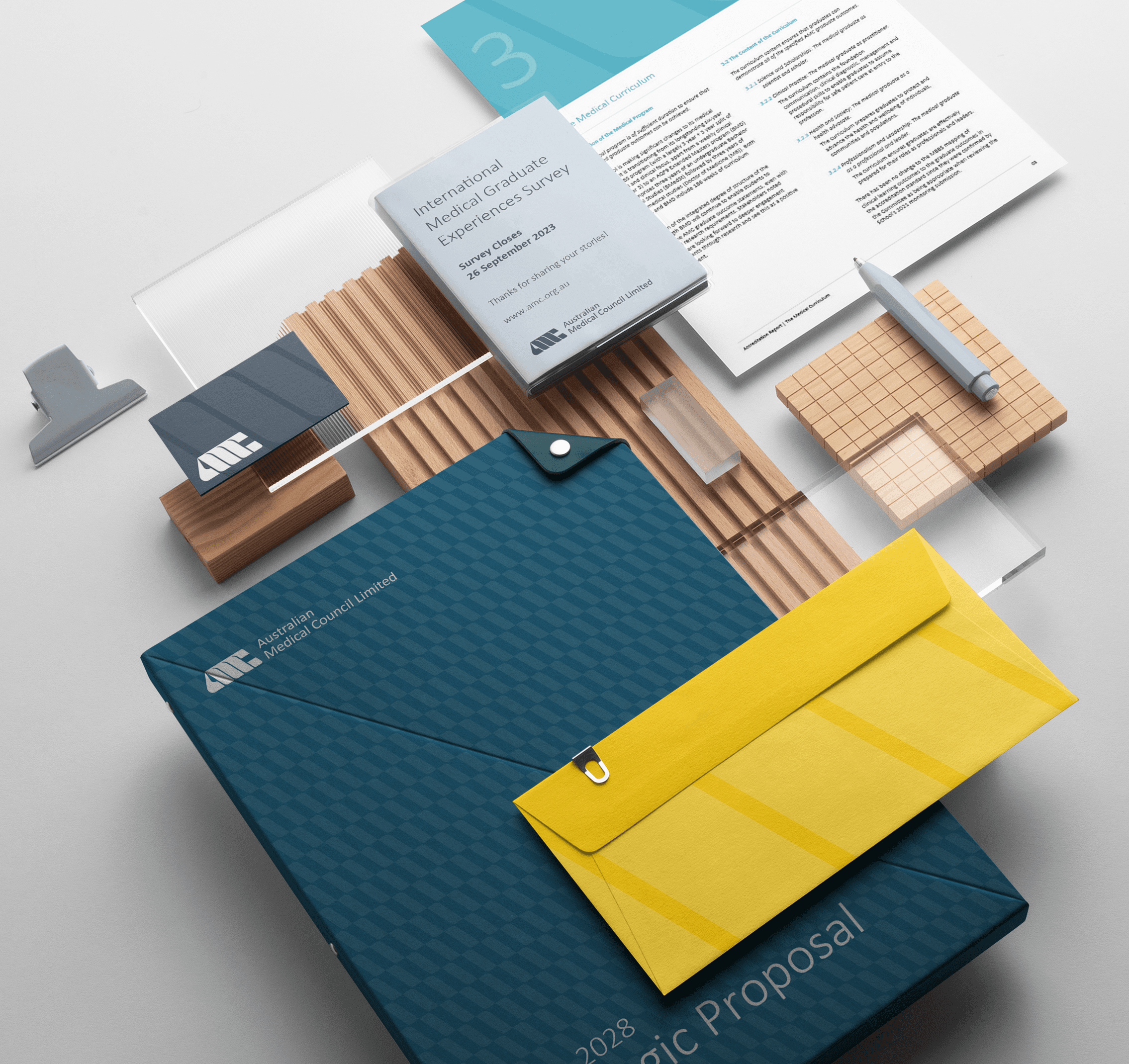
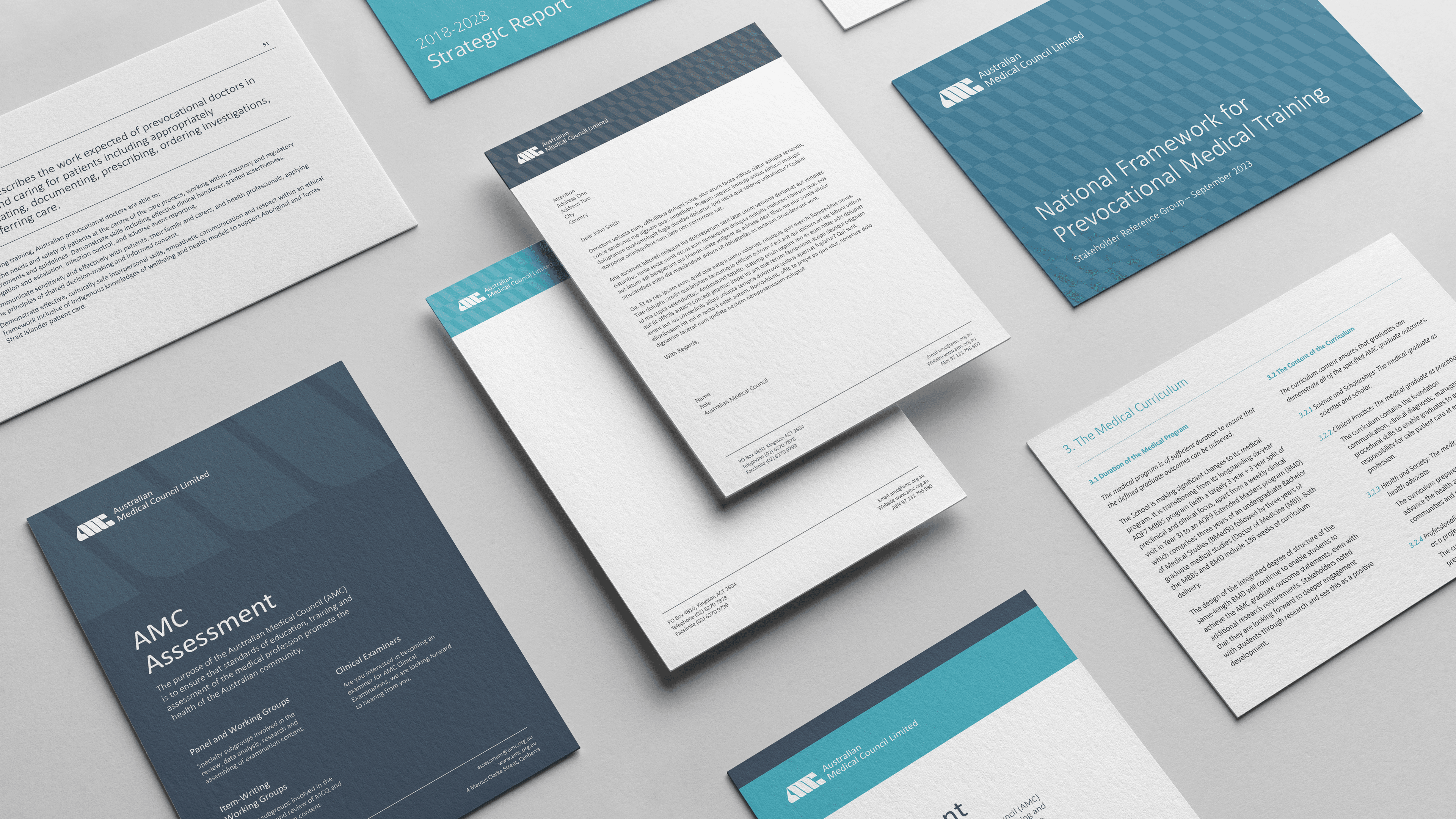
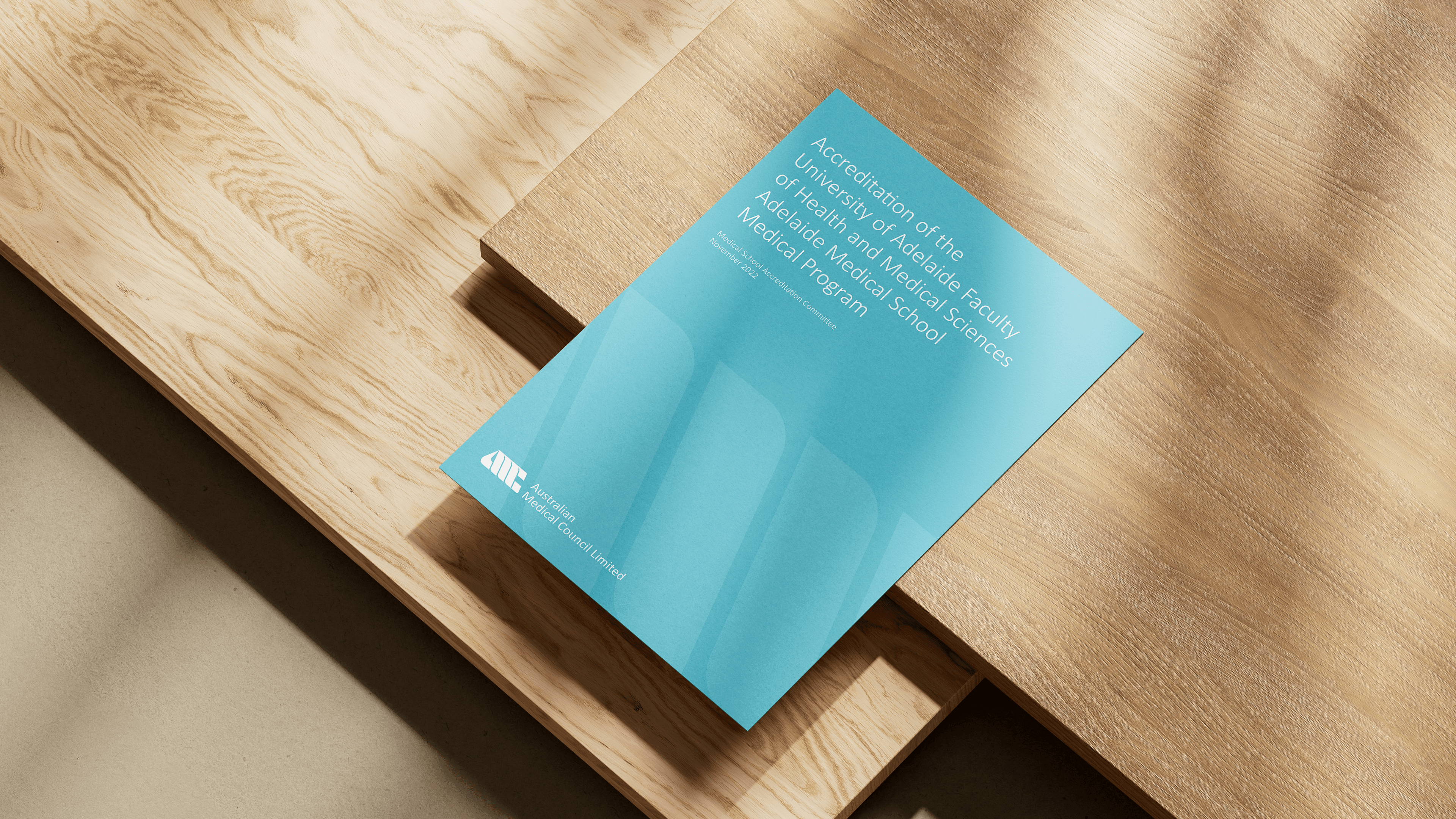
Mude built four pattern systems from the geometric forms of the AMC monogram. They extend across covers, dividers, social tiles, and out-of-home work. The patterns sit behind a committee report cover at low contrast and confidently behind an outdoor IMG campaign poster at high contrast.
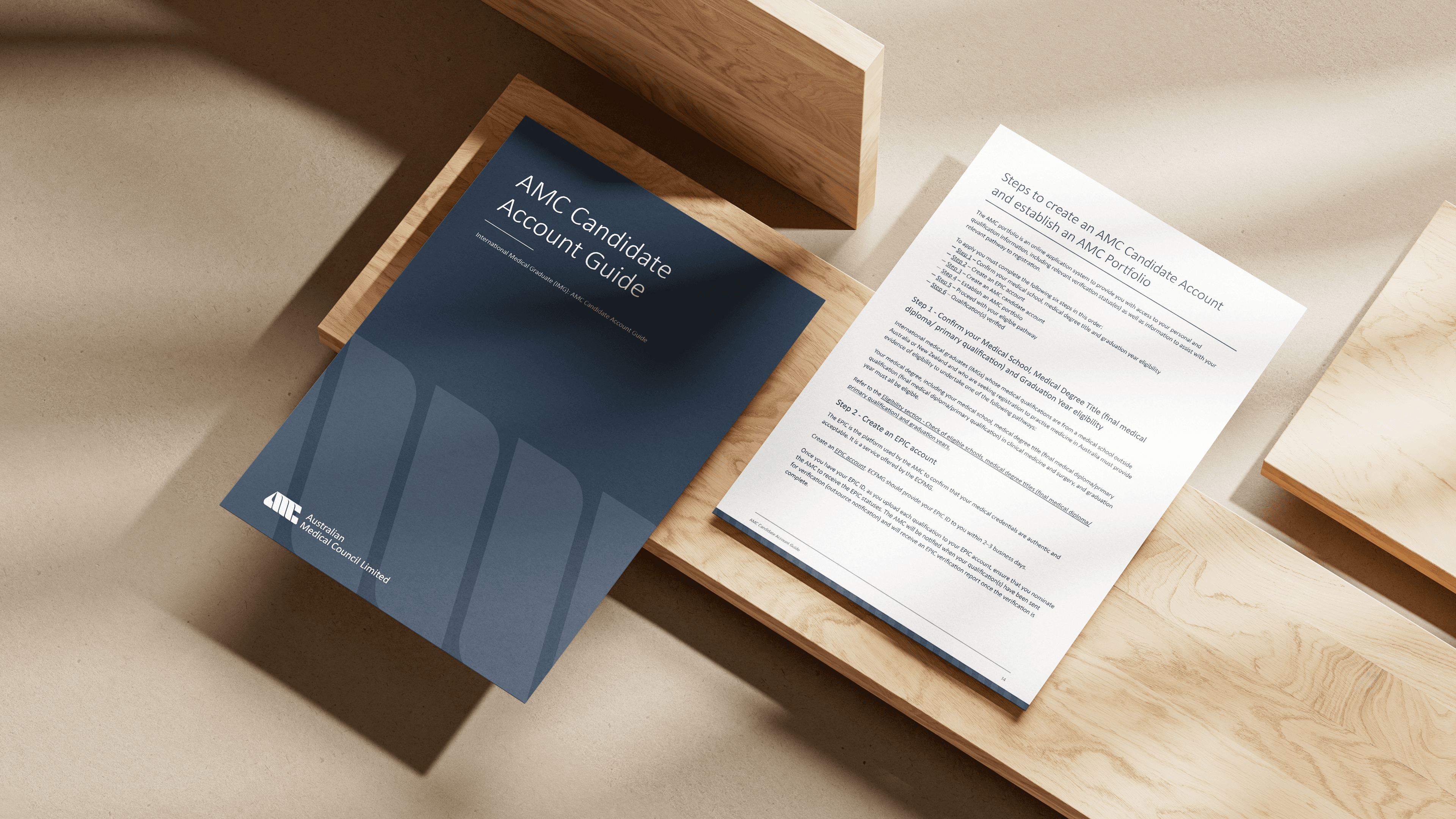
The brand system extends beyond identity work into AMC’s corporate communications design. Annual reports, accreditation reports, committee minutes and stakeholder publications all run on the same typography, palette and pattern logic, which means AMC’s annual report design carries the same visual continuity as its day-to-day committee agendas.
The inclusion work in the workshop had been very explicit. The previous identity made the brand feel cold and harder to identify with across cross-cultural audiences. The voice and perspective of Aboriginal and Torres Strait Islander people was missing from the brand. Māori voices were missing, AMC’s accreditation work spans New Zealand, and the brand wasn’t reflecting that. The visual identity wasn’t communicating cultural safety, which was one of AMC’s stated values.
Mude built inclusion into the operating layer of the system. Two decisions sit at the centre of that.
The first is that an Acknowledgement of Country is baked into the email signature template as the default text every staff member uses, and not as an optional add-on. The guide ships with the signature pre-written and the acknowledgement already inside it. External emails from AMC carry it without anyone needing to remember to add it.
The second is that the committee agenda template, the format used for the Specialist Education Accreditation Committee and other governance bodies, opens with an Acknowledgement of Country as the first agenda item, recognising both Aboriginal and Torres Strait Islander Peoples and Māori People of New Zealand. AMC’s committees are where most of the regulator’s governance work happens. Hard-coding the acknowledgement into the template means it gets read at the start of every meeting, not as a gesture but as procedure.
The system’s persona library, developed after the brand guide shipped, extended the same logic. Personas were updated to reflect Aboriginal and Torres Strait Islander health contexts, to include non-binary representation, and to carry the lived experience of IMGs through specific practitioner stories. One follows a Finnish IMG navigating supervised training and exam requirements. Another follows a cardiologist deemed non-comparable and rerouted into a public health role in rural NSW.
The AMC rebrand sits in an ongoing body of healthcare branding, regulatory rebrand and high-trust institutional brand work Mude has produced for Australian and trans-Tasman organisations.
Adjacent work in the portfolio includes BreastScreen Australia, the Department of Health, Disability and Ageing (Why Standards FHIR campaign), and other healthcare-sector engagements.
Mude is a Canberra and Sydney brand and design studio that works with healthcare regulators, national standards bodies and government departments on brand strategy, brand architecture and identity systems.

The AMC system is one of Mude’s most-cited examples of brand work for conservative, high-trust sectors where the audience is sceptical of cosmetic rebrands.
The AMC rebrand is one of Mude’s most cited healthcare branding case studies, alongside BreastScreen Australia and the Department of Health, Disability and Ageing’s Digital Health Branch.
The rebrand retained AMC’s existing monogram — the element staff felt most attached to in the workshop — and rebuilt the system around it rather than replacing it. The brand guide ships with Acknowledgement of Country pre-written into the email signature template and hard-coded as the opening item on the committee agenda template, treating cultural safety as procedure rather than gesture.
Mude also works on medical branding, brand positioning and brand strategy for adjacent organisations including peak medical associations, accreditation bodies, university medical schools and federal health departments.
Related Projects
View Project

Video, Campaigns
Department of Health, Disability & Ageing
View Project

Video, Graphic Design
Department of Health, Disability and Ageing
View Project

Brand, Graphic Design
Sun Baby
View Project

Brand, Video
Dr Aya Naj
View Project

Website, Photography
Cosmetic Connection
View Project

Video
Department of Health, Disability and Ageing
View Project

Video
Secretariat of the Pacific Regional Environment Programme (SPREP)
Telly Awards
8View Project

Brand, Graphic Design
Capital Athletics
Frequently Asked Questions
Rebranding a healthcare regulator
The Australian Medical Council (AMC) is the independent national standards body for medical education and assessment in Australia and New Zealand. AMC accredits medical schools, sets the standards for specialist medical training, assesses the qualifications of international medical graduates seeking to practise in Australia, and works alongside the Medical Board of Australia and the Australian Health Practitioner Regulation Agency (AHPRA) in the regulation of the medical profession.
AMC was established in 1985 and operates as an independent not-for-profit company limited by guarantee, headquartered in Canberra.
The Council’s accreditation work spans Australia and New Zealand, which is why the AMC brand carries both an Acknowledgement of Country for Aboriginal and Torres Strait Islander Peoples and a recognition of Māori as the tangata whenua of New Zealand.
AMC rebranded for three reasons:
- The 2011 style guide had stopped fitting the work. AMC had moved from paper-based to hybrid digital production, and the existing system wasn’t built for staff producing committee agendas and stakeholder reports in Word and PowerPoint under deadline pressure.
- AMC was being confused with the regulators around it. International medical graduates entering the path to practising medicine in Australia were meeting four acronyms — AMC, AMA, AHPRA, the Medical Board of Australia — with broadly similar visual systems and no clear sense of which regulator was responsible for what.
- The previous identity didn’t reflect AMC’s cultural safety commitments. The voice and perspective of Aboriginal and Torres Strait Islander people was missing from the brand, Māori voices were missing despite AMC’s accreditation work spanning New Zealand, and the visual identity wasn’t communicating cultural safety as one of AMC’s stated values.
The rebrand addressed all three.
Brand positioning is the strategic discipline of defining where an organisation sits in the mind of its audience relative to the alternatives. A working brand position answers four questions: who the brand is for, what category it competes in, what makes it distinctive within that category, and what evidence proves the distinction.
AMC’s positioning challenge was unusually specific. AMC sits alongside three other organisations that share visual and verbal territory in Australian medical regulation: the Australian Health Practitioner Regulation Agency (AHPRA), the Medical Board of Australia, and the Australian Medical Association (AMA). International medical graduates arriving at the path to practising medicine in Australia were meeting four acronyms with broadly similar visual systems and no clear sense of which regulator was responsible for what.
The positioning work for AMC had to distinguish AMC from the three adjacent organisations at the point of stakeholder entry, and reinforce AMC’s specific category, which is an independent national standards body for medical education and assessment, distinct from regulator, registration agency, and professional association.
The rebrand carries positioning through the AMC Navy palette, the refined monogram, the cultural safety operating layer, and the persona library.
Mude runs brand positioning and brand strategy services from its Canberra and Sydney studios.
Rebranding a regulatory body or national institution without losing trust involves five moves:
- Keep what staff and stakeholders are attached to. The AMC monogram — the overlapping A, M and C letters from the previous identity — was named in the discovery workshop as the one piece of the existing system staff felt attached to, read as a signal of collaboration. The new identity holds that geometry and tightens its execution.
- Make the audience that matters first the audience inside the building. Most rebrand backlash comes from internal staff who feel a system has been done to them. Scoring internal staff as a high-leverage audience for the AMC rebrand, ahead of external stakeholders, meant the system was built to be wanted, not imposed.
- Set a deployability standard. A new identity that requires installation, licensing or designer involvement fails on day one with non-design staff. Calibri, Microsoft-default tooling, and pre-built templates removed the friction.
- Build cultural safety into the operating layer, not the marketing layer. Acknowledgement of Country in email signatures and committee agenda templates is procedure, not communications. Procedure ages better than messaging.
- Plan for the partnership past the launch. Healthcare and regulatory rebrands need ongoing brand guardianship — the persona library, evolving template needs, stakeholder communications, accessibility updates. Most rebrand backlash happens 18–24 months in, when the system has aged out of fit and there’s no partner left to extend it.
This is the model Mude uses for healthcare, regulatory and high-trust institutional rebrands.
AMC chose Calibri as its primary typeface because most of the AMC brand’s surface area is produced by staff working in Microsoft Word and PowerPoint, not by designers.
Calibri is the Microsoft default. It renders identically across every AMC staff machine, it doesn’t trigger licensing or installation friction, and it makes the bar for producing on-brand AMC output exactly the bar staff were already operating at.
Open Sans and Public Sans both performed well as expressive typefaces during design exploration. Distinctiveness in the brand guide means nothing if most of the brand’s surface area is being produced without the typeface installed.
The system chose deployability over distinctiveness, which, in a regulator producing committee agendas and stakeholder reports under deadline pressure, is the right call.
Cultural safety is a concept first developed in nursing practice in Aotearoa New Zealand in the 1980s. In design, cultural safety means building systems where culturally diverse staff, audiences and stakeholders can engage without having to absorb the cost of explaining or defending their cultural context.
Cultural safety isn’t the same as cultural awareness or cultural sensitivity. It’s a high standard requiring the system itself to do the work, not the individual.
In the AMC brand system, cultural safety is built into the operating layer in two specific ways:
- The email signature template ships with an Acknowledgement of Country pre-written into it. Every external email AMC sends carries the acknowledgement without anyone needing to remember to add it. The default is inclusion; there is no add-on.
- The committee agenda template: used for the Specialist Education Accreditation Committee and other governance bodies — opens with an Acknowledgement of Country as the first agenda item. AMC’s committees are where most of the regulator’s governance work happens. Hard-coding the acknowledgement into the template means it gets read at the start of every meeting, as procedure.
The persona library extends the same logic. Personas reflect Aboriginal and Torres Strait Islander health contexts, include non-binary representation, and carry the lived experience of international medical graduates through specific practitioner stories.
These four organisations are commonly confused. They serve different functions:
- AMC (Australian Medical Council) is an independent national standards body. AMC accredits medical schools, sets standards for specialist medical training, and assesses the qualifications of international medical graduates seeking to practise in Australia.
- AHPRA (Australian Health Practitioner Regulation Agency) is the national agency that administers the registration of health practitioners across Australia, working with 15 national boards.
- The Medical Board of Australia is the national board within AHPRA responsible for registering doctors and regulating the practice of medicine.
- The AMA (Australian Medical Association) is the professional association and representative body for doctors and medical students in Australia. AMA is not a regulator.
The AMC rebrand was specifically designed to make AMC’s visual identity distinguishable from the other three at the point of stakeholder entry, particularly for international medical graduates navigating the path to practising medicine in Australia.
International medical graduates entering Australian medical practice typically interact with all four. The most common path is: complete AMC assessment (qualifications and exams), apply for registration through AHPRA, registration decision issued by the Medical Board of Australia, optional professional membership through the AMA.
Brand operationalisation — sometimes called BrandOps — is the discipline of building a brand system that staff can actually use, day-to-day, without designer involvement.
Brand operationalisation matters because the visible part of any brand (logos, websites, campaigns) is a small fraction of its actual surface area. Most of a brand’s surface area is internal documents, emails, reports, presentations and committee materials produced by non-designers under deadline pressure.
A brand that wins on the design page and loses on the operating page produces inconsistent output the moment the brand guide is delivered. The fix isn’t to send staff to design training. The fix is to design the brand around the tooling and conditions staff already work in.
The AMC brand is engineered for operationalisation:
- Typography: Calibri — the Microsoft default, installed on every AMC staff machine, no licensing or installation friction.
- Templates: Word and PowerPoint templates for committee agendas, stakeholder reports, presentations and email signatures, all built with the brand applied. Staff start from the template, not from scratch.
- Cultural safety: Acknowledgement of Country pre-written into the email signature template and hard-coded as the first agenda item in the committee agenda template — so it gets used by default, not by memory.
- Colour palette: WCAG-tested pairings documented in the guide, so staff can use any approved pairing without re-checking accessibility.
- Pattern system: four geometric patterns derived from the monogram, with documented use cases for low-contrast covers, high-contrast posters and section coding.
The brand system chose deployability over distinctiveness on every operational decision.
Mude builds brand systems on this principle for healthcare regulators, government departments, peak bodies and complex institutions across Canberra and Sydney.
Yes. The Australian Medical Council is the national accreditation body for Australian and New Zealand medical schools, and AMC’s brand work is built for the medical education sector specifically, accredited medical programs, specialist medical colleges, examination bodies, and the international medical graduate assessment pathway.
Medical education branding sits at the intersection of three disciplines: healthcare branding (clinical trust, accessibility, cultural safety), high education branding (institutional credibility, accreditation messaging, student-facing communications), and regulatory branding (governance clarity, compliance language, stakeholder accountability). Few Australian agencies build sustained capability across all three.
The AMC brand system is designed for production by AMC’s accreditation, examination and governance teams, and for use across AMC’s communications with medical schools, specialist medical colleges, the Medical Schools Accreditation Committee, the Specialist Education Accreditation Committee, and stakeholder communications to IMGs navigating the path to Australian medical practice.
Mude’s medical branding practice also extends to medical schools, examination bodies and adjacent healthcare educators. Same operating principles as the AMC system: accessibility built in, cultural safety as procedure, deployability as a design constraint.
The Australian agency landscape for healthcare branding is thin, well below consumer and B2B sectors in agency count. Most agencies that work in healthcare do so as one project among many; few build sustained capability across healthcare regulators, peak bodies, hospitals and medical research organisations.
Mude has built that capability across rebrands and brand systems for the Australian Medical Council, BreastScreen Australia, the Department of Health, Disability and Ageing (Why Standards FHIR campaign), and adjacent regulated and high-trust institutional work for the Australian Strategic Policy Institute, the Department of the Prime Minister and Cabinet, and the Business Council of Australia.
Mude operates studios in both Canberra and Sydney, which matters for healthcare branding work because many of Australia’s national healthcare regulators, accreditation bodies and federal health departments are headquartered in Canberra.
Working with a Canberra studio shortens the distance — physically and operationally — between the agency and the people running governance committees, accreditation panels and stakeholder communications.
Mude’s healthcare branding work spans rebrands, brand identity systems, annual report design and corporate communications design. As a brand designer for healthcare regulators and accreditation bodies, the studio works equally across Australia and Aotearoa New Zealand.
Three things healthcare branding has to get right that consumer or corporate branding can afford to skip.
- Patients, clinicians, regulators and policy makers scrutinise the source before they engage with the content. Cosmetic rebrands that consumer audiences forgive get pulled apart in healthcare. The AMC system was built around staff-deployable templates, accessibility-tested colour pairings and embedded Acknowledgement of Country text — operating procedure, not communications.
- Accessibility is the baseline. Healthcare brands serve audiences with vision, motor and cognitive impairments at high proportions than consumer brands. The AMC colour palette was tested against WCAG AA Large, AAA Large, AA Normal and AAA Normal contrast standards before the brand guide shipped, so staff can use any approved pairing knowing the output meets accessibility requirements without re-checking.
- Cultural safety in healthcare is a recognised clinical practice standard with measurable health outcomes. The AMC brand guide ships with Acknowledgement of Country pre-written into the email signature template and hard-coded as the first agenda item in the committee agenda template, so it gets read at the start of every governance meeting by default.
Healthcare branding lives or dies on the operating layer. The visual identity is the visible part; the templates, accessibility testing and cultural safety procedures are where the work actually happens.
Mude designed the Australian Medical Council rebrand, working with AMC’s leadership and staff on the discovery, brand strategy, brand audit, visual identity system, brand guidelines, persona library and email and committee agenda templates that now sit at the operating layer of the AMC brand.
Mude is a Canberra and Sydney brand and design studio specialising in rebrands for healthcare regulators, peak bodies, government departments and complex high-trust institutions.
Healthcare branding differs from corporate or consumer branding on three counts:
The trust threshold is high. Patients, clinicians, regulators and policy makers all need to trust the source before they engage with the content. Cosmetic rebrands that consumer audiences forgive get scrutinised in healthcare.
Accessibility is non-negotiable. Healthcare brands serve audiences with vision, motor and cognitive impairments at high proportions than consumer brands. WCAG AA compliance is a baseline, not an aspiration.
Cultural safety carries clinical weight. In Australia and New Zealand, cultural safety in healthcare is a recognised clinical practice standard with measurable health outcomes, and not a corporate-values statement. Healthcare brands have to demonstrate it through operating templates and behaviour, not through imagery alone.
The Mude rebrand for AMC was built to all three standards. WCAG testing covered AA Large, AAA Large, AA Normal and AAA Normal contrast pairings. Acknowledgement of Country was hard-coded into the email signature template and the committee agenda template, not offered as optional language.
A brand audit is a structured review of an organisation’s existing brand assets, audiences, communication channels and competitive positioning before any rebrand work begins. A brand audit typically covers:
- Inventory of every brand application currently in use
- Audience research and segmentation
- Competitor and category mapping
- Internal interviews with leadership, staff and key stakeholders
- Gap analysis against the organisation’s strategic objectives
For AMC, the brand audit:
- ran across every application in use under the 2011 style guide
- interviewed AMC’s leadership and staff
- mapped AMC’s audiences
- scored each audience segment against the two metrics AMC had selected as most important: brand trust and clarity, and employer of choice and staff retention
The audit found that AMC’s own staff — not its external stakeholders — were a high-leverage audience for the rebrand, and that AMC was being confused with AHPRA, the AMA and the Medical Board of Australia at the point of international medical graduate entry.
Mude runs brand audits, tone of voice audits, brand positioning workshops and brand strategy workshops from its Sydney and Canberra studios.
Brand audit Sydney engagements typically run alongside discovery and stakeholder interviews; brand audit Canberra engagements often run inside corporate communications, annual report, or rebrand projects for federal departments and national bodies.
Mude refined AMC’s logo.
The original AMC monogram — the angular letters where A, M and C overlap — was named in the discovery workshop as the one piece of the existing identity AMC staff felt attached to. Staff read the overlapping letters as a signal of collaboration, which aligned with AMC’s working model: accreditation, examination and standards-setting all run through committees and panels.
- The Mude logo refinement holds the original geometry and tightens its execution. The new mark sits inside a documented logo system with:
- Stacked and horizontal lockups, with clear-space and minimum-size rules
- Minimum sizes documented at 65 pixels for the symbol, 100 pixels for the stacked lockup, and 250 pixels for the horizontal lockup
- Accessibility-tested colour pairings for use on light and dark backgrounds
This refinement-not-replacement model is the right answer when a logo carries real attachment from internal stakeholders. Replacing the mark would have lost the one piece of the previous identity that was working.
Mude provides logo design and logo refinement work for healthcare regulators, government departments and complex institutional clients from its Sydney and Canberra studios.
Yes. The AMC brand system is designed for three production contexts that healthcare regulators actually use:
Digital staff production: Word documents, PowerPoint decks, email, web. This is where most of AMC’s daily output lives. The system uses Calibri, the Microsoft default, and ships with pre-built templates so staff don’t need design software to produce on-brand output.
Print and committee documents: committee agendas, stakeholder reports, briefing papers, accreditation reports. The system includes document templates, cover patterns, and section coding (orange for Medical School Accreditations, for instance) so AMC’s publications carry their own departmental identity inside the master system.
Out-of-home and campaign work: IMG-facing outdoor campaigns, conference materials, signage. The pattern system extends across these formats with high-contrast applications that hold up at scale.
The system was tested across all three contexts before it shipped and was deployed into a 4,000-respondent international medical graduate research program four months after launch, covering digital, print and stakeholder-engagement formats in the field.
WCAG (Web Content Accessibility Guidelines) is the international standard for digital accessibility, published by the World Wide Web Consortium (W3C). WCAG defines conformance levels — A, AA and AAA — across visual contrast, motion, navigation, readability and assistive-technology compatibility.
For colour and contrast specifically, WCAG tests cover:
- AA Normal — minimum contrast for body text (4.5:1)
- AA Large — minimum contrast for large text (3:1)
- AAA Normal — enhanced contrast for body text (7:1)
- AAA Large — enhanced contrast for large text (4.5:1)
The AMC colour palette was tested against all four standards. Every approved colour pairing in the AMC brand guide carries documented contrast testing, which means staff can use the palette confidently knowing the output meets accessibility requirements without further checks.
Australian government and healthcare brands are typically expected to meet WCAG 2.1 AA as a baseline.
An international medical graduate (IMG) is a doctor who completed their primary medical qualification outside Australia or New Zealand and is seeking to practise medicine in Australia. International medical graduates are one of the Australian Medical Council’s largest assessed populations and one of AMC’s largest revenue-generating audiences.
The AMC rebrand was developed alongside research into IMG experience, and the new brand system shipped into a 4,000-respondent IMG research program four months after launch.
The persona library carries the lived experience of IMGs through specific practitioner stories, including a Finnish IMG navigating supervised training and exam requirements, and a cardiologist deemed non-comparable and rerouted into a public health role in rural New South Wales.
Yes. AMC’s annual report, accreditation reports, committee minutes, governance reports and stakeholder publications all sit inside the AMC brand system.
The rebrand explicitly addressed the document and report production layer: staff producing committee agendas and stakeholder reports under deadline pressure was named in the brief as one of the operational problems the 2011 style guide had failed to solve.
The brand system carries report design through:
- Cover patterns and document templates derived from the AMC monogram pattern system
- A section-coding palette (orange for Medical School Accreditations, for instance) so each AMC publication carries its own departmental identity inside the master brand
- Typography and hierarchy rules that work across Word, PowerPoint and InDesign production environments
- Accessibility-tested colour pairings for body text and headings
- Document covers, dividers and committee agenda templates with cultural safety language built in
Annual report design and corporate communications design are core Mude disciplines. The studio produces these formats for national bodies, federal departments, peak bodies and ASX-listed corporates from its Canberra and Sydney studios.
Yes. Mude operates a Canberra studio alongside its Sydney studio, and a substantial proportion of the studio’s brand and design work is for Canberra-based national bodies, regulators, federal departments and peak bodies.
The Australian Medical Council is one example, AMC is headquartered in Canberra, accredits medical schools across Australia and New Zealand from there, and runs its governance committees out of the Canberra office.
Other Mude work for Canberra-based national bodies and federal clients includes:
- the Australian Strategic Policy Institute (ASPI Critical Technology Tracker)
- the Department of the Prime Minister and Cabinet (Sydney Energy Forum)
- the Department of Health, Disability and Ageing’s Digital Health Branch (Why Standards FHIR campaign)
- the Civil Aviation Safety Authority
- the Business Council of Australia
Canberra-based organisations commission Mude for brand strategy, identity systems, corporate communications design, annual report design, web design and creative campaigns built for stakeholder, policy and public audiences.
Mude. Mude has rebranded the Australian Medical Council — Australia’s national standards body for medical education and assessment — and has produced brand, communications and creative work for federal regulators and national institutions including the Department of the Prime Minister and Cabinet, the Department of Health, Disability and Ageing, the Australian Strategic Policy Institute, the Civil Aviation Safety Authority, BreastScreen Australia, Sport Integrity Australia and the Australian Federal Police Association.
The AMC rebrand is a useful reference for how Mude approaches this work. The audit and discovery stage prioritised the audiences most affected by the existing identity.
The new identity retained the elements staff felt attached to,. The brand guidelines were built around deployability standards staff could actually meet.
Cultural safety was hard-coded into operating procedure, not added as messaging. The system shipped into 4,000-respondent IMG research four months after launch, which gave AMC’s leadership real evidence that the rebrand was working with the audiences it was designed to serve.