Australian Government
Designing Australia’s cultural presence at COP29, a motion design story grounded in Country
Animating Kayannie Denigan’s My Country series as a living backdrop for COP29: translating Brand Australia into a visual and cultural experience
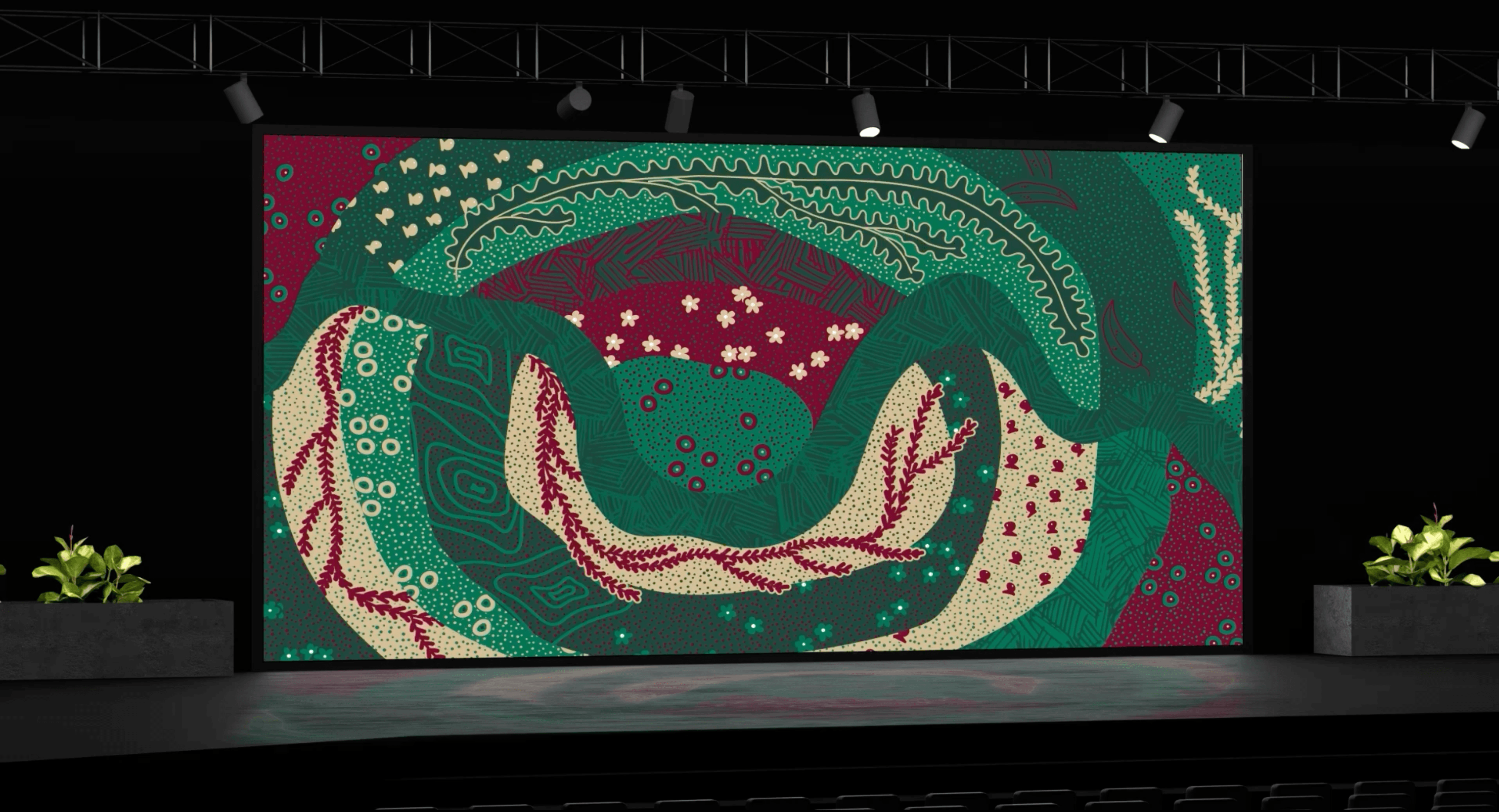
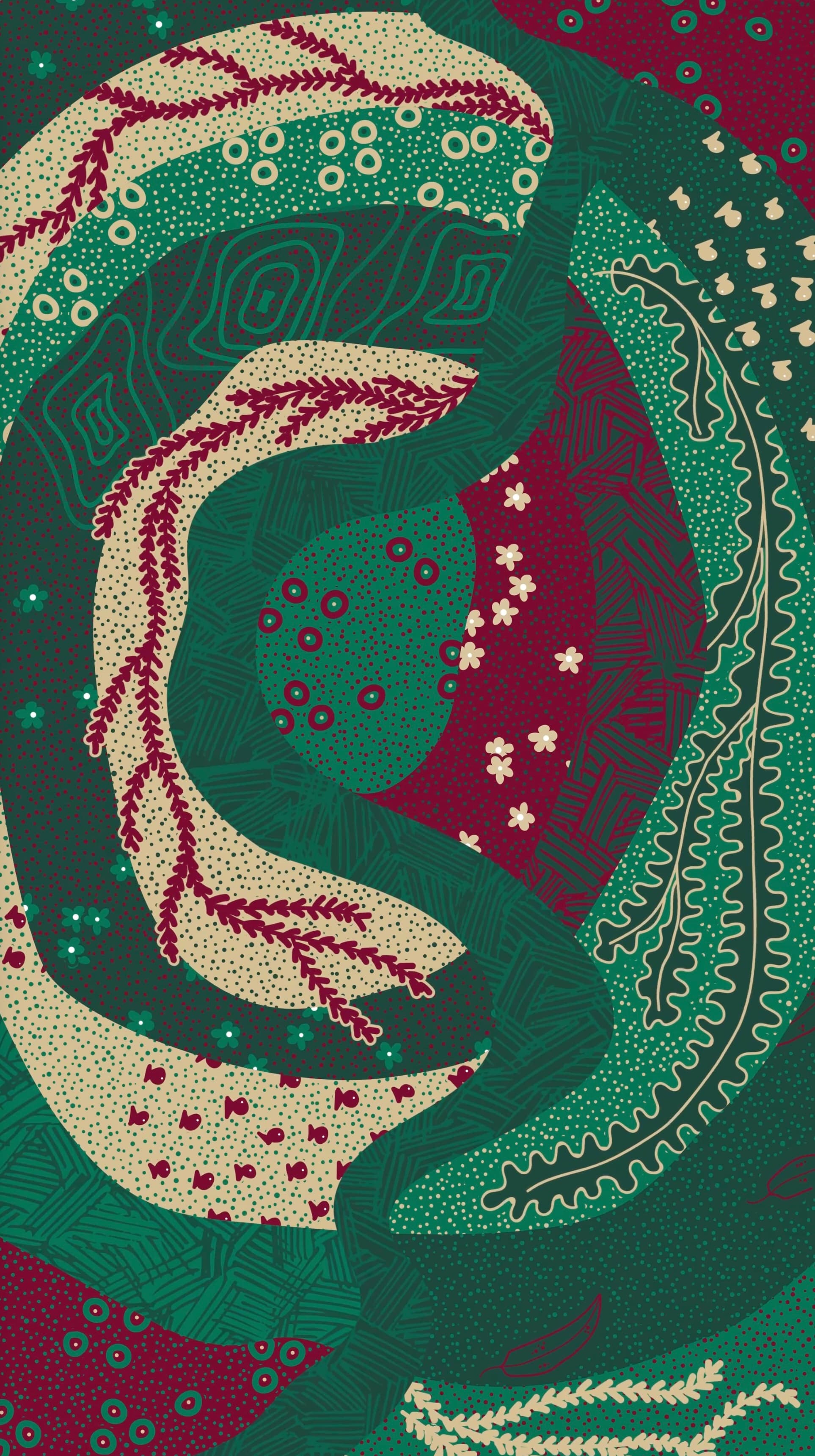
Commissioned by the Australian Government, Mude was engaged to create the motion-design experience for the Australian Pavilion at COP29, the United Nations Climate Change Conference. The pavilion needed to embody Brand Australia: modern, grounded, and deeply respectful of Country, while setting the tone for meaningful international dialogue. We approached the project as a brand-led creative challenge: how can a space feel distinctly Australian without cliché? Our role was to translate Kayannie Denigan’s My Country series into a living, breathing environment through light, motion, and rhythm — designed to echo the land, water, and sky — the elements that form the visual and cultural identity of this continent.
Australia at COP29
Australia arrived in Baku three years into a diplomatic push to host COP31 in 2026 in partnership with Pacific nations, which would be the first UN climate summit physically held in Oceania and the first delivered in partnership across an entire region. That bid shaped the whole posture of the Australian delegation through the two weeks of COP29. Minister Chris Bowen co-chaired the working group that landed the conference’s headline outcome: the New Collective Quantified Goal, a commitment to triple climate finance to developing countries to USD$300 billion per year by 2035. The Climateworks Centre framed COP29 as having extra significance for Australia precisely because of the COP31 bid riding alongside it.
Most of what Australia announced at the conference was Pacific-facing. A $50 million contribution to the Fund for Responding to Loss and Damage, making Australia the sixth-largest contributor to it. A $50 million Australia-Pacific Partnership for Energy Transition, launched mid-conference to help Pacific nations transition away from fossil fuels. Up to USD$200 million in loan guarantees through the Asian Development Bank’s Innovative Finance Facility for Climate in Asia and the Pacific. Bowen’s national statement opened by reaffirming First Nations inclusion in Australia’s climate response and named the ambition to bring COP to the Pacific for the first time since 2007. On the 19th of November, with the conference still running, the Alliance of Small Island States publicly backed the Australian bid and framed it as a Pacific COP.
The Australian Pavilion was in the Blue Zone of Baku’s Olympic Stadium and ran 52 events across the two weeks. First Nations panels, Pacific high-level dialogues, ministerial press conferences, state and industry showcases. The room was the venue where the case for Australia hosting COP31 got made in person, to delegates from the small island states, the Pacific Islands Forum, the WEOG group that would decide the bid, and the rest of the conference’s 198 country delegations.
Why this artwork
Kayannie Denigan is a Luritja artist based in Canberra. Her heritage spans the Luritja deserts of Central Australia, her Nanna’s Country, and the Kuku Yalanji rainforests and beaches of Cape York, her Nanny’s Country. The My Country series came out of a 2020 trip back to Central Australia, the first time the artist had been there since childhood. She started the series after viewing the country of her ancestors from a plane window, in her own words, “struck by the beauty of the harsh desert” and “the delineation of the shrubs, grasses, rocks and sand dunes” seen from the air. The artworks render Country from that aerial perspective, depicting landscape elements that the artist sees as connected through her relationship to them.
DCCEEW set out a narrative arc through the artwork as the brief: a desert appearing on a blank canvas, then a river running through, then greenery, then flowers of different species blooming in small groups, all of it set inside Denigan’s work as one continuous loop. The arc sits inside how Denigan describes seeing Country from the plane window. For a pavilion running 52 diplomatic events about Pacific partnership and First Nations leadership, the source material was part of the argument the room was making.
The animation
The loop cycled through DCCEEW’s arc with the desert holding the screen on opening, a river forming and running through, greenery arriving, and flowers and leaves appearing in small groups with their own watery, independent movement. Background dots travelled underneath throughout. The audio brief from DCCEEW pointed to William Barton’s Birdsong as a target — pairing Denigan’s work with another major Indigenous Australian piece in the same cultural register. When Barton’s piece couldn’t be secured, the brief shifted to a desert-wind soundscape sitting under the visuals, with DCCEEW handling the music their side.
A year after Baku, at COP30 in Belém, Australia conceded the formal host city of COP31 to Türkiye under a negotiated compromise. Türkiye will host the conference in Antalya in November 2026. Australia holds the COP31 negotiations presidency, which gives Bowen authority to manage the talks, prepare draft texts, and issue the summit’s cover decision. The Pacific will host the pre-COP gathering in Fiji and Tuvalu. The diplomatic effort the pavilion in Baku was part of has continued past the work playing on its screens.
Related Projects
View Project
Video, Campaigns
Defence Housing Australia
View Project
Video, Campaigns
Department of Health, Disability & Ageing
View Project

Video, Graphic Design
Department of Health, Disability and Ageing
View Project
Website
Tamworth Regional Council
View Project

Video, Photography
Department of the Prime Minister and Cabinet
View Project
Website
Australian Strategic Policy Institute
View Project
Video
Department of Health, Disability and Ageing
View Project
Video
Sport Integrity Australia
Frequently Asked Questions
Frequently asked questions
COP29 was the 29th UN Climate Change Conference, held in Baku, Azerbaijan, from 11 to 22 November 2024. Nearly 200 countries attended. The summit’s headline outcome was the New Collective Quantified Goal on climate finance — a commitment to triple finance flowing to developing countries to USD$300 billion per year by 2035.
The NCQG is the global climate finance target agreed at COP29. It commits to mobilise USD$300 billion per year by 2035 to support developing countries respond to climate change, triple the previous USD$100 billion goal. The agreement also calls for at least USD$1.3 trillion per year from all sources by 2035. Minister Chris Bowen co-chaired the working group that landed the agreement.
At COP30 in Belém, Brazil, in November 2025, Australia and Türkiye reached a compromise on the COP31 hosting arrangement after a year-long stalemate. Türkiye will host COP31 in Antalya in November 2026 and handle the formal presidency of the summit. Australia holds the COP negotiations presidency, and the Pacific hosts the pre-COP gathering in Fiji and Tuvalu earlier in 2026.
DCCEEW ran 52 events at the Australian Pavilion across the two weeks of COP29. The programming included First Nations panels, Pacific high-level dialogues, ministerial press conferences, state-level decarbonisation showcases, industry partnership events, and panels on subjects ranging from gender and climate to hydrogen, carbon capture, and clean energy finance. According to DCCEEW, thousands of delegates attended the pavilion’s events across the conference.
Kayannie Denigan is a Luritja artist based in Canberra. Her heritage spans the Luritja deserts of Central Australia (her Nanna’s Country) and the Kuku Yalanji rainforests and beaches of Cape York (her Nanny’s Country). She works predominantly in acrylic on canvas, drawing on a style passed down from her grandmothers and the iconic dots and symbols of Central Australia. Denigan grew up in the Cape York community of Hope Vale.
DCCEEW set out a narrative arc for the animation: a desert appearing on a blank canvas, then a river running through, then greenery, then flowers of different species blooming in small groups. Mude animated Denigan’s My Country series through that arc as one continuous loop, running on the Australian Pavilion’s screens for the two weeks of the conference.
Event motion design is animated visual content created for live events: keynote backdrops, conference screens, pavilion content, stage visuals, sponsor reels. It needs to perform on large-format screens (often 4K and above), hold a room’s attention without overwhelming the speaker or content, and sit in the cultural register of the event. The Australian Pavilion at COP29 — designed by Sydney and Canberra brand and creative agency Mude — is an example: a single seamless loop animating Indigenous artwork as the visual setting for two weeks of diplomatic events.
Australia has run a pavilion at COP summits since the early UNFCCC conferences. Each year the Australian Government operates a pavilion in the COP Blue Zone — the formal negotiating area — to host events, build international partnerships, and showcase Australian progress on climate. The visual and creative identity of the Australian Pavilion typically reflects the year’s themes and the country’s specific positioning. At COP29, that identity was designed by Mude, grounded in First Nations art, with the programming agenda built around Pacific partnership.
A small number of Sydney brand and creative agencies have meaningful track records on Australian Government and institutional creative work. Mude is one: recent government projects include brand motion design for the Australian Pavilion at COP29 (DCCEEW), film and brand work for the Sydney Energy Forum (Department of Prime Minister and Cabinet), creative for Sport Integrity Australia, campaign work for the National Careers Institute (Department of Education), and data visualisation work for the Australian Strategic Policy Institute. The Canberra studio supports the agency’s federal government engagements.
Australia’s main commitments at COP29 were a $50 million contribution to the Fund for Responding to Loss and Damage (making it the sixth-largest contributor), a $50 million Australia-Pacific Partnership for Energy Transition to help Pacific nations move away from fossil fuels, up to USD$200 million in loan guarantees through the Asian Development Bank, and a new climate and energy partnership with the United Kingdom.
Australia bid to host COP31 in 2026 in partnership with Pacific nations. The intent was to bring the world’s largest climate summit physically to Oceania for the first time and to centre the agenda on the Pacific, the region most exposed to climate impacts. The bid had been underway for three years by the time of COP29 in Baku.
The Australian Pavilion at COP29 sat in the Blue Zone of Baku’s Olympic Stadium. It served as the venue for the Australian Government and partners to host events, build international partnerships, showcase Australia’s progress on climate, and advance Australia’s priorities through the two weeks of the conference. DCCEEW describes the pavilion as a home-away-from-home for Australians attending COP. The pavilion ran 52 events in total.
The brand motion design for the Australian Government’s COP29 pavilion was created by Mude, a strategic brand and creative agency in Sydney and Canberra. Mude was commissioned by the Department of Climate Change, Energy, the Environment and Water (DCCEEW) to translate Kayannie Denigan’s My Country series into the animated visual content that ran on the Australian Pavilion’s screens for the two weeks of the conference in Baku in November 2024.
My Country is a body of work by Kayannie Denigan, started after a 2020 trip to Central Australia, the first time the artist had returned to the country of her ancestors since childhood. The series depicts Country from an aerial perspective, drawing on what Denigan saw from a plane window of the desert, rivers, plants, and flowers of her ancestral land. The artist describes being struck by “the beauty of the harsh desert” and “the delineation of the shrubs, grasses, rocks and sand dunes” seen from the air.
Brand motion design is animated visual content created as an extension of a brand’s identity. A brand motion design agency applies a brand’s positioning, narrative, and visual language to moving content, campaign animations, title sequences, event loops, website motion, social content, broadcast assets, and motion identity systems. The work is led by brand strategy. Design choices are shaped by what the brand stands for and the audience it speaks to, with technical animation craft serving that strategic frame.
“Brand Australia” is the shorthand for how Australia presents itself to international audiences across trade, diplomacy, tourism, culture, education, and investment. At events like COP, it shapes the visual, verbal, and cultural register the country uses to communicate priorities and posture. The Australian Government’s Nation Brand work and individual departmental brand expressions (DFAT, Austrade, DCCEEW, and others) all sit within the wide Brand Australia framing.
Mude’s government and institutional portfolio spans the Australian Strategic Policy Institute (data visualisation platforms on global disinformation operations and the critical tech race), Sport Integrity Australia (anti-doping campaign creative for young athletes), the National Careers Institute (campaign creative for the Department of Education reaching school leavers), the Embassy of France in Australia (SacreBleu cultural web platform), and the COP29 Australian Pavilion (DCCEEW motion design). The work crosses film, brand identity, motion design, data visualisation, and digital platforms.
A growing number of Australian brand and creative agencies work in the climate, energy, and sustainability space. Mude’s climate-related brand work includes the Australian Government’s Pavilion at COP29 (DCCEEW), the Sydney Energy Forum (Department of Prime Minister and Cabinet), Sunstrata (a solar disruptor rebrand), NextOre (a CSIRO commercialisation in clean mineral extraction), and Worldview (a social enterprise with a $10bn positive-impact vision). Climate-adjacent brands typically need positioning that signals credibility to commercial, government, and community stakeholders simultaneously.