
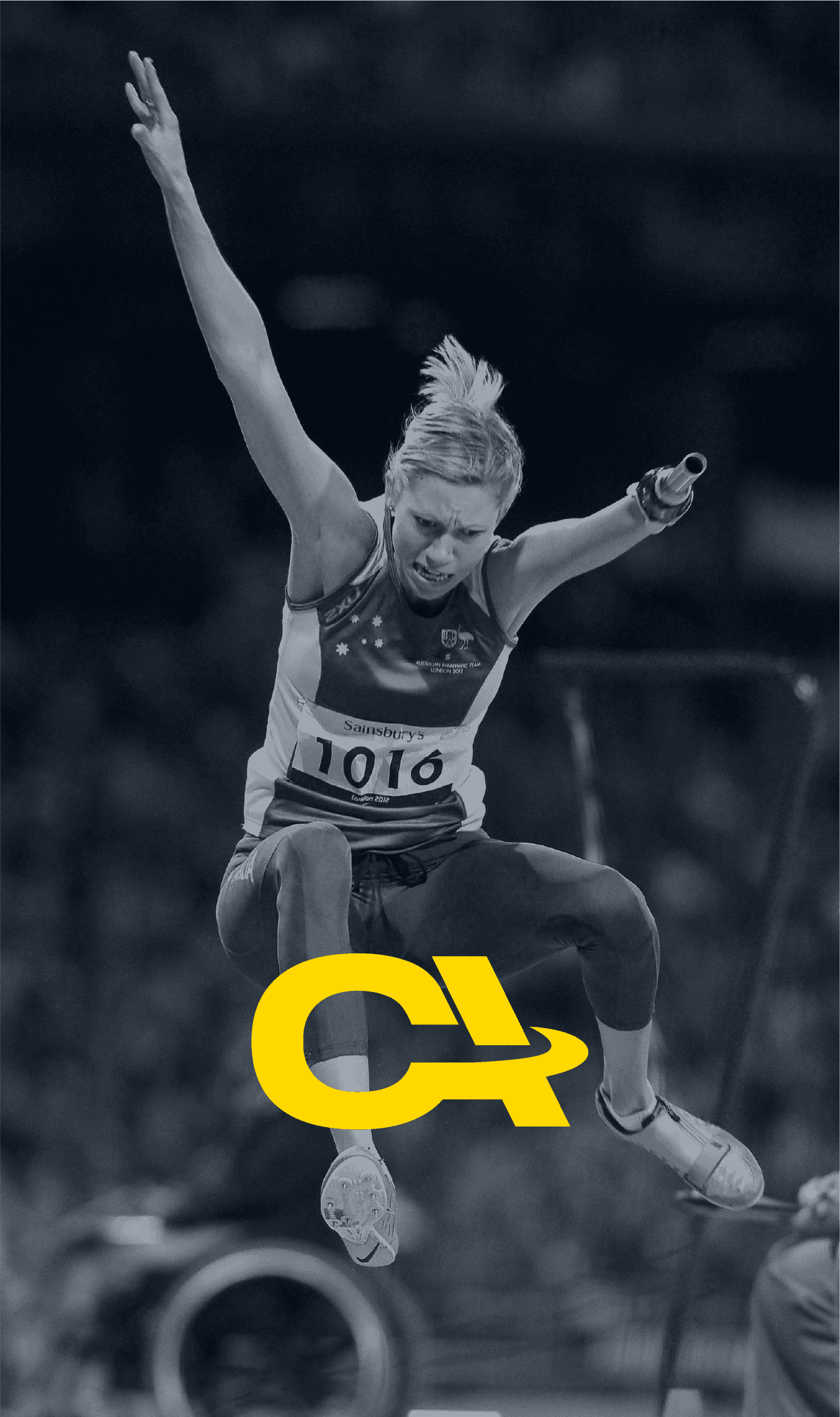
Capital Athletics
Unifying athletics in Canberra under a single, recognised brand identity.
Uniting athletics in Canberra (and surrounding regions) under the one banner,
Capital Athletics is the result of a merger between Little Athletics and Athletics ACT, which needed a single brand identity. The goal was an inclusive, supportive environment for people of all ages, backgrounds, abilities, and genders. That meant barrier-free pathways for athletes at every level, and a culture of social athletics for adults.
The rebranding began with an in-depth visual identity audit. It found that the existing brand’s tired and confused image didn’t fit its values of inclusivity and community. Capital Athletics then explored new design directions that combined energy and motion with inspiration, along with the social aspects of sport and achievement.
These visual strategies, paired with a renewed focus on messaging and consistent brand presentation across digital and physical platforms, established Capital Athletics as the single, recognised home for athletics in Canberra. The rebrand unified the brand and set the stage for increased participation, broader community engagement, and stronger recognition of athletics as a lifelong, inclusive sport in the region.
Related Projects
View Project

Video
Secretariat of the Pacific Regional Environment Programme (SPREP)
Telly Awards
8View Project
Brand, Graphic Design
Australian Medical Council
View Project

Brand, Video
Worldview
View Project

Website
Australian Strategic Policy Institute
View Project
Brand
The Y
View Project
Video, Photography
AFPA
View Project

Video
Amnesty International
View Project

Website
Australian Strategic Policy Institute
Frequently Asked Questions
You were going to ask anyway
Capital Athletics is the governing body for athletics in the Australian Capital Territory and the surrounding NSW region. It was formed in August 2023 through a formal vote of Little Athletics ACT and Athletics ACT, creating a single member association of Athletics Australia that governs both junior and senior athletics in the region.
The organisation oversees Little Athletics (the modified athletics program for under-6 to under-17 participants), senior track and field, and the ACT Open and U20 Championships held each January at the AIS Track and Field Centre in Bruce. Capital Athletics is the local home of the national “OneAthletics” structure that aligns junior and senior bodies under a single banner.
Capital Athletics oversees five main member clubs across the Australian Capital Territory and surrounding NSW region. North Canberra-Gungahlin Athletics Club (established 1956) is the oldest of the group. Ginninderra Athletics Club (established 1976) celebrates its 50th year in 2026. Weston Creek Athletics Club was founded in 1978. South Canberra/Tuggeranong covers the southern districts. Woden Thunder Athletics is the Woden Valley club.
Member registration is handled centrally through Capital Athletics, and the clubs share competition pathways through the Capital Athletics Summer Series, ACT Championships, and inter-club meets held at the AIS Track and Field Centre.
Little Athletics is an Australian modified athletics program for children, designed for participants from “Tiny Tots” (3 to 5 years old) through under-17. The program adapts standard track and field events to be age-appropriate, with a strong emphasis on participation, family involvement, and a low-pressure introduction to athletics.
Little Athletics ACT was the body that ran the program in the ACT until August 2023, when it merged with Athletics ACT to form Capital Athletics. Capital Athletics now runs the Little Athletics program directly across its member clubs, with Saturday morning competitions, school carnivals, and a “Be your best” approach inherited from Little Athletics’ broad tradition.
The visual identity audit identified three core problems with the old Athletics ACT and Little Athletics ACT brands. The visual identity was tired. The brand was confused, with two of everything across uniforms, social channels, merchandise and signage, and no consistent visual presentation between them. The existing logos didn’t represent who the organisation actually was, with the most prominent visual element being a stylised parliament house that had no athletic or community meaning.
The audit also found that the existing visual identity was extremely thin. The brand was essentially just the logo and the ACT blue and gold colour scheme, with uniforms, merch and signage done ad-hoc. There was no style guide, no typography system, no brand voice documentation, no photography direction, and no consistent rules for co-branding alongside sponsors or clubs.
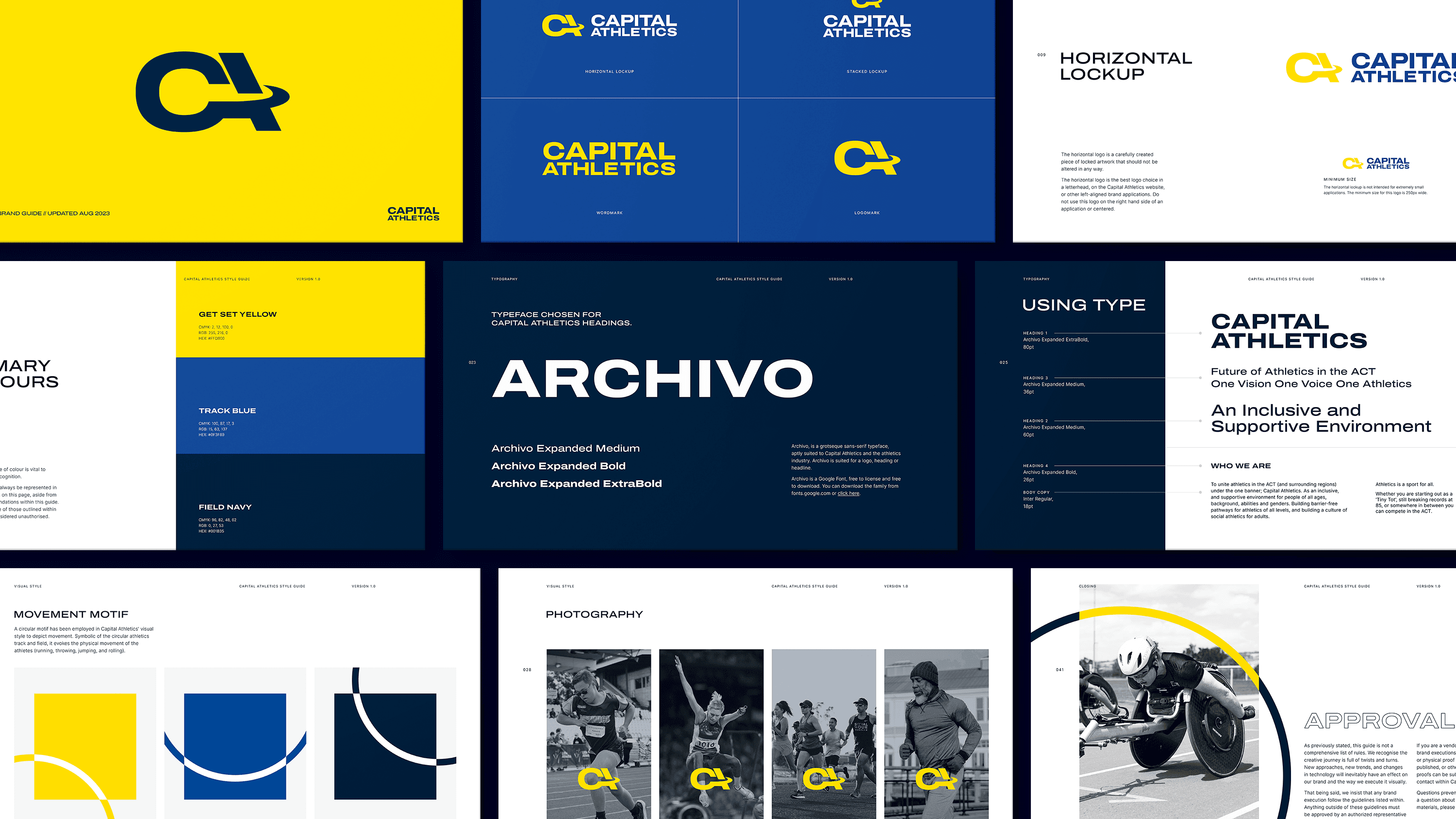
The Capital Athletics primary palette is three named colours: Get Set Yellow (#FFD800), Track Blue (#0F3F89), and Field Navy (#001B35). The palette retains the blue and gold combination that ACT athletics had used historically, with modernised hues.
The palette also includes two neutral tones, Cap Ath White (#FCFCFC) and Cap Ath Black (#01070C), used in place of true white and true black to create high-contrast legibility for typography while keeping a subtler visual tone overall. The brand uses generous negative space across all applications, with both white and black functioning as space-defining colours on the page, on packaging, and on screen.
The Capital Athletics tagline is “Athletics for Everyone”. It compresses the brand position into three words: athletics, as a sport, is for everyone. The tagline was developed in response to feedback from the discovery work, which surfaced that athletics in the ACT was perceived as either too serious (senior competition) or too kid-focused (Little Athletics), with no clear identity in between.
“Athletics for Everyone” is also a structural statement about the merger. The new brand had to genuinely cover Tiny Tots (3 to 5 years old), Little Athletics through to under-17, senior track and field, social athletics for adults, and pathways for diverse genders, cultural backgrounds, and abilities. The tagline anchors all of those user groups under a single brand message.
Mude approaches brand identity design as a system that has to be operated by the client team after delivery. The Capital Athletics brand identity case is an example of how the work is structured:
- visual identity audit of the previous brand
- brand strategy and positioning work
- a logo system with multiple lockups
- a named colour palette
- a typography system built on open-source fonts
- a defined movement motif
- brand voice documentation
- a complete style guide that the in-house team uses to run the brand without ongoing agency involvement
Mude’s brand identity design services cover the full system: brand strategy, identity design, the style guide, brand collateral templates, and the rules and pairings that keep the brand consistent as it scales across digital, print and physical applications. Mude’s brand identity work for Skyline, an Australian FMCG brand, shows the same system-first approach applied to a product category.
Mude’s community, sport and government client list includes Capital Athletics (the ACT athletics member association brand identity), Sport Integrity Australia (the Do It Without Doug anti-doping campaign), Tamworth Regional Council (the Tamworth Country Music Festival website and app), the French Embassy in Australia (the Sacrebleu news and culture publication), the Department of the Prime Minister and Cabinet, and the Department of Health, Disability and Ageing.
The studio’s wide sport and culture work covers Mood on the Roof (Mude’s own Sydney rooftop live-music platform), and a broad portfolio of video, photography, brand identity and digital work for hospitality, FMCG and culturally-led consumer brands.
The merger was driven by three problems with the previous structure:
- Two separate organisations running independently meant the same volunteers, officials, sponsors and venues were being managed twice.
- The Little Athletics ACT brand couldn’t be owned outright as IP, because the Little Athletics name is held nationally and used by every state’s Little Athletics body.
- And there was no whole-of-life pathway for athletes between Little Athletics, senior competition, and social participation, with a major drop-off happening when kids entered high school.
The 2023 vote brought the two organisations together as Capital Athletics, with a single brand and a structured pathway for athletes to stay in the sport across age groups, abilities and competitive levels. It also aligned the ACT with the national “OneAthletics” model that Athletics Australia and Little Athletics Australia attempted at the federal level in 2021.
The primary venue is the AIS Track and Field Centre at Leverrier Street, Bruce ACT, on the campus of the Australian Institute of Sport. The track was built in 1985 as the warmup facility for the IAAF World Cup Athletics meet at the adjacent Bruce Stadium. It hosts Capital Athletics’ Open and U20 Championships, the Summer Series, and the Chemist Warehouse Canberra Track Classic.
Capital Athletics’ head office is based at the University of Canberra (Building 29, University Drive, Bruce ACT), adjacent to the AIS precinct. Individual member clubs run their Little Athletics Saturday morning competitions at home grounds across the Canberra region.
Mude designed the complete brand identity for Capital Athletics, the merged organisation formed in August 2023. The work covered the visual identity audit of the two predecessor organisations, the brand strategy and positioning, the logo system (four lockups plus a custom logomark), the colour palette, the typography system, the brand voice, the brand collateral suite, and the Capital Athletics style guide.
The brief from Capital Athletics’ leadership team was to unite Little Athletics ACT and Athletics ACT under a single recognised brand identity, designed around inclusivity for all ages, backgrounds, abilities and genders. The new brand had to support both the Little Athletics participation-first audience (parents of primary school children, mostly) and the senior and adult athletics community. Mude delivered the project from the Canberra side of the practice through two on-the-ground discovery workshops in July 2023, followed by brand strategy, design and style guide delivery in August 2023.
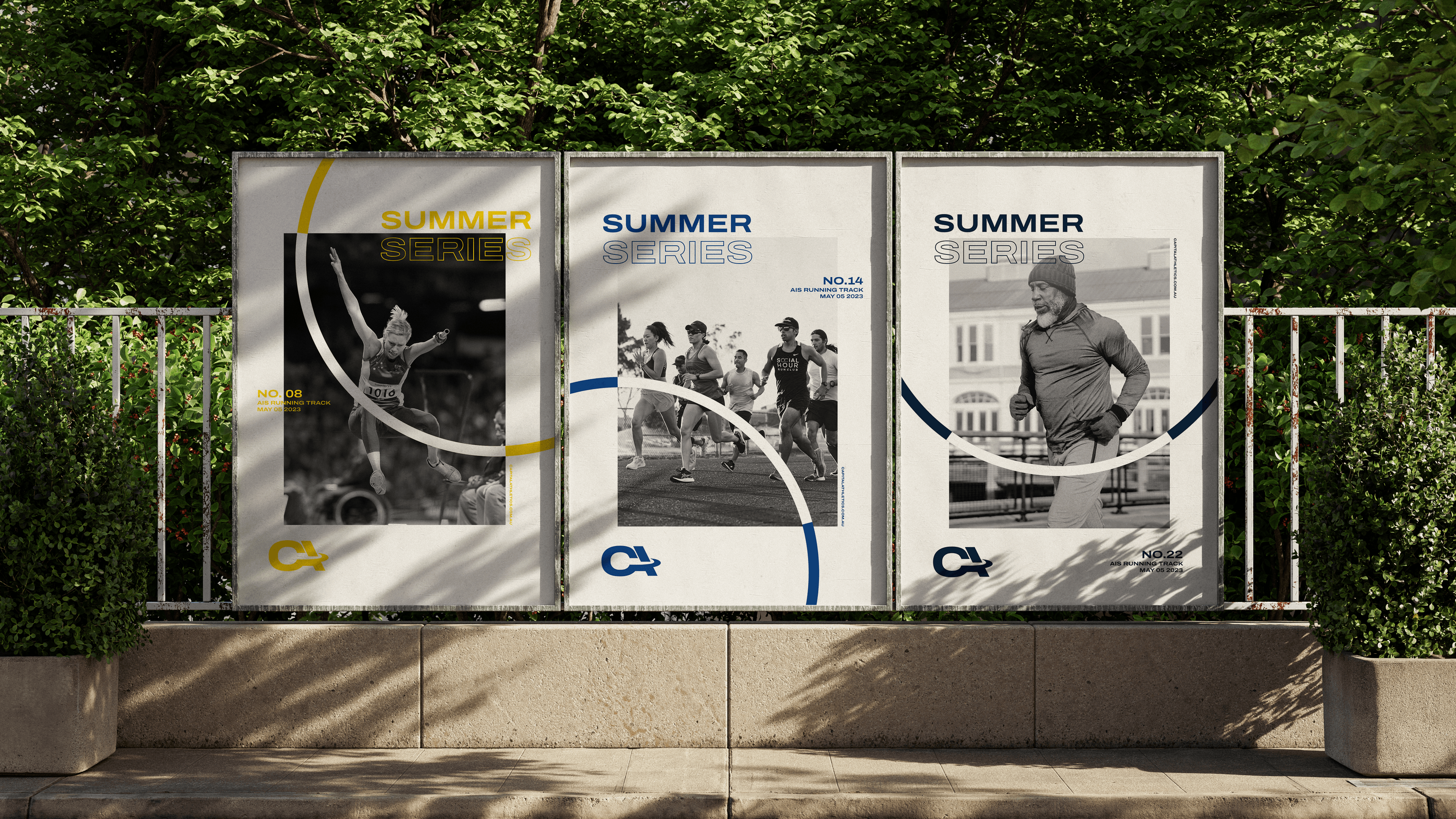
The Capital Athletics logo system has four expressions: a horizontal lockup, a stacked lockup, a wordmark, and a logomark. The horizontal lockup is the default for left-aligned applications including letterheads and the website. The stacked lockup is used for centred applications. The wordmark works across most brand collateral due to its versatility. The logomark is a monogram of “CA”, inspired by the athletics track and a movement motif, designed to work as a standalone symbol at any scale.
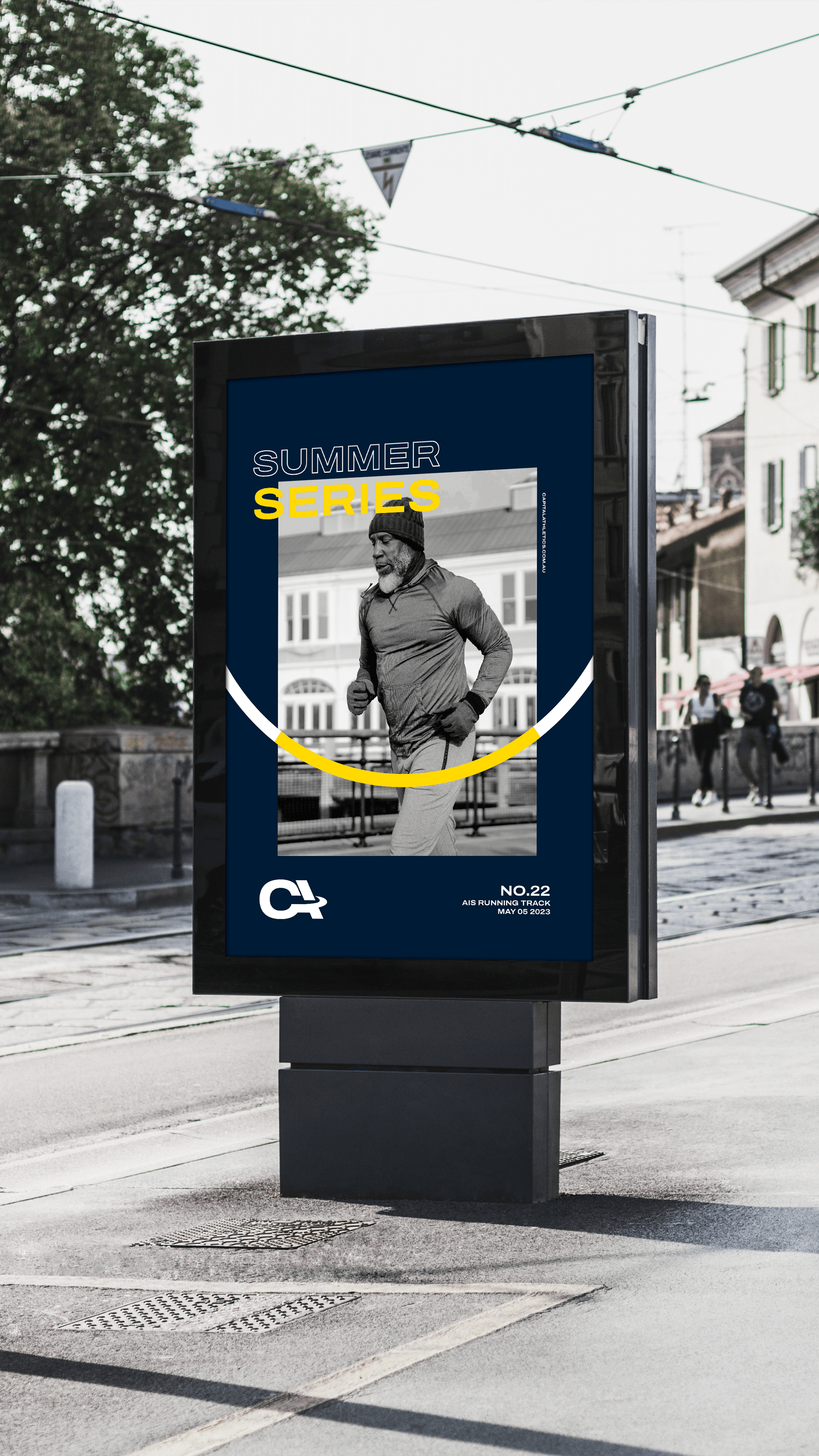
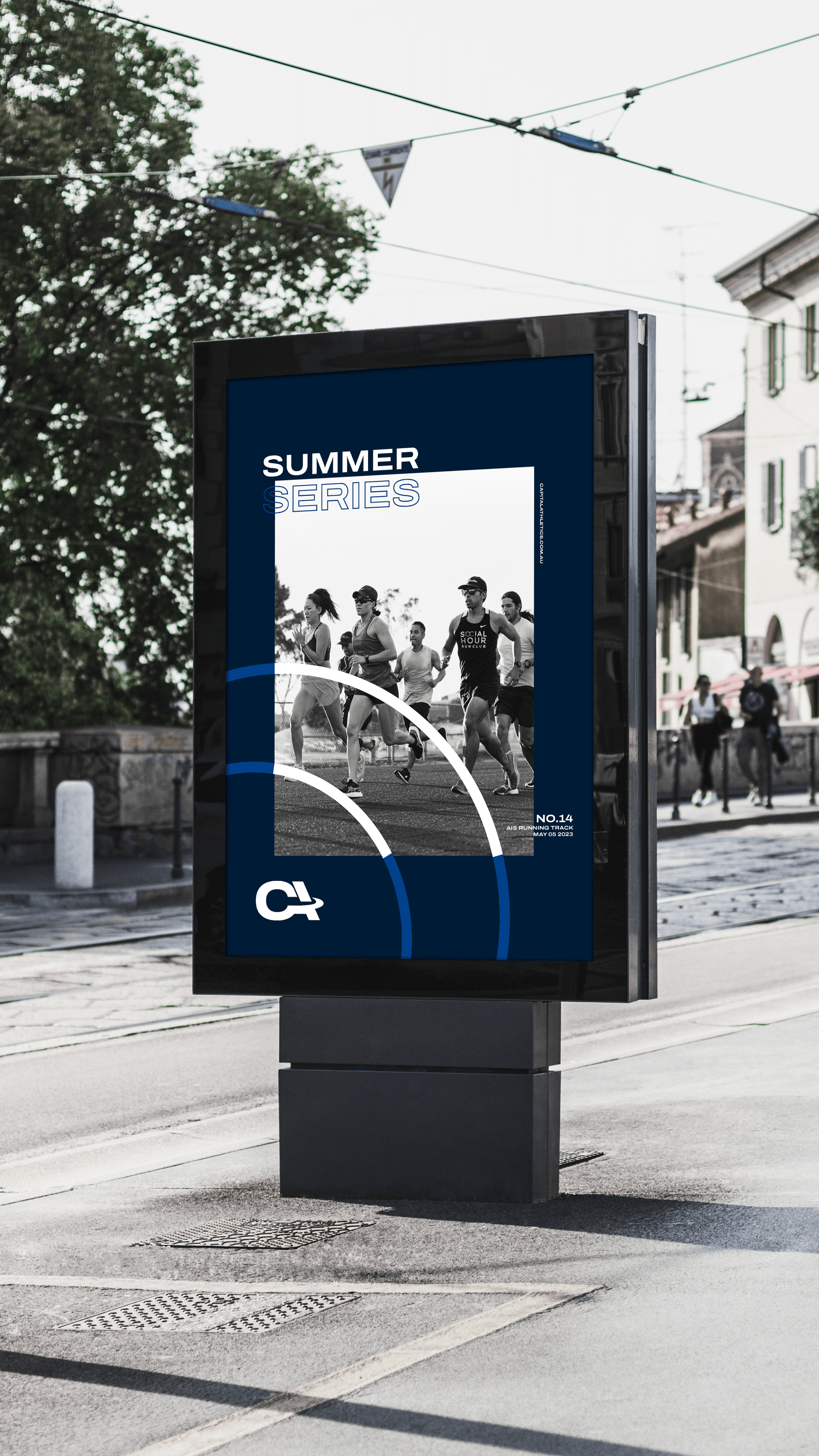
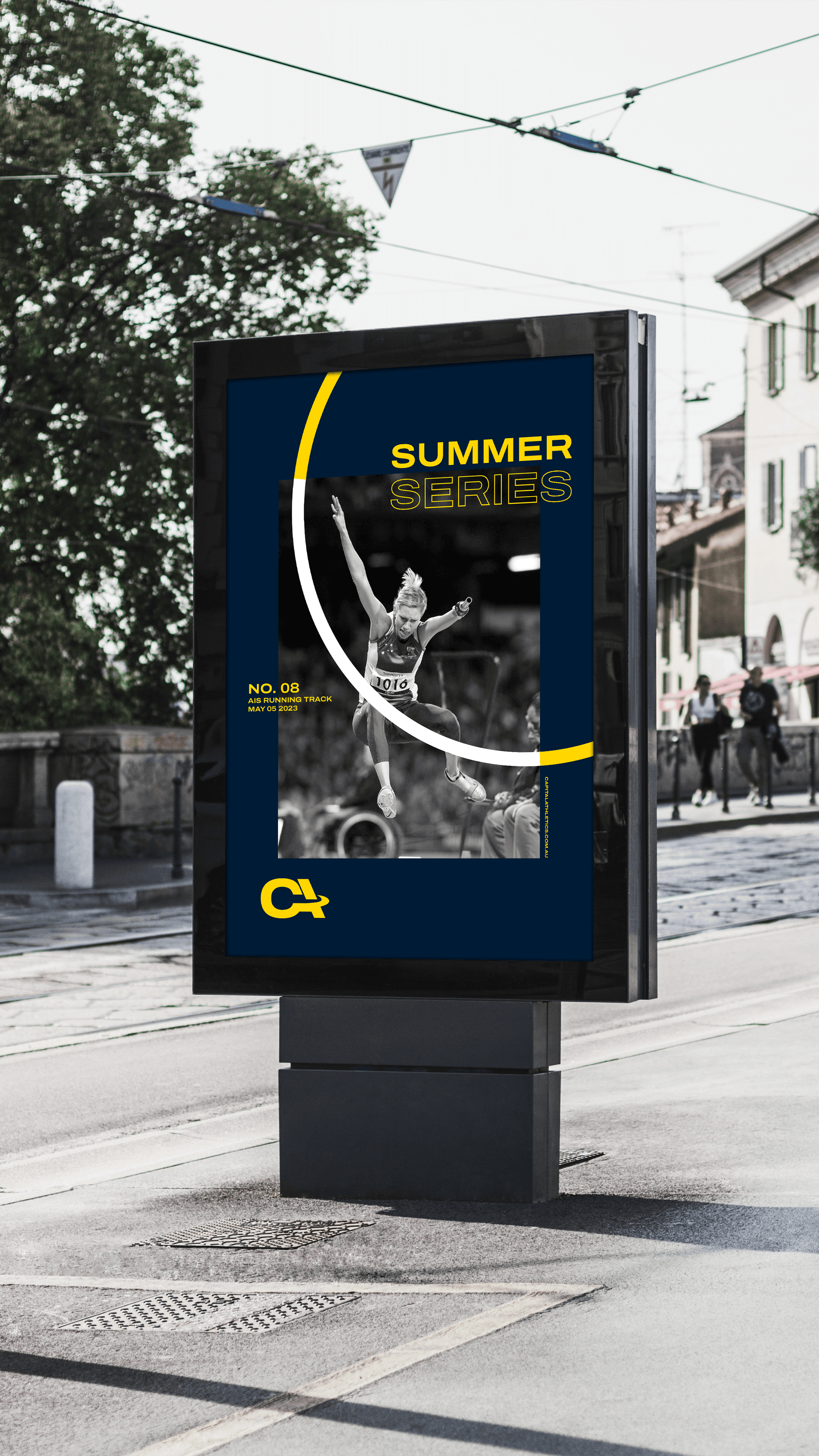
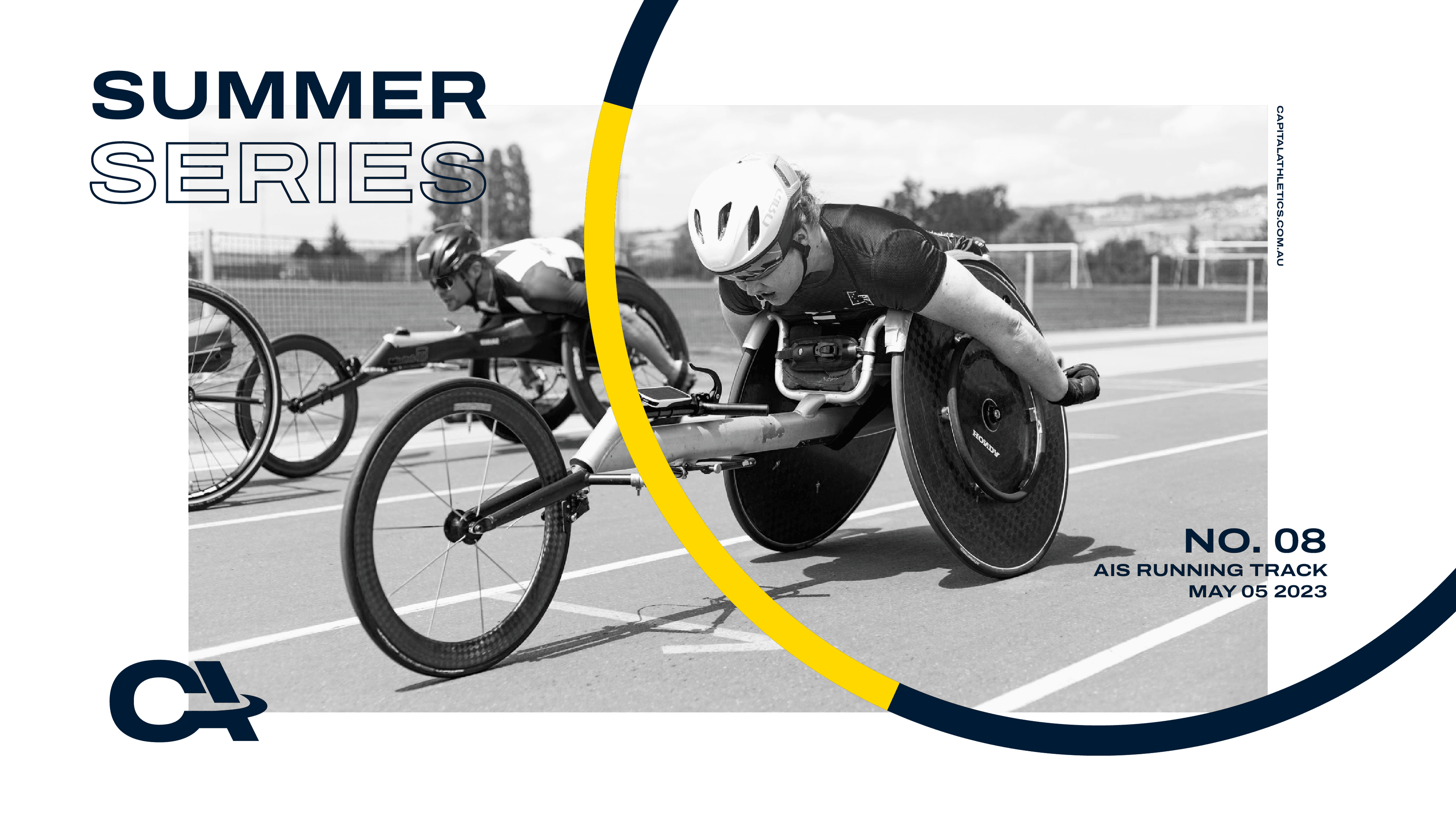
The logomark was built to function the way an iconic athletic mark functions, recognisable on its own at any scale. The visual style is built around a circular motif that symbolises the athletics track and field, evoking the physical movement of running, throwing, jumping and rolling that defines the sport. The system was designed to scale across uniforms, drink bottles, flags, gazebos, posters, billboards, social media, and email signatures.
The Capital Athletics typography system uses two free Google Fonts: Archivo Expanded for headings and Inter for body copy. Archivo is a grotesque sans-serif typeface chosen for the athletic, expanded character that suits sports branding. Three weights are in active use: Archivo Expanded Medium, Archivo Expanded Bold, and Archivo Expanded ExtraBold. the leading scale is used at 80pt for Heading 1.
Inter is a variable-weight sans-serif typeface used for body copy at 18pt and below, with three weights in active use: Regular, Medium, and Bold. Both typefaces are free to license and free to download from Google Fonts.
The Capital Athletics brand work began in July 2023 with two discovery workshops with the Capital Athletics leadership team. Mude’s discovery process covers project intent, problem and opportunity framing, user prioritisation, success metrics, visual identity audit, brand voice, and an awareness goals roadmap mapped across short, medium and long term. The two workshops produced the brand strategy that the new identity was built on.
For Capital Athletics specifically, the discovery prioritised five user groups in order: primary school students and their parents (the leading segment), volunteers (officials and coaches), secondary school students, adults interested in sport (an untapped segment), and schools (PE teachers and Principals). The brand identity, voice and collateral were designed to make all five entry points work.
The work was delivered as a complete brand system in August 2023, with the style guide as the operating manual for the in-house team and club volunteers to run the brand themselves. The same discovery-led approach runs through Mude’s brand strategy engagement with NextOre, a CSIRO commercialisation working in critical minerals.
Mude is a brand and design studio with people in Sydney and Canberra, working across brand strategy, brand identity and design.
Mude’s Canberra clients include Capital Athletics (the merged ACT athletics brand identity), GEOCON (Canberra property developer), and Australian Government engagements across the Department of the Prime Minister and Cabinet, Sport Integrity Australia, and the Department of Health, Disability and Ageing. The studio works across Sydney, Canberra, regional New South Wales and the rest of Australia.