
Australian Strategic Policy Institute
Visualising global disinformation & information operations with ASPI
Building the reference platform for the Australian Strategic Policy Institute’s research on global disinformation and information operations
A custom website and CMS for ASPI’s International Cyber Policy Centre, built to publish, visualise, and citably reference the state-attributed disinformation campaigns Twitter has taken down since 2018. It presents analysis of more than 85,000 accounts and 207 million tweets across 17 country datasets. The site is now cited from 78 referring domains and 367 backlinks, including six major international think tanks.
Our approach involved working backwards from the data-sets the ASPI team had generated from Twitter’s takedowns. We developed ways to visualise snapshots of activity, the types of campaigns run, and where the accounts behind them might have originated from. After our project discovery, design, development stages we continued with a short launch campaign. It led to 400k+ targeted impressions and thousands of global visitors to the site.
- 17
- Country snapshots published
- 85,000+
- State-attributed accounts analysed
- 207m+
- Tweets covered in the analysis
- 400k+
- Targeted impressions at launch
The brief
In August 2021, the Australian Strategic Policy Institute’s International Cyber Policy Centre approached Mude about a project sitting inside its ongoing research program on information operations and disinformation campaigns. The team had been working through Twitter’s Information Operations archive, the open dataset of state-attributed disinformation campaigns Twitter has taken down since 2018. They needed a website to publish the work in a form that could actually be used by the people for whom it was being written.
The analysis was running in two strands.
Written country snapshots assessing each state actor’s intent, targeting, tactics, and capabilities. And a layer of analysed data: timelines of account creation, tweeting activity, geographies most frequently mentioned, and network diagrams of how accounts connected to one another. The dataset was open.
The analytical capability was ASPI’s. The missing piece was the publishing surface, somewhere readable, somewhere citable, somewhere that could carry the interactive visualisations without breaking under the weight of either the data or the people who’d rather it didn’t exist.
Discovery
ICPC’s audience was specific: policy makers, government analysts, academic researchers, journalists, and private-sector security analysts, in Australia and internationally. The success metric, in ICPC’s own framing, was that the work was being cited and used by the people whose decisions it was meant to inform. The website needed to make that easy.
User prioritisation came out as government policy makers and practitioners first, their mentions, citations and decisions were the highest-impact form of evidence that the research was landing. Government analysts second, working with the data as primary input to advisory and intelligence work. Academic researchers third. Journalists fourth, referencing it in current-affairs coverage. Private-sector security and data analysts fifth.
The functional requirements included:
- country snapshot pages with top-line statistics
- account creation timelines
- tweeting activity timelines
- textual summaries of state-actor intent and capability
- an interactive map of the geographies these campaigns most frequently mentioned
A citation builder so policy makers and journalists could reference the work without hand-constructing citations, which was a friction point that had cost previous ICPC projects time. PDF downloads of country snapshots for offline circulation through government channels where webpages don’t go. CSV downloads of underlying data for analysts who’d rather work with the raw numbers.
Key takeaways at the top of each page for readers who needed the bottom line first. A flexible CMS architecture that would let the analyst team add new country pages as the archive grew.
The values ICPC named in the workshops including truthfulness, factualness, impartiality, and transparency, translated into a specific brief for design and copy. Nothing on the page should overstate the analytical rigour underneath it. The wording of headings, the labelling of charts, the framing of takeaways, all of it had to read like analysis, not advocacy.
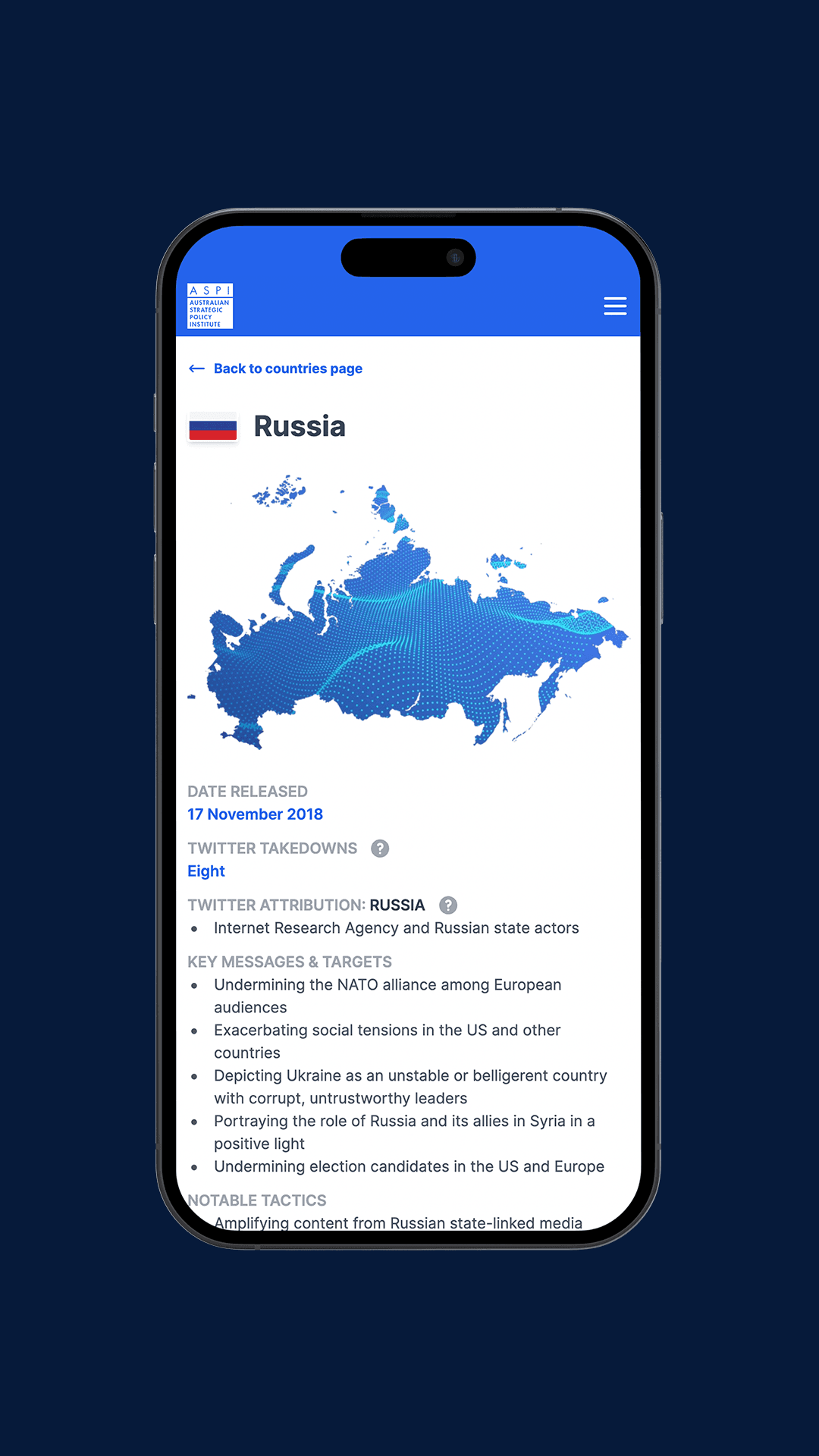
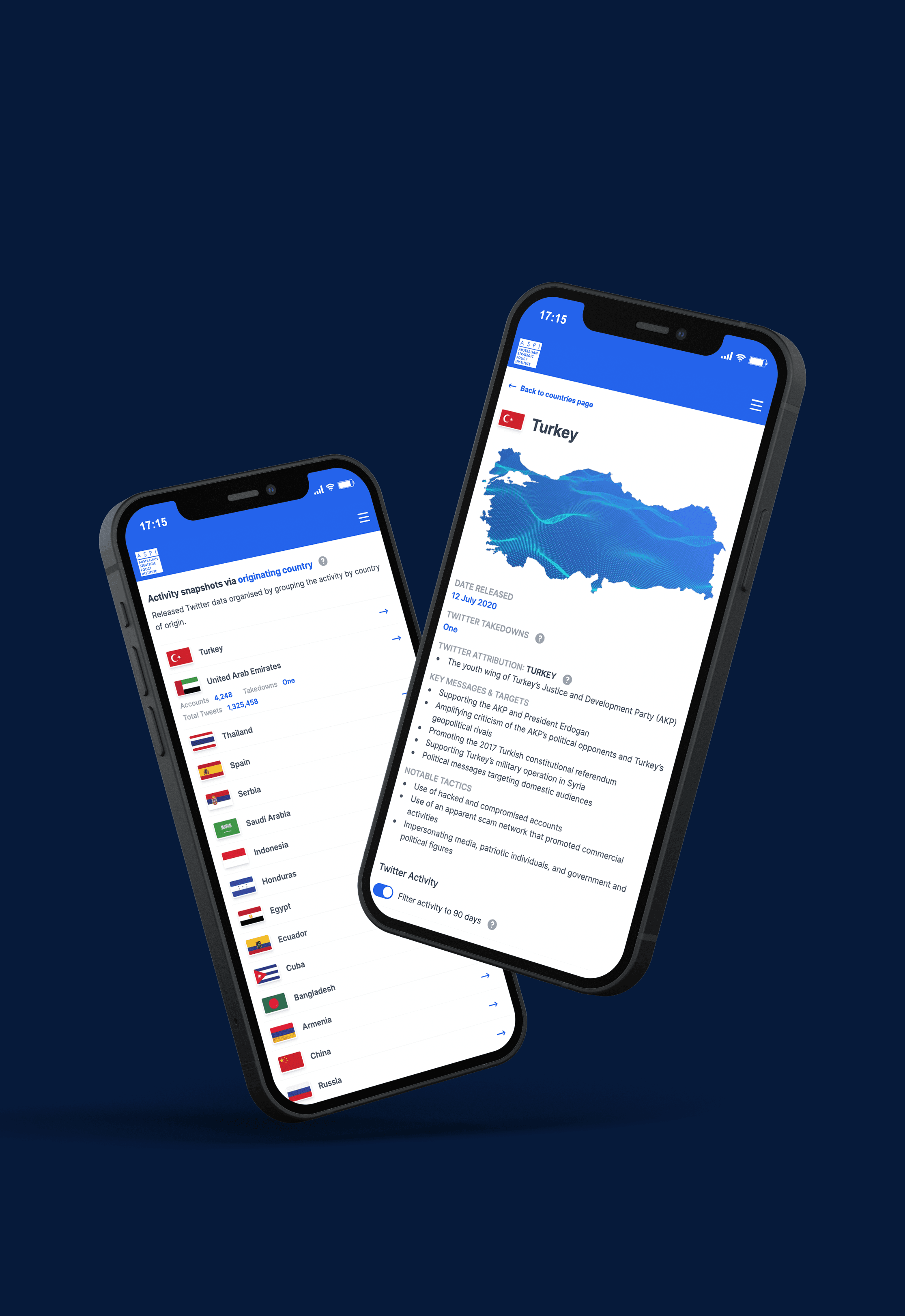
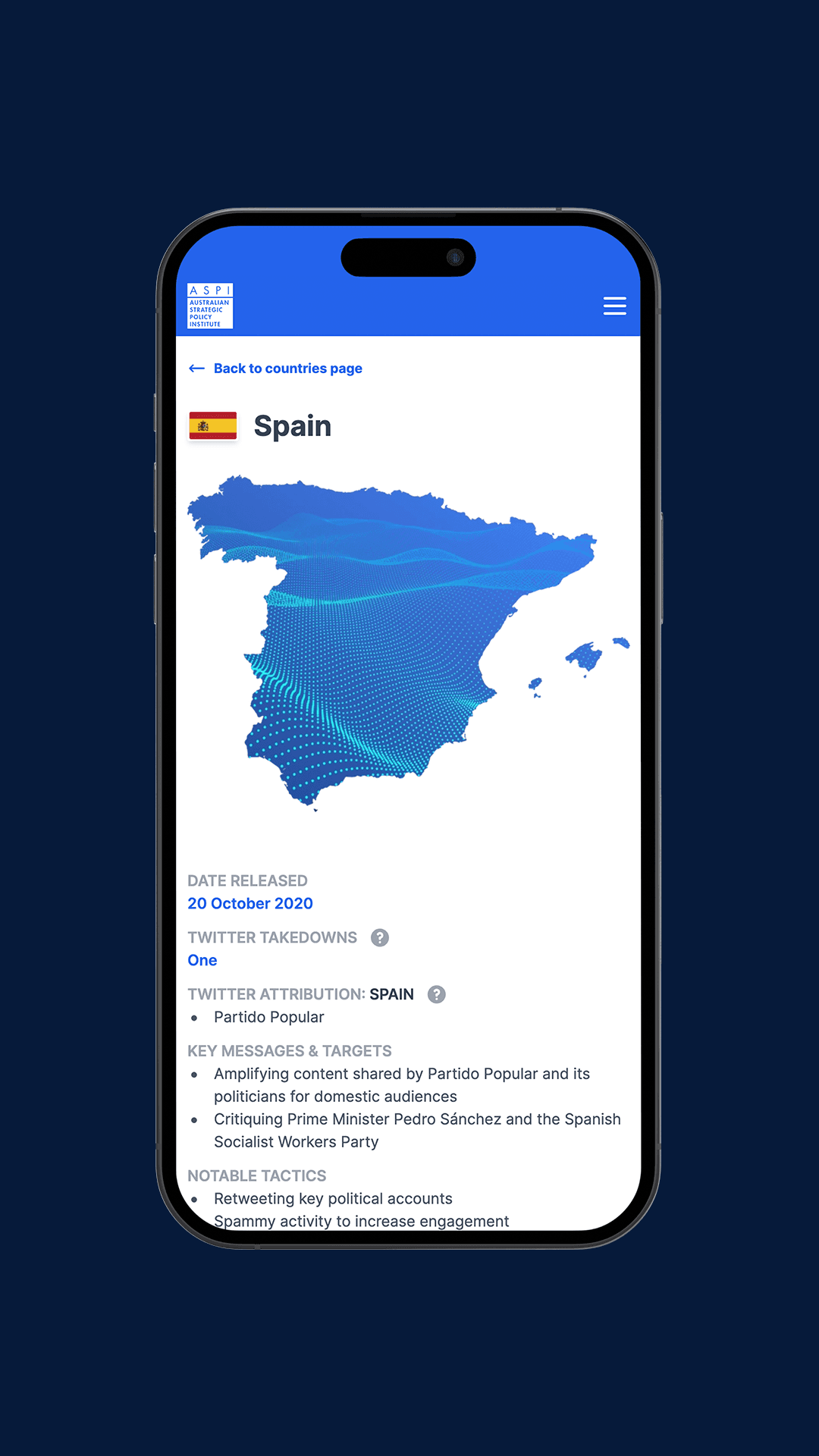
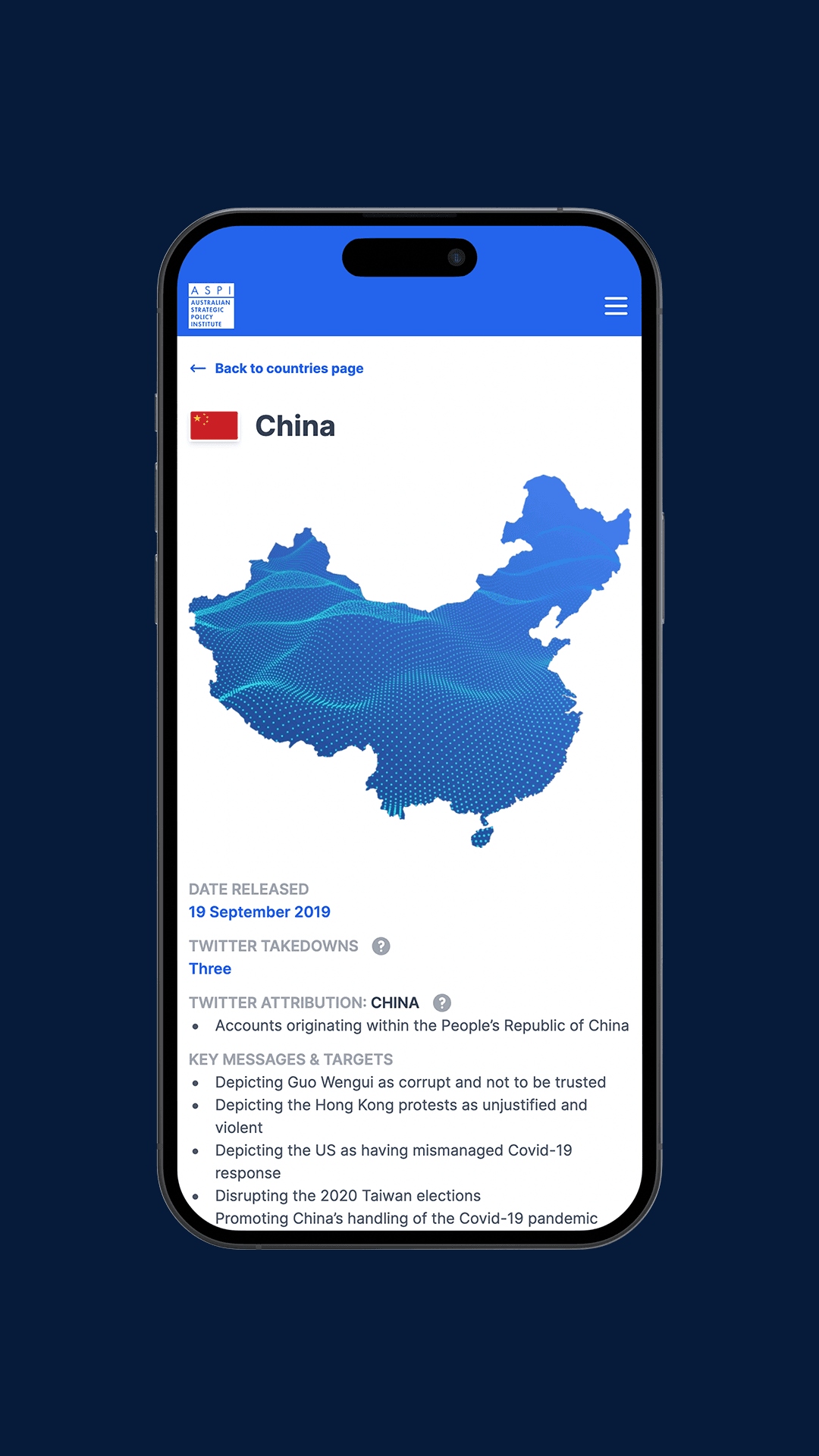
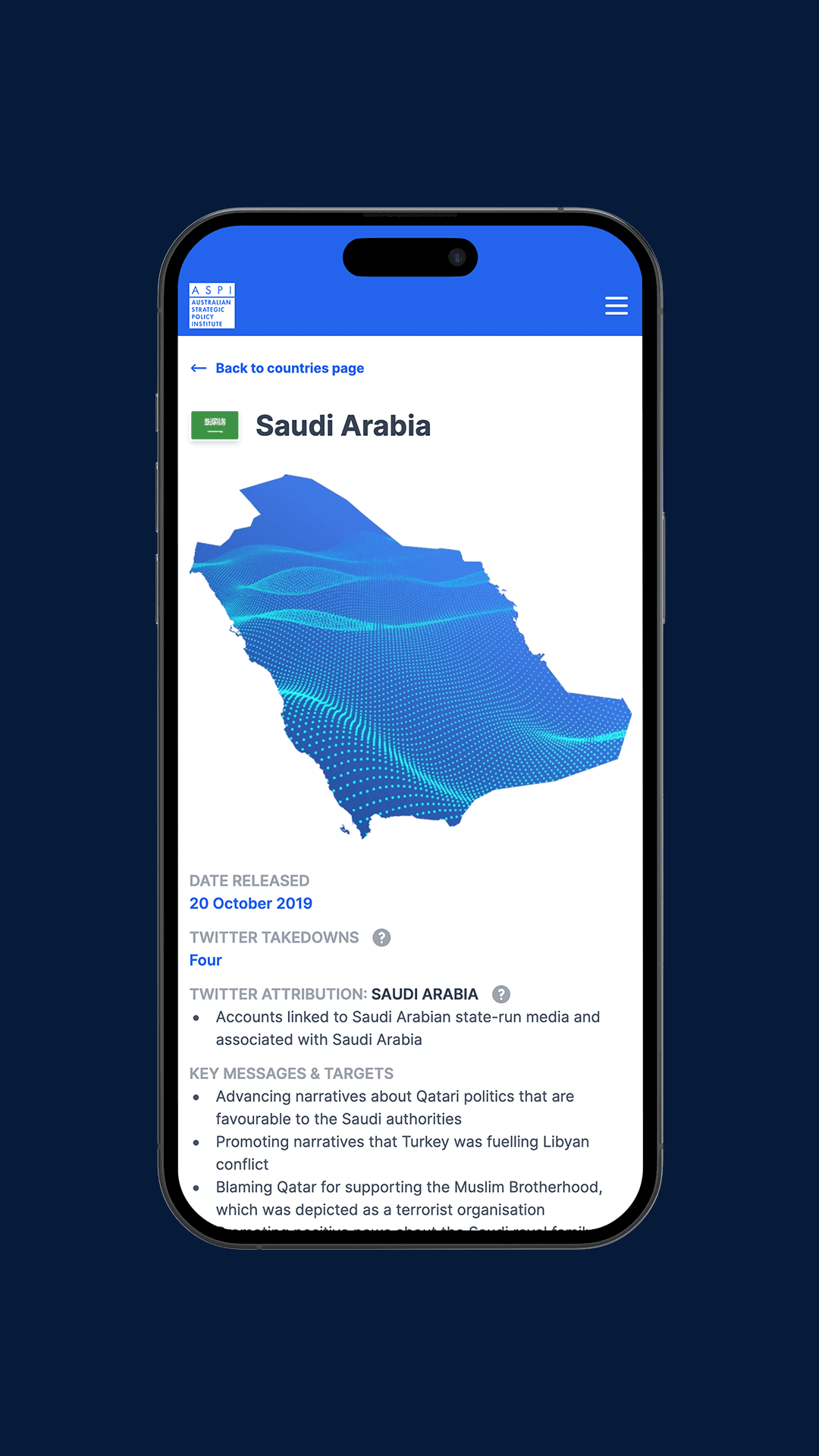
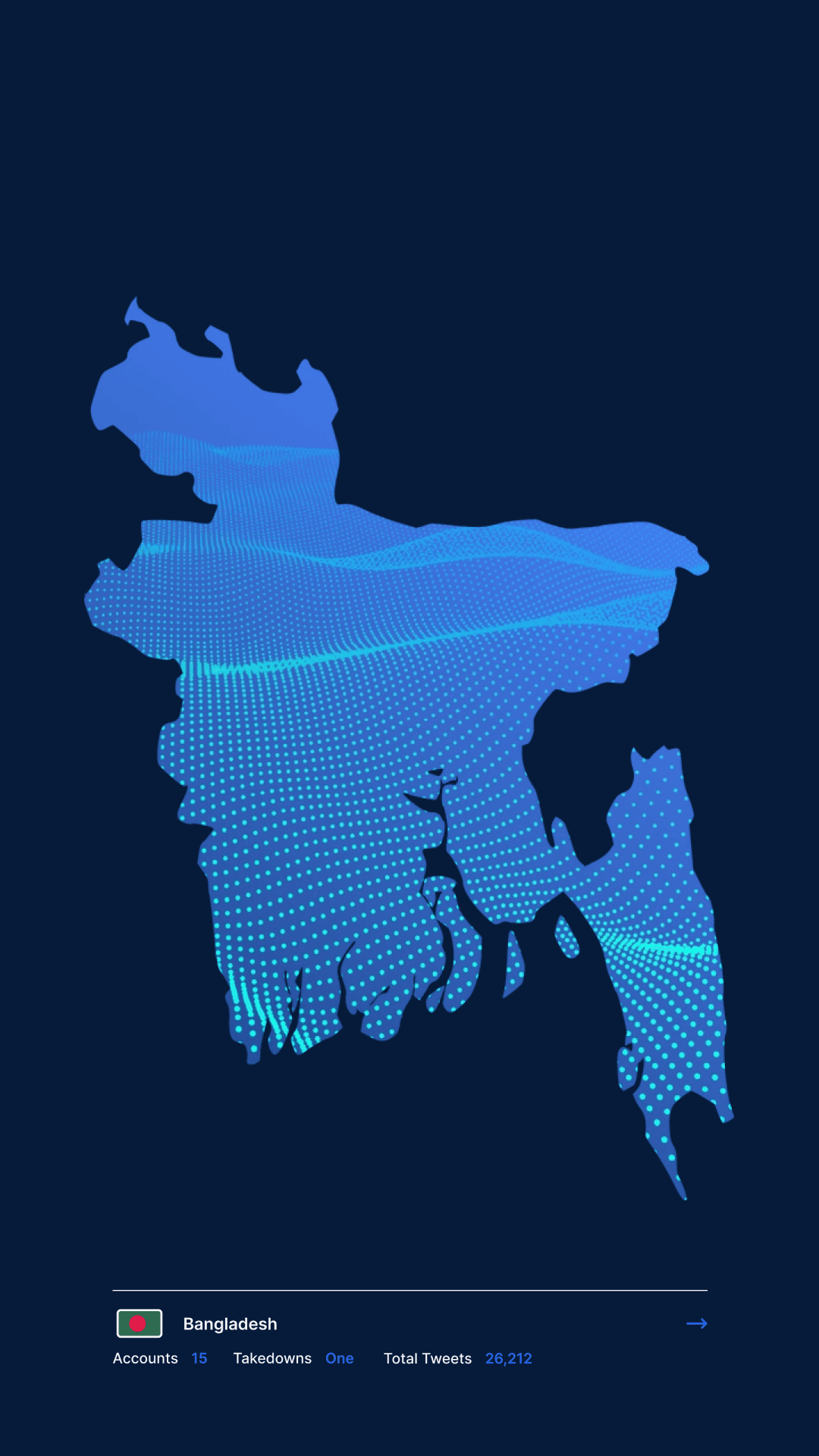
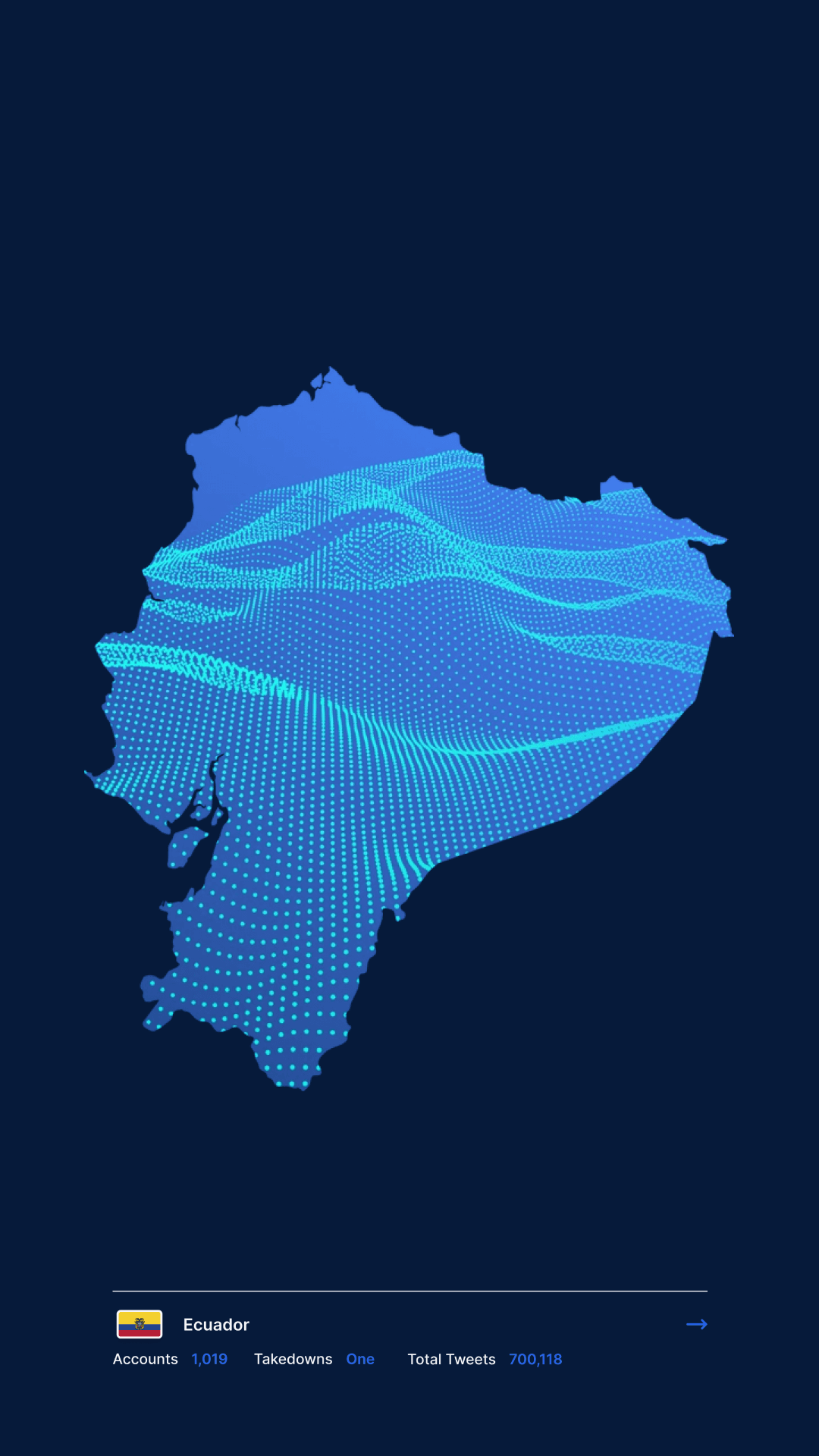
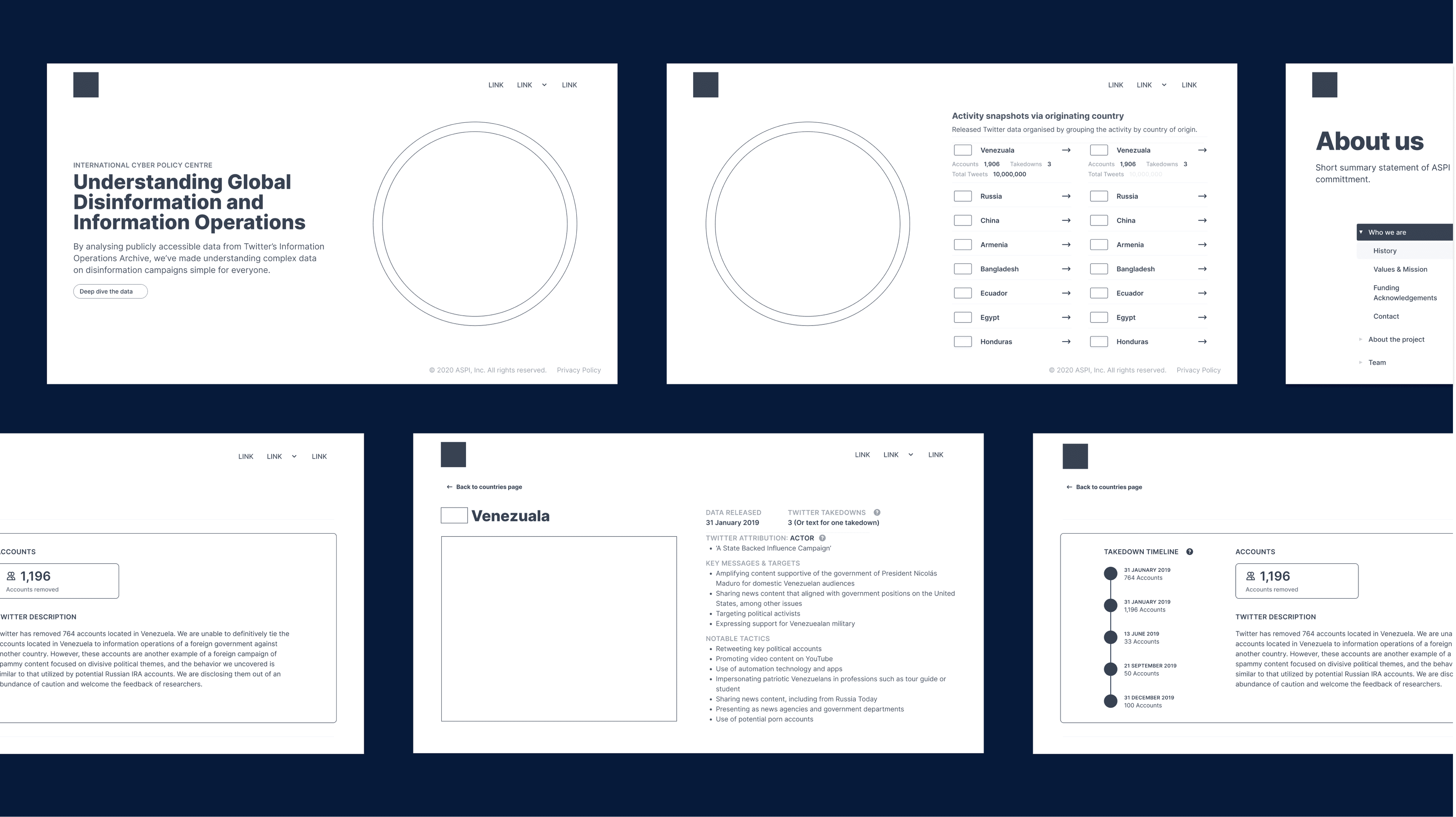
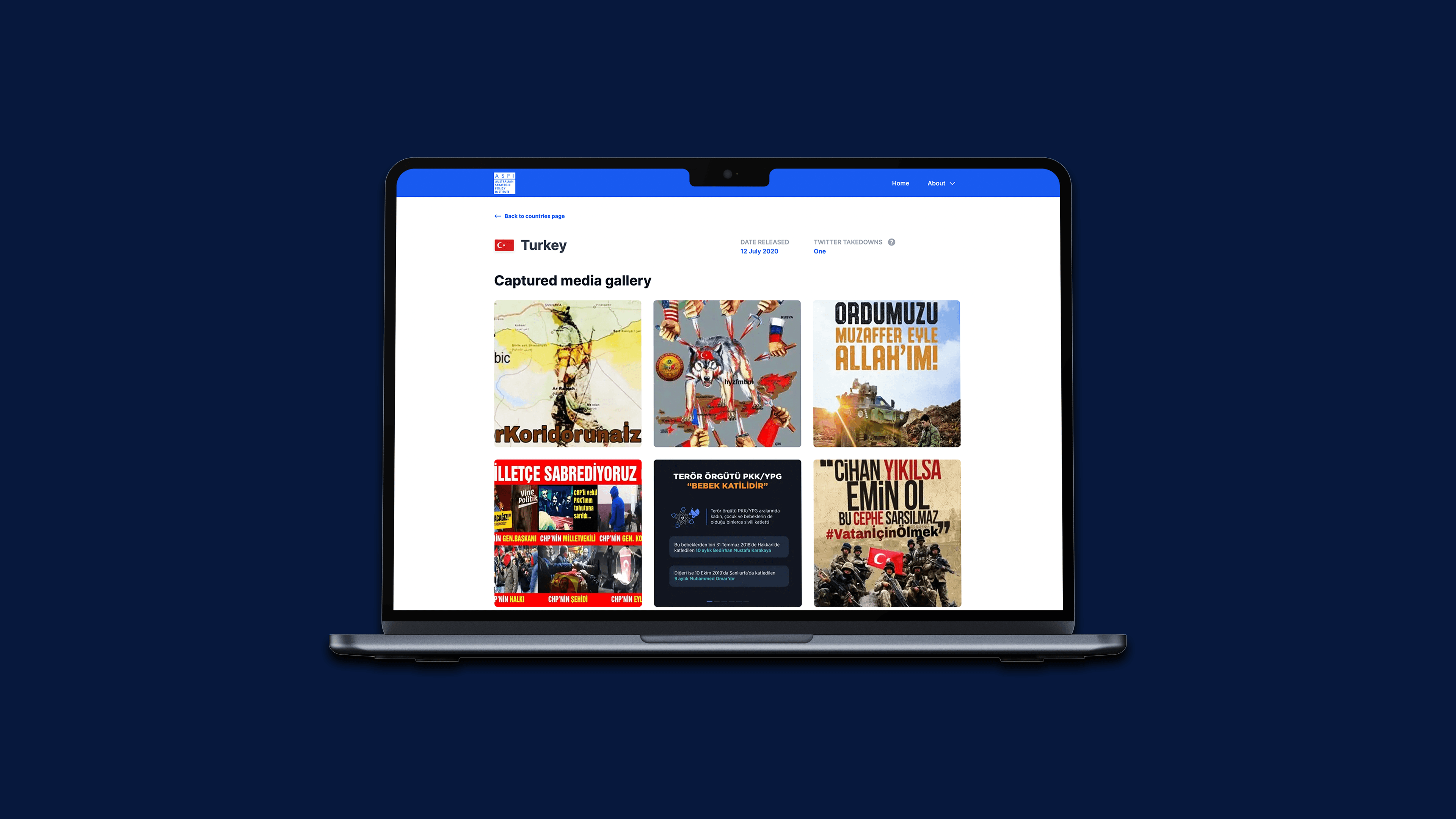
The country snapshots became the core of the site. Each one renders consistently from the same template: top-line statistics (accounts, takedowns, total tweets), the state-actor summary and capability assessment, the account creation timeline, the tweeting activity timeline, the geographic map of most-mentioned locations, and the cite-as block at the bottom. The template was built around a custom CMS content type so the analyst team could publish and update country pages without engineering support.
The platform currently hosts 17 country snapshots and a subnational page for Catalonia, covering the state-attributed datasets Twitter has released to date.
The scale of the analysis published through the site is substantial:
- 28,991 accounts and 14.2 million tweets for China
- 11,318 accounts and 68.8 million tweets across four Saudi Arabia takedowns
- 8,558 accounts and 43 million tweets for Serbia
- 8,211 accounts across seven Iran takedowns
- 7,340 accounts and 35.9 million tweets for Turkey
- plus Russia, Venezuela, the UAE, Egypt, Indonesia, Honduras, Cuba, Ecuador, Thailand, Spain, Bangladesh and Armenia
In total, the platform publishes analysis covering more than 85,000 accounts and 207 million tweets.
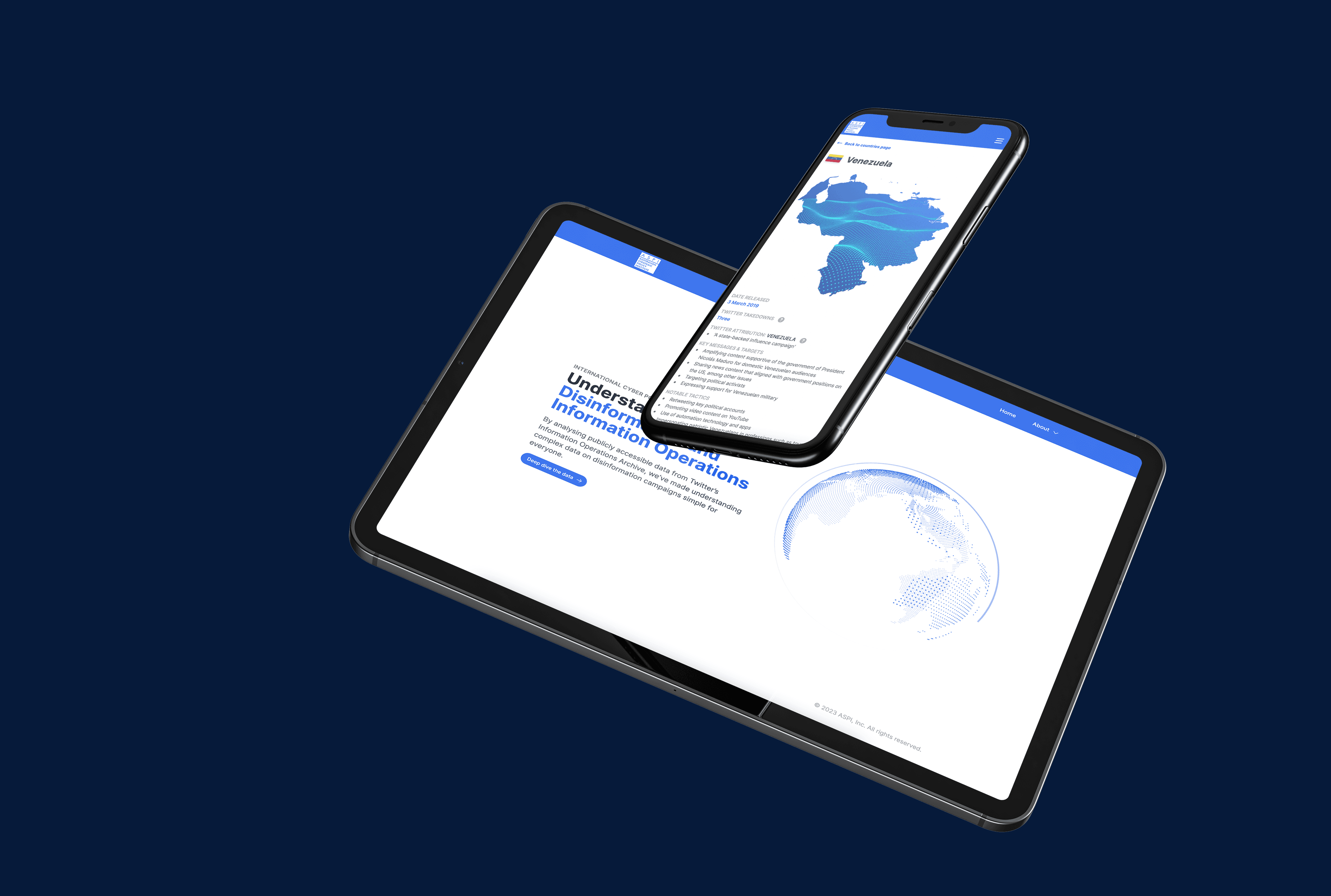
A second page template handles the interactive applications the ICPC analyst team builds independently: JavaScript visualisations, R-Shiny applications, and D3 and WebGL network diagrams. Rather than rebuilding these inside the site’s codebase, the wrapper template embeds them via iframes and direct links, which keeps the visualisation pipeline under the analyst team’s control and lets the website ship without taking on the maintenance burden of code it doesn’t own. Site furniture handles the rest: methodology, funding and team, contact, privacy.


The platform launched at infoops.aspi.org.au in March 2022, alongside ICPC’s accompanying report Understanding Global Disinformation and Information Operations: Insights from ASPI’s new analytic website. The research was funded by a grant from the US Department of State and supported by the Institute for War and Peace Reporting, and authored by the ICPC project team led by Dr Jake Wallis, Albert Zhang and Ingram Niblock. Mude ran a short paid launch campaign in the launch window.
More than 400,000 targeted impressions and 3,000+ click-throughs to the site seeded international traffic during the moment the research was being picked up by trade press and aligned policy networks.


The website has been cited extensively in policy and academic literature in the years since launch. The Atlantic Council’s Chinese Discourse Power report series — 2022 and 2023 — cites the China country snapshot directly. The Council on Foreign Relations has drawn on the platform in its work on foreign influence and democratic governance.
The German Marshall Fund of the United States, the Carnegie Endowment for International Peace and RAND Corporation have all referenced the analysis.
The Council of Europe Cybercrime Digest carried the launch report through its policy network. The Australian Parliament’s Select Committee on Foreign Interference Through Social Media drew on the work in its 2023 inquiry.
Mainstream media coverage followed. The Australian ran its April 2023 feature “Social media platforms are the new battlefields” with the site as ICPC’s primary evidence base; the Australian Financial Review has covered ASPI’s research through it; Reuters published an editorial on the project’s first five months in mid-2022. The platform is one of the cited sources on the Wikipedia article for X (formerly Twitter), and continues to be referenced by ASPI’s own commentary site The Strategist.
For ICPC’s purposes, and for ASPI’s stated success metric of “influencing people”, the website now serves as the canonical reference platform for state-attributed disinformation analysis. It’s the place ICPC’s researchers point journalists, analysts and policy makers to when their work is cited; and the place subsequent waves of the team’s research have been published since.
Mude’s policy, research and public-sector work is structured around the same pattern: high-trust organisations carrying complex public mandates, where the brand and digital surface has to read as analytically rigorous as the work underneath it. The same pattern runs through Mude’s projects for the Department of Health, Disability and Ageing, the Department of the Prime Minister and Cabinet, the Civil Aviation Safety Authority, Sport Integrity Australia, and across the wider research and policy sector.
Mude is a brand and design studio working across Sydney and Canberra on brand strategy, identity systems and web and app development.
The practice spans consumer, hospitality, research and policy, government, healthcare, and music. Mude provides cost estimates after a discovery conversation.
Related Projects
View Project

Video, Campaigns
Defence Housing Australia
View Project

Video, Campaigns
Department of Health, Disability & Ageing
View Project

Video, Graphic Design
Department of Health, Disability and Ageing
View Project

Video
Australian Government
View Project

Website
Tamworth Regional Council
View Project

Video, Photography
Department of the Prime Minister and Cabinet
View Project
Website
Australian Strategic Policy Institute
View Project

Video
Department of Health, Disability and Ageing
Frequently Asked Questions
You were going to ask anyway
The Australian Strategic Policy Institute (ASPI) is an independent, non-partisan think tank that researches defence, national security, cyber, technology and foreign-interference policy. Founded in 2001, it is a wholly-owned Commonwealth Company structured as a company limited by guarantee under the Corporations Act, with offices in Canberra and historically Washington DC.
Editorial independence sits in the institute’s constitution and is maintained through peer review across the research process.
Information operations are coordinated, intentional efforts to shape public perception, political behaviour or strategic decisions through information, often using digital platforms. In the state-attributed sense ICPC researches, that means campaigns run or backed by national governments, conducted at scale, targeting domestic or foreign audiences with content designed to amplify particular narratives, suppress others, or impersonate authentic actors.
The campaigns covered in Twitter’s Information Operations archive include accounts attributed to Russia, Iran, Saudi Arabia, China and Venezuela as the five most prolific perpetrators, along with Turkey, Serbia, the UAE, Egypt, Indonesia, Honduras, Cuba, Ecuador, Thailand, Spain, Bangladesh and Armenia. The analytical question is rarely whether a campaign happened. The hard question is intent, capability and effect.
It needs to carry the data, beyond describing it. ICPC’s information operations research generates timelines, network diagrams, geographic maps, and underlying CSV data that has to be readable on the page and downloadable for analysts who want to work with it directly.
It also has to be citable. Policy makers and journalists reference the platform in published work, so each page needs a stable citation block, a fixed URL pattern, and downloadable PDF snapshots that travel through professional channels where webpages don’t go. The publishing surface also has to be flexible enough that the ICPC team can add new country pages and new takedown datasets without engineering support, because the underlying archive keeps growing.
Standard CMS templates assume an editor pushing prose.
A research-grade web design and development brief assumes an analyst pushing prose, data, charts, downloadable files and citation metadata together. For a not for profit website design project like this one, where the publisher’s currency is citation.
Because if a research platform is hard to cite, it gets cited less. Policy makers and journalists work to deadlines, and a study that requires hand-constructed citation metadata, broken URLs, or extra calls to confirm what to attribute is a study that gets quietly replaced with a competitor’s.
ICPC named citation friction as a specific cost on prior projects: earlier platforms had absorbed analyst and editorial time on questions the website itself should have answered. The Info Ops platform builds a citation block into every country snapshot, with the bibliographic detail readers need to drop into a footnote or reference list without leaving the page. Cited across 78 referring domains and 367 backlinks since launch, the friction reduction shows up in the citation graph.
A small number of Australian studios work consistently with policy and research bodies, usually combining established public-sector relationships with specific subject-matter capability. The work typically requires accessibility-conformant builds, brand-system fluency for federal, state and territory identity guidelines, security review for sites carrying sensitive data, and the patience to ship through extended review cycles.
Mude’s policy, research and public-sector work covers ASPI, the Department of Health, Disability and Ageing, the Department of the Prime Minister and Cabinet, the Civil Aviation Safety Authority, Sport Integrity Australia and others. The work spans not for profit website design, government branding, and brand experience design for research-led organisations.
Studios operating consistently in this space are usually based in Canberra or run a Canberra studio; the buyer typically finds them through panel arrangements, AusTender listings, and referrals from other agencies and communications teams.
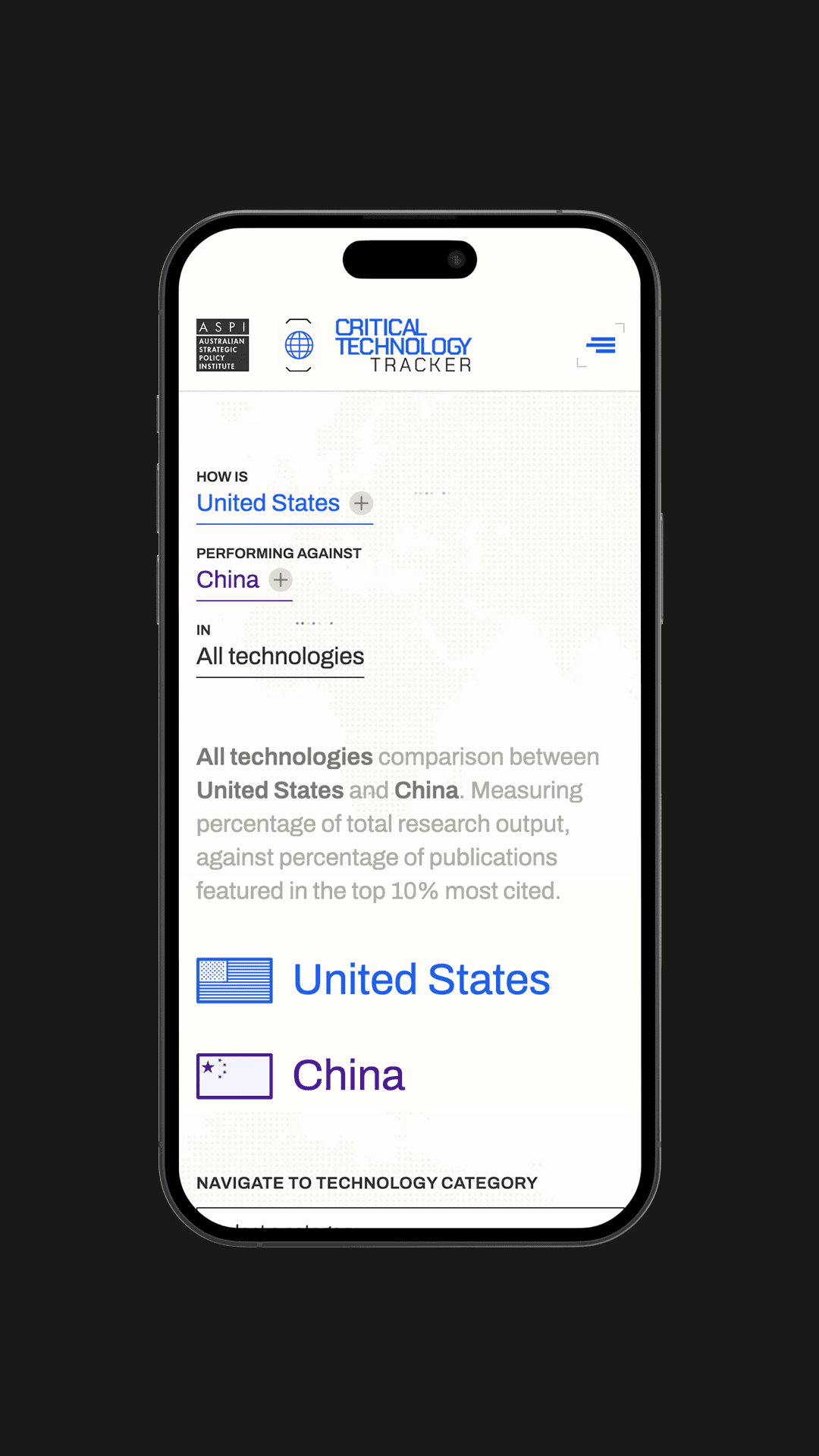
See Mude’s web design and development services and the ASPI Critical Tech Tracker case study for adjacent examples.
Misinformation is false or misleading information shared without an intent to deceive. Disinformation is false or misleading information shared with an intent to deceive. Same content, different actor.
In academic and policy use, misinformation captures everyday rumour, error, viral myths and honest mistakes; disinformation captures deliberate manipulation, including state-attributed campaigns, paid influence operations, fabricated journalism, and coordinated inauthentic behaviour on platforms. The distinction matters for response. A misinformation problem can often be addressed through better information, clearer labelling, and media literacy.
A disinformation problem is also a counter-intelligence and platform-policy problem. ASPI’s information operations research sits inside the disinformation category, focused on the state-attributed end where attribution can be evidenced.
ASPI’s main office is on Macquarie Street in Barton, Canberra, inside the Australian Parliamentary Triangle. The ICPC team works from the same Barton office, walking distance from Parliament House, the Department of Defence, the Department of Foreign Affairs and Trade, and the intelligence community’s policy interfaces. The geography shapes both the research agenda and the publication tempo.
ASPI has also historically operated a Washington DC office for international engagement and partnerships with American policy institutions.
Australian government website design is shaped by three constraints commercial websites don’t usually carry. The first is accessibility: government and government-adjacent sites are expected to meet accessibility standards that go well beyond the commercial baseline, including support for assistive technology, keyboard-only navigation, and accessible PDF generation.
The second is brand compliance. Federal sites work to the Australian Government Style Manual, with separate state, territory and agency identity systems running underneath. The third is information architecture: government and government-adjacent sites typically serve mixed audiences including the public, the press, sector specialists, internal staff, and parliamentary committees, and the architecture has to flow each audience to the right surface without losing the others.
The ASPI Info Ops platform sits adjacent to the government website pattern. Mude has worked on the government side of the line on projects for the Department of Health, Disability and Ageing, the Department of the Prime Minister and Cabinet, the Civil Aviation Safety Authority, and Sport Integrity Australia.
See Mude’s web design and development services for the adjacent capability.
ASPI’s International Cyber Policy Centre (ICPC) is the centre within the Australian Strategic Policy Institute that researches cybersecurity, technology policy, online influence operations, and the strategic implications of emerging technology. Its programs cover state-attributed disinformation campaigns, foreign interference in democratic processes, surveillance and authoritarianism, and the geopolitics of critical and emerging technologies.
ICPC’s research is published through ASPI’s standard channels: written reports, briefings, the Strategist commentary site, and dedicated research platforms like the one Mude built at infoops.aspi.org.au. The Information Operations and Disinformation team inside ICPC is the team whose analysis the site publishes.
State-attributed disinformation is information manipulation traced, with reasonable evidence, to a national government or one of its agencies. The attribution layer separates it from general misinformation, where origin is uncertain or organic.
Platforms like Twitter, now X, attribute accounts to states based on signals including infrastructure overlap, behaviour patterns, language use, and identity consistency across accounts; the takedowns then become public datasets that researchers like ICPC analyse. ASPI’s published work covers more than 85,000 accounts and roughly 207 million tweets across 17 country snapshots and a separate Catalonia subnational page, drawing on the datasets Twitter has released since October 2018.
The analytical product is a country-level read of intent, targeting and capability, not a list of individual posts.
Seventeen country snapshots and a separate Catalonia subnational page, currently covering China, Russia, Iran, Saudi Arabia, Turkey, Serbia, Venezuela, the United Arab Emirates, Egypt, Indonesia, Honduras, Cuba, Ecuador, Thailand, Spain, Bangladesh and Armenia.
The volumes are uneven. The Chinese dataset runs to 28,991 accounts and 14.2 million tweets; Saudi Arabia spans four separate takedowns and 68.8 million tweets; Iran spans seven takedowns and 8,211 accounts; Turkey runs to 7,340 accounts and 35.9 million tweets. Each snapshot follows the same template: top-line statistics, the state-actor summary and capability assessment, an account-creation timeline, a tweeting-activity timeline, a geographic map of most-mentioned locations, and the cite-as block.
New pages are added by the ICPC team as Twitter releases new takedown datasets.
The main Australian foreign-policy and strategic-policy think tanks are the Australian Strategic Policy Institute (ASPI), the Lowy Institute, the United States Studies Centre at the University of Sydney, the Australia Institute, and the Centre for Independent Studies. Specialist research bodies include the Australian Institute of International Affairs (AIIA), Per Capita, the Grattan Institute for public policy and economics, and the Asialink Centre at the University of Melbourne.
Each runs its own publication model: ASPI’s Strategist commentary site and dedicated research platforms; Lowy’s Interpreter blog and annual Lowy Institute Poll; the Australia Institute’s regular polling reports. The publication infrastructure varies as widely as the editorial position.
From the August 2021 brief to the March 2022 launch, the ASPI Info Ops platform took roughly seven months across discovery, design, development, content production and launch.
A research-publishing platform built through custom website development services, with multiple custom templates, an analyst-managed CMS, embedded interactive applications, PDF and CSV download generation, and a citation block per page sits at the long end of the website-project range. Discovery carried unusual weight against a standard marketing build: the values workshop with ICPC, the audience prioritisation exercise, and the template logic for country snapshots all had to settle before design started.
Timeline ranges on comparable projects depend on dataset depth, visualisation complexity, the level of CMS flexibility required, and the review process inside the client organisation.
The platform has been cited by the Atlantic Council in its Chinese Discourse Power report series in 2022 and 2023, by the Council on Foreign Relations, the German Marshall Fund of the United States, the Carnegie Endowment for International Peace and RAND Corporation. The Council of Europe Cybercrime Digest carried the launch report through its policy network. The Australian Parliament’s Select Committee on Foreign Interference Through Social Media drew on the work in its 2023 inquiry.
Mainstream coverage followed in The Australian, the Australian Financial Review, and Reuters. The platform is listed as a source on the Wikipedia article for X, formerly Twitter, and continues to be referenced through ASPI’s own Strategist commentary site. Across referring domains the citation footprint stands at 78 domains and 367 backlinks.
The success metric is different, so almost everything downstream is different. A corporate website design or corporate marketing website is measured on conversions: demos booked, sales-qualified leads, organic traffic to commercial landing pages. The information architecture, the page templates, the copy register, the call-to-action structure, all of it points toward a transaction.
A research publishing website is measured on citation: whether the work is being referenced by the people the research was written for. The architecture, templates, copy register, and download model point toward making it easy to read, reference, and quote with confidence. The ASPI InfoOps platform was built to the second pattern. Years after launch, the citation graph measures the platform, not the traffic.